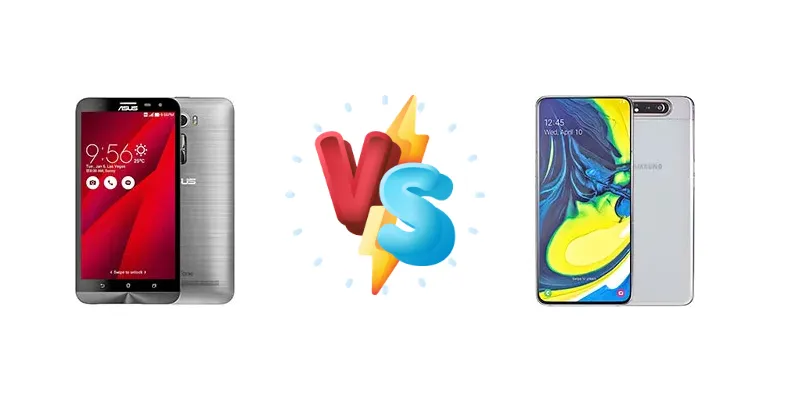
Released in different eras, the Asus Zenfone 2 Laser and Samsung Galaxy A80 represent distinct approaches to the mid-range smartphone market. The Zenfone 2 Laser, a veteran of the budget-friendly segment, prioritizes affordability, while the Galaxy A80 aimed for a more premium experience with its innovative rotating camera. This comparison dissects their core components to determine which device holds up better today.
🏆 Quick Verdict
For the average user in 2024, the Samsung Galaxy A80 is the superior choice. Its Snapdragon 730 chipset, built on an 8nm process, delivers significantly better performance and efficiency than the Zenfone 2 Laser’s Snapdragon 615. While both offer comparable battery endurance, the A80’s faster 25W charging and brighter display provide a more modern user experience.
| Network |
|---|
| 2G bands | GSM 850 / 900 / 1800 / 1900 - SIM 1 & SIM 2 | GSM 850 / 900 / 1800 / 1900 |
| 3G bands | HSDPA 850 / 900 / 1900 / 2100 - TW/WW version | HSDPA 850 / 900 / 1700(AWS) / 1900 / 2100 |
| 4G bands | 1, 2, 3, 5, 8, 9, 28 - TW version | 1, 2, 3, 4, 5, 7, 8, 12, 13, 17, 20, 26, 28, 38, 40, 41, 66 |
| Speed | HSPA 42.2/5.76 Mbps, LTE Cat4 150/50 Mbps | HSPA 42.2/5.76 Mbps, LTE (3CA) Cat11 600/75 Mbps |
| Technology | GSM / HSPA / LTE | GSM / HSPA / LTE |
| | 1, 2, 3, 5, 7, 8, 20 - WW version | - |
| Launch |
|---|
| Announced | 2015, October. Released 2016, January | 2019, April 10. Released 2019, May |
| Status | Discontinued | Discontinued |
| Body |
|---|
| Build | - | Glass front (Gorilla Glass 3), glass back (Gorilla Glass 6), aluminum frame |
| Dimensions | 164.6 x 84 x 10.6 mm (6.48 x 3.31 x 0.42 in) | 165.2 x 76.5 x 9.3 mm (6.50 x 3.01 x 0.37 in) |
| SIM | Dual SIM (Micro-SIM, dual stand-by) | · Nano-SIM· Nano-SIM + Nano-SIM |
| Weight | 190 g (6.70 oz) | 220 g (7.76 oz) |
| Display |
|---|
| Protection | Corning Gorilla Glass 4 | Corning Gorilla Glass 3 |
| Resolution | 720 x 1280 pixels, 16:9 ratio (~245 ppi density) | 1080 x 2400 pixels, 20:9 ratio (~393 ppi density) |
| Size | 6.0 inches, 99.2 cm2 (~71.8% screen-to-body ratio) | 6.7 inches, 108.4 cm2 (~85.8% screen-to-body ratio) |
| Type | IPS LCD | Super AMOLED |
| | - | Always-on display |
| Platform |
|---|
| CPU | Octa-core (4x1.7 GHz Cortex-A53 & 4x1.0 GHz Cortex-A53) | Octa-core (2x2.2 GHz Kryo 470 Gold & 6x1.8 GHz Kryo 470 Silver) |
| Chipset | Qualcomm MSM8939 Snapdragon 615 (28 nm) | Qualcomm SDM730 Snapdragon 730 (8 nm) |
| GPU | Adreno 405 | Adreno 618 |
| OS | Android 5.0 (Lollipop), upgradable to 6.0 (Marshmallow), ZenUI | Android 9.0 (Pie), upgradable to Android 11, One UI 3.1 |
| Memory |
|---|
| Card slot | microSDXC (dedicated slot) | No |
| Internal | 16GB 2GB RAM, 32GB 3GB RAM | 128GB 8GB RAM |
| | eMMC 4.5 | UFS 2.1 |
| Main Camera |
|---|
| Dual | - | 48 MP, f/2.0, 26mm (wide), 1/2.0", 0.8µm, PDAF
8 MP, f/2.2, 12mm (ultrawide), 1/4.0", 1.12µm
TOF 3D, f/1.2, (depth) |
| Features | Laser AF, Dual-LED dual-tone flash, panorama, HDR | LED flash, panorama, HDR |
| Single | 13 MP, f/2.0 | - |
| Video | 1080p@30fps, 720p@60fps | 4K@30fps, 1080p@30/60fps (gyro-EIS), 720p@480fps |
| Selfie camera |
|---|
| Features | - | LED flash, HDR |
| Single | 5 MP, f/2.0 | - |
| Triple | - | Motorized pop-up rotating main camera module |
| Video | - | 4K@30fps, 1080p@30/60fps (gyro-EIS) |
| Sound |
|---|
| 3.5mm jack | Yes | No |
| 35mm jack | Yes | No |
| Loudspeaker | Yes, dual speakers | Yes |
| Comms |
|---|
| Bluetooth | 4.1, A2DP, EDR | 5.0, A2DP, LE |
| NFC | No | Yes |
| Positioning | GPS, GLONASS, BDS | GPS, GLONASS, GALILEO, BDS |
| Radio | No | FM radio |
| USB | microUSB 2.0 | USB Type-C 2.0 |
| WLAN | Wi-Fi 802.11 a/b/g/n/ac, Wi-Fi Direct, hotspot | Wi-Fi 802.11 a/b/g/n/ac, dual-band, Wi-Fi Direct |
| Features |
|---|
| Sensors | Accelerometer, gyro, proximity, compass | Fingerprint (under display, optical), accelerometer, gyro, proximity, compass |
| | - | ANT+
Bixby natural language commands and dictation |
| Battery |
|---|
| Charging | - | 25W wired |
| Type | Li-Po 3000 mAh, removable | Li-Po 3700 mAh, non-removable |
| Misc |
|---|
| Colors | Glacier Gray, Sheer Gold, Glamour Red | Angel Gold, Ghost White, Phantom Black |
| Models | Z00MD | SM-A805F, SM-A8050, SM-A805X, SM-A805N |
| Price | About 310 EUR | About 380 EUR |
| SAR | - | 0.30 W/kg (head) 0.71 W/kg (body) |
| SAR EU | - | 0.22 W/kg (head) 1.43 W/kg (body) |
| Tests |
|---|
| Battery life | - |
Endurance rating 90h
|
| Camera | - |
Photo / Video |
| Display | - |
Contrast ratio: Infinite (nominal) |
| Loudspeaker | - |
Voice 69dB / Noise 71dB / Ring 79dB
|
| Performance | - |
AnTuTu: 207502 (v7)
GeekBench: 6934 (v4.4)
GFXBench: 14fps (ES 3.1 onscreen) |
Asus Zenfone 2 Laser ZE600KL
- Extremely affordable price point
- Compact and lightweight design
- Decent battery life for basic use
- Outdated Snapdragon 615 chipset
- Lower display brightness and quality
- Limited performance for demanding tasks
Samsung Galaxy A80
- More powerful Snapdragon 730 chipset
- Brighter and more vibrant display
- Faster 25W wired charging
- Higher price compared to Zenfone 2 Laser
- Rotating camera mechanism may be a concern for durability
- Larger size and weight
Display Comparison
The Samsung Galaxy A80 boasts a significantly brighter display, reaching 607 nits, compared to the Zenfone 2 Laser’s unspecified brightness. This difference is crucial for outdoor visibility. The A80’s ‘Infinite’ contrast ratio, while a marketing term, suggests a superior panel capable of deeper blacks. While both likely utilize LCD technology, the A80’s larger screen size and higher brightness contribute to a more immersive viewing experience. The Zenfone 2 Laser’s display, while functional, feels dated in comparison.
Camera Comparison
Both devices feature photo/video capabilities, but details are limited. The A80 likely benefits from Samsung’s superior image processing algorithms. Without specific sensor details for the Zenfone 2 Laser, it’s difficult to assess its image quality. The A80’s rotating camera mechanism, while innovative, doesn’t necessarily guarantee superior image quality, but it does offer versatility. The A80’s more powerful chipset also aids in faster image processing and potentially better low-light performance.
Performance
The core difference lies in the chipsets. The Samsung Galaxy A80’s Snapdragon 730 (8nm) is a substantial upgrade over the Asus Zenfone 2 Laser’s Snapdragon 615 (28nm). The 730’s Kryo 470 cores, with a 2x2.2 GHz Gold/6x1.8 GHz Silver configuration, offer a significant performance boost over the 615’s 4x1.7 GHz Cortex-A53 & 4x1.0 GHz Cortex-A53 setup. The 8nm process node of the 730 also translates to better thermal efficiency, reducing throttling during sustained workloads. Gamers and power users will find the A80 far more capable.
Battery Life
Both phones achieve an endurance rating of 90 hours, suggesting comparable battery life under similar usage scenarios. However, the Galaxy A80’s 25W wired charging is a significant advantage over the Zenfone 2 Laser’s likely slower charging speed. This means the A80 can be topped up much faster, minimizing downtime. While both offer all-day battery life for moderate users, the A80’s charging speed provides greater convenience.
Buying Guide
Buy the Asus Zenfone 2 Laser ZE600KL if you need an extremely affordable device for basic tasks like calling, texting, and light social media use, and are willing to compromise on performance and features. Buy the Samsung Galaxy A80 if you prioritize a smoother user experience, better performance for multitasking and media consumption, a brighter and more vibrant display, and faster charging, even if it comes at a higher price point.
Frequently Asked Questions
❓ Is the Snapdragon 730 in the Galaxy A80 still capable of handling modern apps and games?
Yes, the Snapdragon 730 remains a capable chipset for most modern apps and games, offering a smooth experience for everyday tasks and moderate gaming. While it won't match the performance of flagship processors, it provides a significant upgrade over the Zenfone 2 Laser's Snapdragon 615.
❓ Does the rotating camera mechanism on the Galaxy A80 affect its durability?
The rotating camera mechanism was a potential point of concern for durability. While Samsung likely implemented robust engineering, the moving parts inherently introduce a potential failure point. Users should handle the device with care to avoid damaging the mechanism.
❓ How does the 28nm process of the Snapdragon 615 impact battery life and heat generation in the Zenfone 2 Laser?
The 28nm process is relatively inefficient compared to the 8nm process used in the Snapdragon 730. This means the Snapdragon 615 consumes more power and generates more heat for the same level of performance, potentially leading to shorter battery life and thermal throttling during intensive tasks.