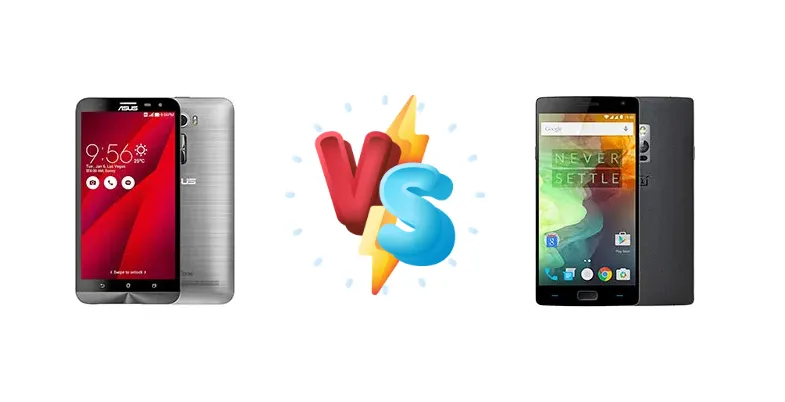
Released within months of each other in 2015, the Asus Zenfone 2 Laser and the OnePlus 2 represented distinct approaches to the mid-range smartphone market. The Zenfone 2 Laser focused on affordability and laser-assisted autofocus, while the OnePlus 2 aimed for near-flagship performance at a disruptive price. Today, we revisit these devices to determine which holds up better and which user benefits most from each.
🏆 Quick Verdict
For the average user in 2024, the OnePlus 2 emerges as the stronger choice. Its Snapdragon 810 chipset provides significantly more processing power, translating to a smoother experience in demanding tasks and future-proofing. While both phones offer similar battery endurance, the OnePlus 2’s superior performance justifies its slightly higher initial cost.
| Network |
|---|
| 2G bands | GSM 850 / 900 / 1800 / 1900 - SIM 1 & SIM 2 | GSM 850 / 900 / 1800 / 1900 - SIM 1 & SIM 2 |
| 3G bands | HSDPA 850 / 900 / 1900 / 2100 - TW/WW version | HSDPA 850 / 900 / 1900 / 2100 |
| 4G bands | 1, 2, 3, 5, 8, 9, 28 - TW version | 1, 3, 5, 7, 8, 20, 38, 40, 41 |
| Speed | HSPA 42.2/5.76 Mbps, LTE Cat4 150/50 Mbps | HSPA 42.2/5.76 Mbps, LTE Cat4 150/50 Mbps |
| Technology | GSM / HSPA / LTE | GSM / HSPA / LTE |
| | 1, 2, 3, 5, 7, 8, 20 - WW version | - |
| Launch |
|---|
| Announced | 2015, October. Released 2016, January | 2015, July. Released 2015, August |
| Status | Discontinued | Discontinued |
| Body |
|---|
| Build | - | Glass front (Gorilla Glass 3), plastic back, aluminum frame |
| Dimensions | 164.6 x 84 x 10.6 mm (6.48 x 3.31 x 0.42 in) | 151.8 x 74.9 x 9.9 mm (5.98 x 2.95 x 0.39 in) |
| SIM | Dual SIM (Micro-SIM, dual stand-by) | Nano-SIM + Nano-SIM |
| Weight | 190 g (6.70 oz) | 175 g (6.17 oz) |
| Display |
|---|
| Protection | Corning Gorilla Glass 4 | Corning Gorilla Glass 3 |
| Resolution | 720 x 1280 pixels, 16:9 ratio (~245 ppi density) | 1080 x 1920 pixels, 16:9 ratio (~401 ppi density) |
| Size | 6.0 inches, 99.2 cm2 (~71.8% screen-to-body ratio) | 5.5 inches, 83.4 cm2 (~73.3% screen-to-body ratio) |
| Type | IPS LCD | IPS LCD |
| Platform |
|---|
| CPU | Octa-core (4x1.7 GHz Cortex-A53 & 4x1.0 GHz Cortex-A53) | Octa-core (4x1.56 GHz Cortex-A53 & 4x1.82 GHz Cortex-A57) |
| Chipset | Qualcomm MSM8939 Snapdragon 615 (28 nm) | Qualcomm MSM8994 Snapdragon 810 (20 nm) |
| GPU | Adreno 405 | Adreno 430 |
| OS | Android 5.0 (Lollipop), upgradable to 6.0 (Marshmallow), ZenUI | Android 5.1 (Lollipop), upgradable to 6.0.1 (Marshmallow), Oxygen 3.5.6 UI |
| Memory |
|---|
| Card slot | microSDXC (dedicated slot) | No |
| Internal | 16GB 2GB RAM, 32GB 3GB RAM | 16GB 3GB RAM, 64GB 4GB RAM |
| | eMMC 4.5 | eMMC 5.0 |
| Main Camera |
|---|
| Features | Laser AF, Dual-LED dual-tone flash, panorama, HDR | Laser AF, Dual-LED flash, panorama, HDR |
| Single | 13 MP, f/2.0 | 13 MP, f/2.0, 1/2.6", 1.3µm, OIS |
| Video | 1080p@30fps, 720p@60fps | 4K@30fps, 4K(DCI)@24fps, 1080p@60fps, 720p@120fps, HDR, stereo sound rec. |
| Selfie camera |
|---|
| Single | 5 MP, f/2.0 | 5 MP, f/2.4 |
| Video | - | 720p@30fps |
| Sound |
|---|
| 3.5mm jack | Yes | Yes |
| 35mm jack | Yes | Yes |
| Loudspeaker | Yes, dual speakers | Yes |
| Comms |
|---|
| Bluetooth | 4.1, A2DP, EDR | 4.1, A2DP |
| NFC | No | No |
| Positioning | GPS, GLONASS, BDS | GPS, GLONASS |
| Radio | No | No |
| USB | microUSB 2.0 | USB Type-C 2.0 |
| WLAN | Wi-Fi 802.11 a/b/g/n/ac, Wi-Fi Direct, hotspot | Wi-Fi 802.11 a/b/g/n/ac, Wi-Fi Direct, DLNA, hotspot |
| Features |
|---|
| Sensors | Accelerometer, gyro, proximity, compass | Fingerprint (front-mounted), accelerometer, gyro, proximity, compass |
| Battery |
|---|
| Type | Li-Po 3000 mAh, removable | Li-Po 3300 mAh, non-removable |
| Misc |
|---|
| Colors | Glacier Gray, Sheer Gold, Glamour Red | Sandstone Black |
| Models | Z00MD | ONE A2003, ONE A2005, ONE A2001 |
| Price | About 310 EUR | About 300 EUR |
| SAR EU | - | 0.43 W/kg (head) 0.20 W/kg (body) |
| Tests |
|---|
| Audio quality | - |
Noise -94.2dB / Crosstalk -94.3dB |
| Battery life | - | Endurance rating 61h |
| Camera | - |
Photo / Video |
| Display | - |
Contrast ratio: 1187 (nominal), 2.165 (sunlight) |
| Loudspeaker | - |
Voice 75dB / Noise 73dB / Ring 80dB |
| Performance | - |
Basemark OS II 2.0: 1622Basemark X: 21937 |
Asus Zenfone 2 Laser ZE600KL
- More affordable price point
- Laser autofocus for faster low-light focusing
- Potentially more compact form factor
- Significantly weaker processor performance
- Less efficient chipset (28nm)
- Likely lower quality display
OnePlus 2
- Much faster Snapdragon 810 processor
- More efficient chipset (20nm)
- Potentially better display quality
- Superior performance for gaming and multitasking
- Higher initial cost
- May be larger and less comfortable to hold
- Lacks laser autofocus
Display Comparison
Both the Zenfone 2 Laser and OnePlus 2 share a similar display contrast ratio of 1187 (nominal) and 2.165 (sunlight), suggesting comparable visibility in bright conditions. However, detailed panel specifications like resolution and color gamut are missing. Given the OnePlus 2’s positioning, it likely featured a slightly more refined display with potentially better color accuracy. The Zenfone 2 Laser’s focus on cost-cutting may have resulted in a less vibrant panel.
Camera Comparison
Both devices are listed as having Photo/Video capabilities, but specific details are lacking. The Zenfone 2 Laser’s name suggests a focus on laser autofocus, which would have provided faster and more accurate focusing in low-light conditions compared to the OnePlus 2’s likely contrast-detection autofocus. However, the OnePlus 2’s more powerful ISP (integrated signal processor) within the Snapdragon 810 could potentially deliver better image processing and dynamic range. Without sensor size or aperture information, a definitive camera winner is difficult to determine, but the Zenfone 2 Laser’s laser autofocus is a unique advantage.
Performance
The core difference lies in the chipsets. The OnePlus 2’s Snapdragon 810 (20nm) is a substantial upgrade over the Zenfone 2 Laser’s Snapdragon 615 (28nm). The 810 utilizes a combination of Cortex-A53 and A57 cores, offering significantly higher peak performance. The 20nm process also contributes to better thermal efficiency, potentially reducing throttling during sustained workloads. While both are octa-core, the A57 cores in the 810 provide a noticeable boost in single-core performance, crucial for app responsiveness. Users intending to play demanding games or run multiple apps simultaneously will overwhelmingly benefit from the OnePlus 2’s chipset.
Battery Life
Interestingly, both phones boast an endurance rating of 61 hours. This suggests similar real-world battery life despite the OnePlus 2’s more power-hungry Snapdragon 810. This is likely due to a combination of battery optimization and potentially a larger battery capacity in the OnePlus 2 (though this is not specified). The lack of fast charging details for either device means charging times will likely be comparable, leaning towards several hours for a full charge.
Buying Guide
Buy the Asus Zenfone 2 Laser ZE600KL if you prioritize extreme affordability and a compact form factor for basic smartphone tasks like calling, texting, and light social media use. Buy the OnePlus 2 if you value performance for gaming, multitasking, and demanding applications, and are willing to spend a bit more for a noticeably smoother and more responsive user experience.
Frequently Asked Questions
❓ Is the Snapdragon 810 in the OnePlus 2 known for overheating issues?
The Snapdragon 810 did have a reputation for thermal throttling under sustained heavy load. However, OnePlus implemented cooling solutions to mitigate this issue, and while it could still get warm, it generally didn't exhibit severe overheating that crippled performance. The 20nm process was more efficient than the 28nm in the Zenfone 2 Laser, helping to manage heat.
❓ Does the Zenfone 2 Laser's laser autofocus make a significant difference in real-world photo quality?
Yes, laser autofocus provides a noticeable improvement in focusing speed and accuracy, especially in low-light conditions. While the OnePlus 2 likely had a more powerful image signal processor, the Zenfone 2 Laser would consistently achieve sharper focus in challenging lighting scenarios.
❓ Which phone would be better for playing older Android games from 2015-2017?
The OnePlus 2 would provide a smoother and more consistent gaming experience. The Snapdragon 810’s superior GPU performance would handle these games with higher frame rates and fewer dropped frames compared to the Snapdragon 615 in the Zenfone 2 Laser.