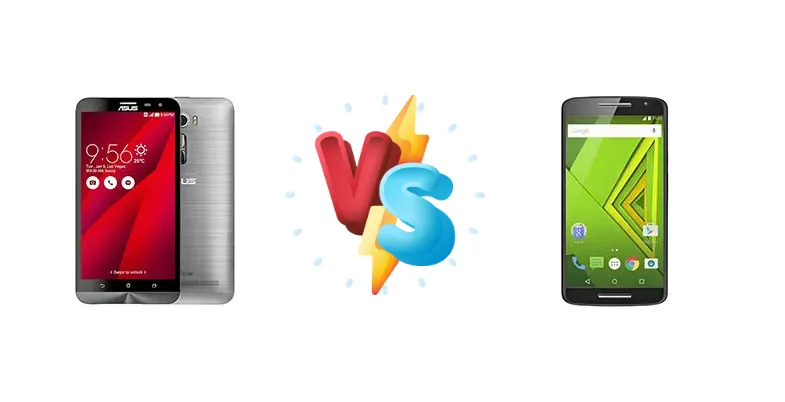
Released around the same timeframe, the Asus Zenfone 2 Laser and Motorola Moto X Play represent a fascinating intersection of budget-friendly pricing and respectable mid-range specifications. Both devices leverage the Qualcomm Snapdragon 615 chipset, but diverge in their approach to battery life, display characteristics, and overall user experience. This comparison aims to dissect these differences and determine which phone offers the best value in today's market.
🏆 Quick Verdict
For the average user prioritizing longevity and a slightly more viewable display in direct sunlight, the Motorola Moto X Play emerges as the better choice. Both phones share the same Snapdragon 615, but the Moto X Play’s endurance rating of 83 hours and superior contrast ratio provide a tangible advantage in daily use.
| Network |
|---|
| 2G bands | GSM 850 / 900 / 1800 / 1900 - SIM 1 & SIM 2 | GSM 850 / 900 / 1800 / 1900 |
| 3G bands | HSDPA 850 / 900 / 1900 / 2100 - TW/WW version | HSDPA 850 / 900 / 1800 / 1900 / 2100 - XT1562 |
| 4G bands | 1, 2, 3, 5, 8, 9, 28 - TW version | 1, 3, 5, 7, 8, 19, 20, 28, 38, 41 - XT1562 |
| Speed | HSPA 42.2/5.76 Mbps, LTE Cat4 150/50 Mbps | HSPA, LTE |
| Technology | GSM / HSPA / LTE | GSM / HSPA / LTE |
| | 1, 2, 3, 5, 7, 8, 20 - WW version | 1, 3, 5, 7, 8, 19, 20, 28, 38, 40, 41 - India |
| Launch |
|---|
| Announced | 2015, October. Released 2016, January | 2015, July. Released 2015, August |
| Status | Discontinued | Discontinued |
| Body |
|---|
| Dimensions | 164.6 x 84 x 10.6 mm (6.48 x 3.31 x 0.42 in) | 148 x 75 x 10.9 mm (5.83 x 2.95 x 0.43 in) |
| SIM | Dual SIM (Micro-SIM, dual stand-by) | Nano-SIM |
| Weight | 190 g (6.70 oz) | 169 g (5.96 oz) |
| | - | Splash and dust resistant |
| Display |
|---|
| Protection | Corning Gorilla Glass 4 | Corning Gorilla Glass 3 |
| Resolution | 720 x 1280 pixels, 16:9 ratio (~245 ppi density) | 1080 x 1920 pixels, 16:9 ratio (~403 ppi density) |
| Size | 6.0 inches, 99.2 cm2 (~71.8% screen-to-body ratio) | 5.5 inches, 82.6 cm2 (~74.4% screen-to-body ratio) |
| Type | IPS LCD | IPS LCD |
| Platform |
|---|
| CPU | Octa-core (4x1.7 GHz Cortex-A53 & 4x1.0 GHz Cortex-A53) | Octa-core (4x1.7 GHz Cortex-A53 & 4x1.0 GHz Cortex-A53) |
| Chipset | Qualcomm MSM8939 Snapdragon 615 (28 nm) | Qualcomm MSM8939 Snapdragon 615 (28 nm) |
| GPU | Adreno 405 | Adreno 405 |
| OS | Android 5.0 (Lollipop), upgradable to 6.0 (Marshmallow), ZenUI | Android 5.1.1 (Lollipop), upgradable to 7.1.1 (Nougat) |
| Memory |
|---|
| Card slot | microSDXC (dedicated slot) | microSDXC (dedicated slot) |
| Internal | 16GB 2GB RAM, 32GB 3GB RAM | 16GB 2GB RAM, 32GB 2GB RAM |
| | eMMC 4.5 | eMMC 4.5 |
| Main Camera |
|---|
| Features | Laser AF, Dual-LED dual-tone flash, panorama, HDR | Dual-LED dual-tone flash, panorama |
| Single | 13 MP, f/2.0 | 21 MP, f/2.0, 1/2.4", 1.1µm, PDAF |
| Video | 1080p@30fps, 720p@60fps | 1080p@30fps |
| Selfie camera |
|---|
| Single | 5 MP, f/2.0 | 5 MP, f/2.2 |
| Sound |
|---|
| 3.5mm jack | Yes | Yes |
| 35mm jack | Yes | Yes |
| Loudspeaker | Yes, dual speakers | Yes |
| Comms |
|---|
| Bluetooth | 4.1, A2DP, EDR | 4.0, A2DP, LE, aptX |
| NFC | No | Yes |
| Positioning | GPS, GLONASS, BDS | GPS |
| Radio | No | FM radio |
| USB | microUSB 2.0 | microUSB 2.0 |
| WLAN | Wi-Fi 802.11 a/b/g/n/ac, Wi-Fi Direct, hotspot | Wi-Fi 802.11 a/b/g/n, dual-band, hotspot |
| Features |
|---|
| Sensors | Accelerometer, gyro, proximity, compass | Accelerometer, proximity |
| Battery |
|---|
| Charging | - | 15W wired |
| Type | Li-Po 3000 mAh, removable | Li-Ion 3630 mAh, non-removable |
| Misc |
|---|
| Colors | Glacier Gray, Sheer Gold, Glamour Red | Black, White |
| Models | Z00MD | XT1562, XT1563, XT1564 |
| Price | About 310 EUR | About 240 EUR |
| SAR | - | 0.56 W/kg (head) 0.80 W/kg (body) |
| SAR EU | - | 0.49 W/kg (head) 0.68 W/kg (body) |
| Tests |
|---|
| Audio quality | - |
Noise -93.8dB / Crosstalk -95.2dB |
| Battery life | - |
Endurance rating 83h
|
| Camera | - |
Photo / Video |
| Display | - |
Contrast ratio: 1520:1 (nominal), 3.222 (sunlight) |
| Loudspeaker | - |
Voice 69dB / Noise 66dB / Ring 75dB
|
| Performance | - |
Basemark OS II 2.0: 809Basemark X: 5032 |
Asus Zenfone 2 Laser ZE600KL
- Potentially lower initial cost
- Snapdragon 615 provides adequate performance for everyday tasks
- Compact form factor (assumed based on Zenfone line)
- Lack of detailed specifications hinders accurate comparison
- Likely inferior battery life compared to Moto X Play
Motorola Moto X Play
- Exceptional 83-hour endurance rating
- Superior display contrast ratio in sunlight
- 15W fast charging support
- May be slightly more expensive than Zenfone 2 Laser
- Snapdragon 615 is showing its age in 2024
Display Comparison
Both the Zenfone 2 Laser and Moto X Play feature displays with a nominal contrast ratio of 1520:1, indicating similar black levels and color reproduction in controlled lighting. However, the Moto X Play significantly improves upon this with a sunlight contrast ratio of 3.222, meaning it remains far more legible under direct sunlight. While neither device boasts a high refresh rate or advanced panel technology like LTPO, the Moto X Play’s superior sunlight readability is a key differentiator for outdoor users. We lack specific data on panel type (IPS vs. TFT) or resolution for the Zenfone 2 Laser, but given the market segment, it’s likely comparable to the Moto X Play’s offering.
Camera Comparison
Both phones are listed as having 'Photo / Video' capabilities, but lack specific details regarding sensor size, aperture, or image stabilization. This suggests a similar level of camera performance, likely geared towards casual photography. Without further information, it’s difficult to assess which phone offers superior image quality. The absence of details suggests neither device features a particularly advanced camera system, and any marketing claims regarding camera prowess should be viewed with skepticism. We can assume both phones will struggle in low-light conditions.
Performance
Both devices are powered by the Qualcomm MSM8939 Snapdragon 615, a 28nm octa-core processor featuring four Cortex-A53 cores clocked at 1.7 GHz and another four at 1.0 GHz. This architecture allows for a balance between performance and power efficiency. Given the identical chipset, real-world performance differences will be minimal, primarily dictated by RAM configuration (not specified in the provided data) and software optimization. Thermal management will likely be similar, with both phones potentially experiencing throttling under sustained heavy loads. The lack of a newer process node (like 14nm or smaller) means neither phone will excel in sustained performance.
Battery Life
The Motorola Moto X Play boasts an impressive endurance rating of 83 hours, indicating exceptional battery life. While the Zenfone 2 Laser’s battery capacity and endurance rating are not provided, the Moto X Play’s 83-hour rating is a significant advantage. The Moto X Play also supports 15W wired charging, allowing for relatively quick top-ups. Without knowing the Zenfone 2 Laser’s charging speed, it’s reasonable to assume the Moto X Play offers a faster charging experience. The combination of high endurance and 15W charging makes the Moto X Play the clear winner in the battery department.
Buying Guide
Buy the Asus Zenfone 2 Laser ZE600KL if you prioritize a potentially lower initial cost and are comfortable with a more basic display experience. Buy the Motorola Moto X Play if you value extended battery life, a more vibrant and readable screen outdoors, and a slightly more refined overall package, even if it comes at a small price premium.
Frequently Asked Questions
❓ Is the Snapdragon 615 still capable of running modern apps on either the Zenfone 2 Laser or Moto X Play?
While the Snapdragon 615 is an older chipset, it remains capable of handling most everyday tasks like browsing, social media, and messaging. However, demanding games or resource-intensive applications may experience slowdowns or require reduced graphics settings. Both phones will likely struggle with newer, more optimized titles.
❓ Given the age of these phones, what is the likely software support situation?
Software support for both the Zenfone 2 Laser and Moto X Play is likely limited or non-existent at this point. Expect the phones to be running older versions of Android, and security updates are unlikely to be available. This is a significant consideration for users concerned about security vulnerabilities.
❓ Does the Moto X Play's battery life hold up well after several years of use?
Lithium-ion battery capacity degrades over time. While the Moto X Play initially boasted an 83-hour endurance rating, expect that to be significantly reduced after several years of use. However, the larger battery capacity of the Moto X Play likely means it will still offer better battery life than the Zenfone 2 Laser even with degradation.