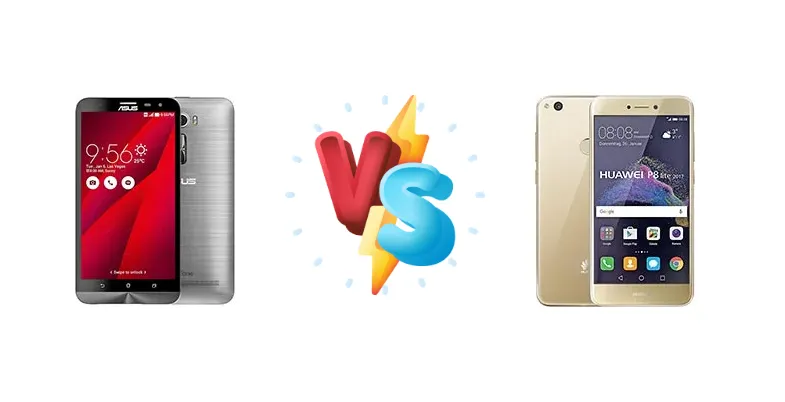
Released in different years, the Asus Zenfone 2 Laser (2015) and the Huawei P8 Lite (2017) represent distinct approaches to the budget smartphone market. While both aimed for affordability, they differed significantly in their core hardware. This comparison focuses on the key architectural differences between the Qualcomm Snapdragon 615 and the Huawei Kirin 655, and how those translate into real-world user experience.
🏆 Quick Verdict
For the average user prioritizing efficiency and slightly better performance, the Huawei P8 Lite (2017) emerges as the stronger choice. Its Kirin 655, built on a 16nm process, offers a noticeable advantage in power consumption and a modest performance boost over the Zenfone 2 Laser’s older 28nm Snapdragon 615.
| Network |
|---|
| 2G bands | GSM 850 / 900 / 1800 / 1900 - SIM 1 & SIM 2 | GSM 850 / 900 / 1800 / 1900 - SIM 1 & SIM 2 |
| 3G bands | HSDPA 850 / 900 / 1900 / 2100 - TW/WW version | HSDPA 850 / 900 / 1900 / 2100 |
| 4G bands | 1, 2, 3, 5, 8, 9, 28 - TW version | 1, 3, 7, 8, 20 |
| Speed | HSPA 42.2/5.76 Mbps, LTE Cat4 150/50 Mbps | HSPA 42.2/5.76 Mbps, LTE Cat4 150/50 Mbps |
| Technology | GSM / HSPA / LTE | GSM / HSPA / LTE |
| | 1, 2, 3, 5, 7, 8, 20 - WW version | - |
| Launch |
|---|
| Announced | 2015, October. Released 2016, January | 2017, January. Released 2017, January |
| Status | Discontinued | Discontinued |
| Body |
|---|
| Build | - | Glass front, glass back, aluminum frame |
| Dimensions | 164.6 x 84 x 10.6 mm (6.48 x 3.31 x 0.42 in) | 147.2 x 72.9 x 7.6 mm (5.80 x 2.87 x 0.30 in) |
| SIM | Dual SIM (Micro-SIM, dual stand-by) | Nano-SIM + Nano-SIM |
| Weight | 190 g (6.70 oz) | 147 g (5.19 oz) |
| Display |
|---|
| Protection | Corning Gorilla Glass 4 | - |
| Resolution | 720 x 1280 pixels, 16:9 ratio (~245 ppi density) | 1080 x 1920 pixels, 16:9 ratio (~424 ppi density) |
| Size | 6.0 inches, 99.2 cm2 (~71.8% screen-to-body ratio) | 5.2 inches, 74.5 cm2 (~69.5% screen-to-body ratio) |
| Type | IPS LCD | IPS LCD |
| Platform |
|---|
| CPU | Octa-core (4x1.7 GHz Cortex-A53 & 4x1.0 GHz Cortex-A53) | Octa-core (4x2.1 GHz Cortex-A53 & 4x1.7 GHz Cortex-A53) |
| Chipset | Qualcomm MSM8939 Snapdragon 615 (28 nm) | Kirin 655 (16 nm) |
| GPU | Adreno 405 | Mali-T830MP2 |
| OS | Android 5.0 (Lollipop), upgradable to 6.0 (Marshmallow), ZenUI | Android 7.0 (Nougat), upgradable to Android 8.0 (Oreo), EMUI 9 |
| Memory |
|---|
| Card slot | microSDXC (dedicated slot) | microSDXC (uses shared SIM slot) |
| Internal | 16GB 2GB RAM, 32GB 3GB RAM | 16GB 3GB RAM, 32GB 4GB RAM, 64GB 4GB RAM |
| | eMMC 4.5 | - |
| Main Camera |
|---|
| Features | Laser AF, Dual-LED dual-tone flash, panorama, HDR | LED flash, panorama, HDR |
| Single | 13 MP, f/2.0 | 12 MP, AF |
| Video | 1080p@30fps, 720p@60fps | 1080p@30fps |
| Selfie camera |
|---|
| Single | 5 MP, f/2.0 | 8 MP, f/2.0 |
| Video | - | 1080p@30fps |
| Sound |
|---|
| 3.5mm jack | Yes | Yes |
| 35mm jack | Yes | Yes |
| Loudspeaker | Yes, dual speakers | Yes |
| Comms |
|---|
| Bluetooth | 4.1, A2DP, EDR | 4.1, A2DP, EDR, LE |
| NFC | No | Yes (market dependent) |
| Positioning | GPS, GLONASS, BDS | GPS, GLONASS |
| Radio | No | FM radio |
| USB | microUSB 2.0 | microUSB 2.0, OTG |
| WLAN | Wi-Fi 802.11 a/b/g/n/ac, Wi-Fi Direct, hotspot | Wi-Fi 802.11 b/g/n, Wi-Fi Direct |
| Features |
|---|
| Sensors | Accelerometer, gyro, proximity, compass | Fingerprint (rear-mounted), accelerometer, proximity, compass |
| Battery |
|---|
| Type | Li-Po 3000 mAh, removable | Li-Ion 3000 mAh, non-removable |
| Misc |
|---|
| Colors | Glacier Gray, Sheer Gold, Glamour Red | Black, White, Gold, Blue |
| Models | Z00MD | PRA-TL10, PRA-TL20, PRA-LA1, PRA-LX1, PRA-LX2, TAG-L21, PRA-AL00X, TAG-L32, PRA-LX3, PRA-AL00 |
| Price | About 310 EUR | About 170 EUR |
Asus Zenfone 2 Laser ZE600KL
- Potentially lower price point due to age.
- Laser autofocus may offer faster focusing in ideal conditions.
- Compact form factor (likely).
- Less efficient Snapdragon 615 chipset.
- Older architecture and potentially slower performance.
- Likely shorter battery life.
Huawei P8 Lite (2017)
- More efficient Kirin 655 chipset.
- Improved performance and multitasking capabilities.
- Likely better battery life.
- May be slightly more expensive.
- Potentially larger form factor.
- Software support may be limited.
Display Comparison
Neither device is known for a standout display. Given the age of both, detailed panel specs like brightness (nits) and color accuracy are difficult to ascertain without testing. However, the P8 Lite (2017) likely benefits from advancements in display technology during its production cycle, potentially offering slightly better viewing angles and color reproduction. Bezels were also likely reduced on the P8 Lite, reflecting design trends of 2017.
Camera Comparison
Without detailed sensor information, a direct comparison is challenging. Both phones likely featured modest camera setups for their price points. The Zenfone 2 Laser’s name suggests a focus on laser autofocus, potentially offering faster focusing speeds in good lighting conditions. However, the Kirin 655’s ISP (Image Signal Processor) likely benefited from Huawei’s growing expertise in mobile photography, potentially leading to better image processing and dynamic range. The prevalence of 2MP auxiliary sensors on both devices suggests limited utility beyond marketing claims.
Performance
The core difference lies in the chipsets. The Snapdragon 615 in the Zenfone 2 Laser utilizes a 28nm manufacturing process, known for being less efficient. Its octa-core CPU (4x1.7 GHz Cortex-A53 & 4x1.0 GHz Cortex-A53) is paired with an Adreno 405 GPU. The P8 Lite (2017) features the Kirin 655, fabricated on a more advanced 16nm process. This translates to lower power consumption for similar workloads. The Kirin 655 also boasts an octa-core CPU (4x2.1 GHz Cortex-A53 & 4x1.7 GHz Cortex-A53) and a Mali-T830 MP2 GPU. The higher clock speeds on the Kirin 655’s prime cores, combined with the more efficient process node, result in a noticeable performance advantage in demanding applications and multitasking. While both use Cortex-A53 cores, the Kirin 655’s architecture benefits from two years of refinement.
Battery Life
Battery capacity figures are unavailable. However, the Kirin 655’s 16nm process gives it a significant advantage in power efficiency. This means the P8 Lite (2017) will likely deliver longer battery life on a single charge, even with a similar battery capacity to the Zenfone 2 Laser. Charging wattage is also unknown, but the more modern chipset in the P8 Lite (2017) may support faster charging protocols.
Buying Guide
Buy the Asus Zenfone 2 Laser ZE600KL if you find it at a significantly lower price point and need a phone primarily for basic tasks like calling, texting, and light social media. Buy the Huawei P8 Lite (2017) if you prioritize smoother multitasking, slightly better gaming performance, and improved battery life, even if it means spending a bit more.
Frequently Asked Questions
❓ Is the Snapdragon 615 in the Zenfone 2 Laser still capable of running modern apps?
While it can run many apps, the Snapdragon 615 will struggle with demanding games and multitasking. Expect noticeable lag and slowdowns with resource-intensive applications. It's best suited for basic tasks like calling, texting, and light browsing.
❓ Does the Kirin 655 in the P8 Lite (2017) support fast charging?
While specific charging wattage isn't confirmed, the Kirin 655 is more likely to support some form of fast charging compared to the older Snapdragon 615. However, the included charger may not be a fast charger, so a separate compatible charger might be needed to take advantage of this feature.
❓ Which phone is better for playing PUBG Mobile?
The Huawei P8 Lite (2017) is the better choice for PUBG Mobile. The Kirin 655’s GPU and more efficient architecture will allow for smoother frame rates and less overheating compared to the Zenfone 2 Laser’s Snapdragon 615. However, don't expect high graphics settings.