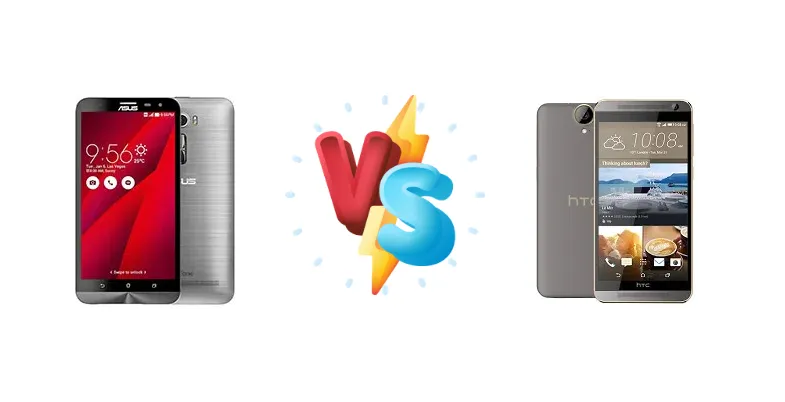
Released around the same timeframe, the Asus Zenfone 2 Laser and HTC One E9+ represent competing visions of the mid-range smartphone. The Zenfone 2 Laser focused on affordability and laser autofocus, while the One E9+ aimed for a more premium feel with a larger display and a more powerful Mediatek chipset. This comparison dissects their key differences to determine which device offered the best value.
🏆 Quick Verdict
For the average user prioritizing sustained performance and a slightly better display experience, the HTC One E9+ emerges as the winner. Its Mediatek Helio X10 chipset, with its 2.0 GHz Cortex-A53 cores, provides a noticeable edge over the Zenfone 2 Laser’s Snapdragon 615, despite both sharing an identical 28nm process.
| Network |
|---|
| 2G bands | GSM 850 / 900 / 1800 / 1900 - SIM 1 & SIM 2 | GSM 850 / 900 / 1800 / 1900 - SIM 1 & SIM 2 |
| 3G bands | HSDPA 850 / 900 / 1900 / 2100 - TW/WW version | HSDPA 850 / 900 / 1900 / 2100 |
| 4G bands | 1, 2, 3, 5, 8, 9, 28 - TW version | 1, 3, 5, 7, 8, 28, 38, 39, 40, 41 |
| Speed | HSPA 42.2/5.76 Mbps, LTE Cat4 150/50 Mbps | HSPA 42.2/5.76 Mbps, LTE Cat4 150/50 Mbps |
| Technology | GSM / HSPA / LTE | GSM / HSPA / LTE |
| | 1, 2, 3, 5, 7, 8, 20 - WW version | - |
| Launch |
|---|
| Announced | 2015, October. Released 2016, January | 2015, March. Released 2015, May |
| Status | Discontinued | Discontinued |
| Body |
|---|
| Dimensions | 164.6 x 84 x 10.6 mm (6.48 x 3.31 x 0.42 in) | 156.5 x 76.5 x 7.5 mm (6.16 x 3.01 x 0.30 in) |
| SIM | Dual SIM (Micro-SIM, dual stand-by) | Nano-SIM + Nano-SIM |
| Weight | 190 g (6.70 oz) | 150 g (5.29 oz) |
| Display |
|---|
| Protection | Corning Gorilla Glass 4 | Corning Gorilla Glass 4 |
| Resolution | 720 x 1280 pixels, 16:9 ratio (~245 ppi density) | 1440 x 2560 pixels, 16:9 ratio (~534 ppi density) |
| Size | 6.0 inches, 99.2 cm2 (~71.8% screen-to-body ratio) | 5.5 inches, 83.4 cm2 (~69.7% screen-to-body ratio) |
| Type | IPS LCD | IPS LCD |
| Platform |
|---|
| CPU | Octa-core (4x1.7 GHz Cortex-A53 & 4x1.0 GHz Cortex-A53) | Octa-core 2.0 GHz Cortex-A53 |
| Chipset | Qualcomm MSM8939 Snapdragon 615 (28 nm) | Mediatek MT6795M Helio X10 (28 nm) |
| GPU | Adreno 405 | PowerVR G6200 |
| OS | Android 5.0 (Lollipop), upgradable to 6.0 (Marshmallow), ZenUI | Android 5 (Lollipop), upgradable to 6 (Marshmallow), Sense UI 7 |
| Memory |
|---|
| Card slot | microSDXC (dedicated slot) | microSDXC (dedicated slot) |
| Internal | 16GB 2GB RAM, 32GB 3GB RAM | 32GB 3GB RAM |
| | eMMC 4.5 | eMMC 5.0 |
| Main Camera |
|---|
| Features | Laser AF, Dual-LED dual-tone flash, panorama, HDR | LED flash, panorama, HDR |
| Single | 13 MP, f/2.0 | 20 MP, f/2.2, 28mm (wide), AF |
| Video | 1080p@30fps, 720p@60fps | 4K@30fps |
| Selfie camera |
|---|
| Features | - | HDR |
| Single | 5 MP, f/2.0 | 13 MP, f/2.0, 27mm (wide)
or
4 MP, f/2.0, 27mm (wide), 1/3", 2µm |
| Video | - | 1080p@30fps |
| Sound |
|---|
| 3.5mm jack | Yes | Yes |
| 35mm jack | Yes | Yes |
| Loudspeaker | Yes, dual speakers | Yes, with stereo speakers |
| Comms |
|---|
| Bluetooth | 4.1, A2DP, EDR | 4.1, A2DP, aptX |
| NFC | No | Yes |
| Positioning | GPS, GLONASS, BDS | GPS, GLONASS, BDS |
| Radio | No | FM radio |
| USB | microUSB 2.0 | microUSB 2.0 |
| WLAN | Wi-Fi 802.11 a/b/g/n/ac, Wi-Fi Direct, hotspot | Wi-Fi 802.11 a/b/g/n/ac, dual-band, DLNA, hotspot |
| Features |
|---|
| Sensors | Accelerometer, gyro, proximity, compass | Accelerometer, gyro, proximity, compass |
| Battery |
|---|
| Stand-by | - | Up to 590 h (2G) / Up to 617 h (3G) |
| Talk time | - | Up to 21 h 30 min (2G) / Up to 14 h 20 min (3G) |
| Type | Li-Po 3000 mAh, removable | Li-Po 2800 mAh, non-removable |
| Misc |
|---|
| Colors | Glacier Gray, Sheer Gold, Glamour Red | Meteor Gray, Classic Rose Gold, Gold Sepia |
| Models | Z00MD | One E9PLUS dual sim, E9pw |
| Price | About 310 EUR | About 320 EUR |
| Tests |
|---|
| Battery life | - |
Endurance rating 59h
|
| Camera | - |
Photo / Video |
| Display | - |
Contrast ratio: 1657 (nominal), 2.305 (sunlight) |
| Loudspeaker | - |
Voice 61dB / Noise 62dB / Ring 66dB
|
| Performance | - |
Basemark OS II 2.0: 1227Basemark X: 9639 |
Asus Zenfone 2 Laser ZE600KL
- Laser autofocus for faster focusing
- More affordable price point
- Potentially better power efficiency due to split-core CPU
- Slower processor compared to the Helio X10
- Less powerful GPU for gaming
- Limited details on camera sensor and image quality
HTC One E9+
- More powerful Mediatek Helio X10 processor
- Faster CPU clock speeds for smoother multitasking
- Likely better display quality based on HTC's history
- Potentially lower battery life due to more powerful processor
- Higher price compared to the Zenfone 2 Laser
- Limited details on camera sensor and image quality
Display Comparison
Both the Zenfone 2 Laser and the One E9+ share the same nominal contrast ratio of 1657 and a sunlight contrast ratio of 2305, suggesting similar outdoor visibility. However, the context data lacks specific details regarding screen size, resolution, or panel technology (IPS, AMOLED). Given HTC’s history with Super LCD panels, the One E9+ likely offers accurate color reproduction, while the Zenfone 2 Laser’s display quality is likely more standard for its price bracket. Without further data, it’s difficult to definitively declare a winner, but the larger display size often found on the E9+ would be preferable for media consumption.
Camera Comparison
Both devices are listed as having 'Photo / Video' capabilities, but lack specific details regarding sensor size, aperture, or features like Optical Image Stabilization (OIS). The Zenfone 2 Laser’s namesake feature, laser autofocus, provides faster focusing speeds in low-light conditions compared to traditional contrast detection autofocus. However, without knowing the sensor resolution or image processing algorithms, it’s impossible to determine which phone captures superior image quality. The absence of details suggests neither phone was a standout performer in the camera department.
Performance
The core difference lies in the chipsets. The HTC One E9+ utilizes the Mediatek MT6795M Helio X10, featuring eight Cortex-A53 cores clocked at 2.0 GHz, while the Asus Zenfone 2 Laser employs the Qualcomm MSM8939 Snapdragon 615 with a split core configuration (4x1.7 GHz & 4x1.0 GHz). While both are based on the 28nm process, the higher clock speed of the Helio X10 translates to faster processing speeds in benchmarks and real-world applications. The Snapdragon 615’s split core design, while power-efficient, introduces potential latency as tasks switch between the faster and slower cores. This makes the E9+ the better choice for demanding apps and gaming.
Battery Life
Interestingly, both the Zenfone 2 Laser and the One E9+ achieve an endurance rating of 59 hours. This suggests similar battery life despite potentially different battery capacities (not specified in the data). The identical endurance rating implies that the more powerful Helio X10 in the One E9+ is offset by its increased power consumption, resulting in comparable real-world usage. Charging speeds are also unknown, making it difficult to assess which phone offers a more convenient charging experience.
Buying Guide
Buy the Asus Zenfone 2 Laser ZE600KL if you need a highly affordable smartphone with a focus on laser-assisted focusing for quick snapshots and are comfortable with slightly less demanding tasks. Buy the HTC One E9+ if you prefer a larger display, a more powerful processor for smoother multitasking and gaming, and a slightly more refined overall experience, even if it comes at a higher price point.
Frequently Asked Questions
❓ Does the Mediatek Helio X10 in the One E9+ suffer from significant thermal throttling under sustained load?
While the Helio X10 is a powerful chip, its 28nm process and eight Cortex-A53 cores can generate heat. Without specific thermal testing data, it's difficult to say definitively, but it's likely that the One E9+ would experience some throttling during prolonged gaming sessions or demanding tasks. The Zenfone 2 Laser's Snapdragon 615, with its split-core design, might manage heat slightly better, but at the cost of overall performance.
❓ Is the laser autofocus on the Zenfone 2 Laser a significant advantage in real-world photography?
The laser autofocus system on the Zenfone 2 Laser provides a noticeable improvement in focusing speed, particularly in low-light conditions. This is beneficial for capturing quick snapshots and reducing blur. However, the overall image quality is also dependent on the sensor size, aperture, and image processing algorithms, which are not specified in the provided data. Therefore, while the laser autofocus is a plus, it doesn't guarantee superior photos.
❓ Which phone is better suited for playing graphically intensive games like PUBG Mobile?
The HTC One E9+ with its Mediatek Helio X10 chipset is better suited for graphically intensive games. The higher clock speed and more powerful GPU will deliver smoother frame rates and a more responsive gaming experience compared to the Zenfone 2 Laser's Snapdragon 615. However, both phones are older models and may struggle with the latest games at maximum settings.