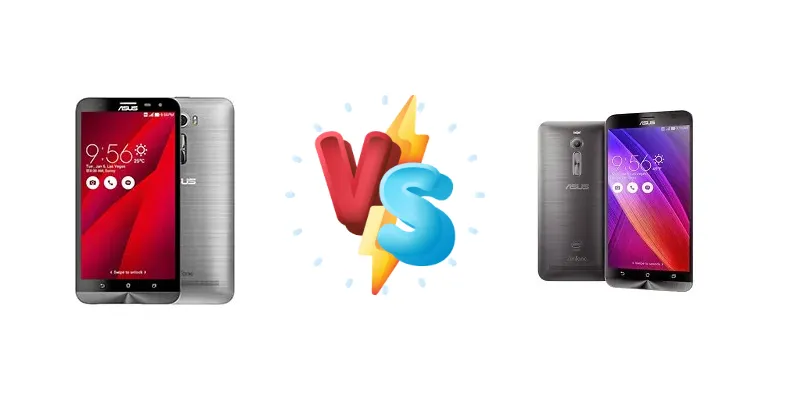
The Asus Zenfone 2 series offered a compelling blend of affordability and features. The Zenfone 2 Laser (ZE600KL) and the Zenfone 2 (ZE551ML) represent distinct approaches within that lineup. The Laser prioritized a more efficient chipset, while the standard Zenfone 2 aimed for raw processing power. This comparison dissects their differences to help you determine which model best suits your needs in 2024.
🏆 Quick Verdict
For the average user prioritizing sustained performance and faster charging, the Asus Zenfone 2 ZE551ML is the better choice. Its Intel Atom Z3580 (in the 4GB RAM variant) delivers a noticeable speed advantage over the Snapdragon 615, and the 18W charging is significantly quicker. However, the Laser's efficiency is a plus for those seeking longer standby times.
| Network |
|---|
| 2G bands | GSM 850 / 900 / 1800 / 1900 - SIM 1 & SIM 2 | GSM 850 / 900 / 1800 / 1900 - SIM 1 & SIM 2 |
| 3G bands | HSDPA 850 / 900 / 1900 / 2100 - TW/WW version | HSDPA 850 / 900 / 1900 / 2100 |
| 4G bands | 1, 2, 3, 5, 8, 9, 28 - TW version | 1, 2, 3, 4, 5, 8, 9, 18, 19, 28 - Taiwan |
| Speed | HSPA 42.2/5.76 Mbps, LTE Cat4 150/50 Mbps | HSPA 42.2/5.76 Mbps, LTE Cat4 150/50 Mbps |
| Technology | GSM / HSPA / LTE | GSM / HSPA / LTE |
| | 1, 2, 3, 5, 7, 8, 20 - WW version | - |
| Launch |
|---|
| Announced | 2015, October. Released 2016, January | 2015, January. Released 2015, March |
| Status | Discontinued | Discontinued |
| Body |
|---|
| Build | - | Glass front (Gorilla Glass 3), plastic back, plastic frame |
| Dimensions | 164.6 x 84 x 10.6 mm (6.48 x 3.31 x 0.42 in) | 152.5 x 77.2 x 10.9 mm (6.00 x 3.04 x 0.43 in) |
| SIM | Dual SIM (Micro-SIM, dual stand-by) | Dual SIM (Micro-SIM, dual stand-by) |
| Weight | 190 g (6.70 oz) | 170 g (6.00 oz) |
| Display |
|---|
| Protection | Corning Gorilla Glass 4 | Corning Gorilla Glass 3 |
| Resolution | 720 x 1280 pixels, 16:9 ratio (~245 ppi density) | 1080 x 1920 pixels, 16:9 ratio (~401 ppi density) |
| Size | 6.0 inches, 99.2 cm2 (~71.8% screen-to-body ratio) | 5.5 inches, 83.4 cm2 (~70.8% screen-to-body ratio) |
| Type | IPS LCD | IPS LCD |
| Platform |
|---|
| CPU | Octa-core (4x1.7 GHz Cortex-A53 & 4x1.0 GHz Cortex-A53) | Quad-core 2.3 GHz (4 GB RAM model)Quad-core 1.8 GHz (2 GB RAM model) |
| Chipset | Qualcomm MSM8939 Snapdragon 615 (28 nm) | Intel Atom Z3580 (4 GB RAM model)Intel Atom Z3560 (2 GB RAM model) |
| GPU | Adreno 405 | PowerVR G6430 |
| OS | Android 5.0 (Lollipop), upgradable to 6.0 (Marshmallow), ZenUI | Android 5.0 (Lollipop), upgradable to 6.0 (Marshmallow) |
| Memory |
|---|
| Card slot | microSDXC (dedicated slot) | microSDXC (dedicated slot) |
| Internal | 16GB 2GB RAM, 32GB 3GB RAM | 16GB 2GB RAM, 32GB 2GB RAM, 32GB 4GB RAM, 64GB 4GB RAM, 128GB 4GB RAM |
| | eMMC 4.5 | - |
| Main Camera |
|---|
| Features | Laser AF, Dual-LED dual-tone flash, panorama, HDR | Dual-LED dual-tone flash, panorama, HDR |
| Single | 13 MP, f/2.0 | 13 MP, f/2.0, AF |
| Video | 1080p@30fps, 720p@60fps | 1080p@30fps |
| Selfie camera |
|---|
| Single | 5 MP, f/2.0 | 5 MP, f/2.0 |
| Sound |
|---|
| 3.5mm jack | Yes | Yes |
| 35mm jack | Yes | Yes |
| Loudspeaker | Yes, dual speakers | Yes |
| Comms |
|---|
| Bluetooth | 4.1, A2DP, EDR | 4.0, A2DP, EDR |
| NFC | No | Yes |
| Positioning | GPS, GLONASS, BDS | GPS, GLONASS |
| Radio | No | FM radio, RDS |
| USB | microUSB 2.0 | microUSB 2.0, OTG |
| WLAN | Wi-Fi 802.11 a/b/g/n/ac, Wi-Fi Direct, hotspot | Wi-Fi 802.11 a/b/g/n/ac, Wi-Fi Direct, hotspot |
| Features |
|---|
| Sensors | Accelerometer, gyro, proximity, compass | Accelerometer, gyro, proximity, compass |
| Battery |
|---|
| Charging | - | 18W wired, 60% in 40 min |
| Type | Li-Po 3000 mAh, removable | Li-Po 3000 mAh, non-removable |
| Misc |
|---|
| Colors | Glacier Gray, Sheer Gold, Glamour Red | Osmium Black, Sheer Gold, Glacier Gray, Glamor Red, Ceramic White |
| Models | Z00MD | Z00AD, Z00A |
| Price | About 310 EUR | About 300 EUR |
| SAR EU | - | 0.35 W/kg (head) |
| Tests |
|---|
| Battery life | - | Endurance rating 59h |
| Camera | - |
Photo / Video |
| Loudspeaker | - |
Voice 62dB / Noise 61dB / Ring 67dB |
| Performance | - |
Basemark OS II 2.0: 1090Basemark X: 12565 |
Asus Zenfone 2 Laser ZE600KL
- Potentially better thermal management due to 28nm process
- Efficient Snapdragon 615 chipset for longer standby times
- Possible laser autofocus (speculation)
- Lower peak performance compared to Intel Atom Z3580
- Slower charging speeds (unspecified)
- Limited information on camera capabilities
Asus Zenfone 2 ZE551ML
- Faster Intel Atom Z3580 processor (4GB RAM model)
- 18W fast charging (60% in 40 minutes)
- Potentially smoother multitasking with 4GB RAM
- Intel Atom Z3580 may run warmer under sustained load
- 2GB RAM variant significantly limits performance
- Similar battery endurance to Zenfone 2 Laser
Display Comparison
Both devices lack detailed display specifications in the provided data. However, given their market positioning, it's reasonable to assume both utilized IPS LCD panels. The Zenfone 2 Laser's name suggests a focus on clarity, but without knowing resolution or pixel density, a direct comparison is impossible. Bezels were likely substantial on both, typical for the era. Color accuracy would have been standard for mid-range phones of the time.
Camera Comparison
Both phones are listed as having 'Photo / Video' capabilities, offering minimal insight. Without sensor size, aperture, or image processing details, a meaningful comparison is difficult. The 'Laser' moniker of the ZE600KL *might* indicate the inclusion of laser autofocus, offering faster focusing speeds in low light, but this is speculation. Given the era, image quality would likely be comparable, with both struggling in challenging lighting conditions. The absence of details suggests neither phone featured particularly advanced camera systems.
Performance
The core difference lies in the chipset. The Zenfone 2 Laser utilizes the Qualcomm MSM8939 Snapdragon 615, an octa-core processor built on a 28nm process. This chip employs a big.LITTLE architecture with four Cortex-A53 cores clocked at 1.7 GHz and four at 1.0 GHz, prioritizing power efficiency. Conversely, the Zenfone 2 ZE551ML comes in two configurations: an Intel Atom Z3580 (4GB RAM) clocked at 2.3 GHz and a Z3560 (2GB RAM) at 1.8 GHz. The Intel Atom, while also utilizing a quad-core design, generally offered higher single-core performance than the Snapdragon 615, resulting in a more responsive user experience. The 4GB RAM variant of the ZE551ML is crucial for maximizing this performance advantage, preventing app reloading and improving multitasking. The 28nm process of the Snapdragon 615 suggests it would run cooler under sustained load, but the Intel Atom's higher clock speeds provide a burst of power when needed.
Battery Life
Interestingly, both the Zenfone 2 Laser and the Zenfone 2 ZE551ML share an endurance rating of 59 hours. This suggests similar battery capacities and power consumption under typical usage scenarios. However, the ZE551ML boasts 18W wired charging, capable of reaching 60% charge in 40 minutes. The Zenfone 2 Laser's charging speed is not specified, implying it was significantly slower. This faster charging capability gives the ZE551ML a practical advantage, minimizing downtime.
Buying Guide
Buy the Asus Zenfone 2 Laser ZE600KL if you need a phone with a focus on battery efficiency and are primarily concerned with everyday tasks like browsing, social media, and light photography. Buy the Asus Zenfone 2 ZE551ML if you prefer a snappier user experience, enjoy occasional gaming, and value faster charging speeds. Consider the RAM configuration of the ZE551ML – the 4GB model is strongly recommended for optimal performance.
Frequently Asked Questions
❓ Is the Intel Atom Z3580 in the Zenfone 2 ZE551ML prone to overheating during gaming?
While the Intel Atom Z3580 offers higher performance, it can generate more heat than the Snapdragon 615. However, Asus likely implemented thermal management solutions to mitigate this. Expect some throttling during extended, graphically intensive gaming sessions, but it shouldn't be a major issue for casual gaming.
❓ Does the Zenfone 2 Laser's 'Laser' feature significantly improve autofocus speed?
If the Zenfone 2 Laser does indeed include laser autofocus (which isn't explicitly confirmed in the provided data), it would offer faster and more accurate focusing, particularly in low-light conditions, compared to traditional contrast-detection autofocus. This would be beneficial for capturing quick moments and improving image clarity.
❓ Which model is better for running multiple apps simultaneously?
The Zenfone 2 ZE551ML with 4GB of RAM is significantly better for multitasking. The extra RAM prevents apps from being frequently reloaded, resulting in a smoother and more responsive experience when switching between applications.