
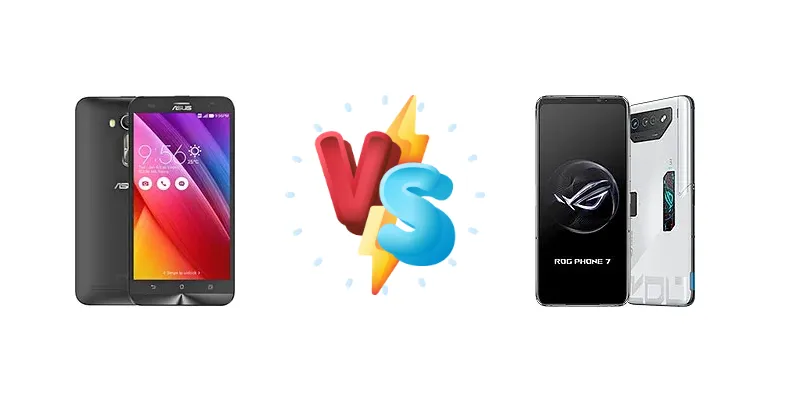
Asus Zenfone 2 Laser vs. ROG Phone 7 Ultimate: A Generational Leap
| Phones Images | |||||
|---|---|---|---|---|---|
|
🏆 Quick Verdict
The ROG Phone 7 Ultimate utterly dominates the Zenfone 2 Laser. While the Laser was a great value in 2015, the ROG Phone 7’s cutting-edge Snapdragon 8 Gen 2, stunning display, and exceptional battery life make it the clear winner for anyone seeking top-tier performance and features.
| PHONES | ||
|---|---|---|
| Phone Names | Asus Zenfone 2 Laser ZE550KL | Asus ROG Phone 7 Ultimate |
| Network | ||
|---|---|---|
| 2G bands | GSM 850 / 900 / 1800 / 1900 - SIM 1 & SIM 2 | GSM 850 / 900 / 1800 / 1900 |
| 3G bands | HSDPA 850 / 900 / 1900 / 2100 - Global | HSDPA 800 / 850 / 900 / 1700(AWS) / 1900 / 2100 |
| 4G bands | 1, 2, 3, 5, 7, 8, 20 - Global | 1, 2, 3, 4, 5, 7, 8, 12, 17, 18, 19, 20, 25, 26, 28, 32, 34, 38, 39, 40, 41, 42, 43, 48, 66 - International |
| 5G bands | - | 1, 2, 3, 5, 7, 8, 12, 18, 20, 25, 26, 28, 38, 40, 41, 48, 66, 77, 78, 79 SA/NSA/Sub6 - International |
| Speed | HSPA 42.2/5.76 Mbps, LTE Cat4 150/50 Mbps | HSPA, LTE (Up to 7CA), 5G |
| Technology | GSM / HSPA / LTE | GSM / CDMA / HSPA / LTE / 5G |
| 1, 3, 38, 40, 41 - India | 1, 3, 5, 8, 28, 41, 77, 78, 79 SA/NSA/Sub6 - China | |
| Launch | ||
|---|---|---|
| Announced | 2015, August. Released 2015, September | 2023, April 13 |
| Status | Discontinued | Available. Released 2023, May |
| Body | ||
|---|---|---|
| Build | - | Glass front (Gorilla Glass Victus), glass back (Gorilla Glass 3), aluminum frame |
| Dimensions | 152.5 x 77.2 x 10.8 mm (6.00 x 3.04 x 0.43 in) | 173 x 77 x 10.3 mm (6.81 x 3.03 x 0.41 in) |
| SIM | Dual SIM (Micro-SIM, dual stand-by) | Nano-SIM + Nano-SIM |
| Weight | 170 g (6.00 oz) | 239 g (8.43 oz) |
| - | Built-in motorized cooling air vent (AeroActive Portal) IP54 water resistant 2" OLED display (on the back) Pressure sensitive zones (Gaming triggers) | |
| Display | ||
|---|---|---|
| Protection | Corning Gorilla Glass 4 | Corning Gorilla Glass Victus |
| Resolution | 720 x 1280 pixels, 16:9 ratio (~267 ppi density) | 1080 x 2448 pixels (~395 ppi density) |
| Size | 5.5 inches, 83.4 cm2 (~70.8% screen-to-body ratio) | 6.78 inches, 109.5 cm2 (~82.2% screen-to-body ratio) |
| Type | IPS LCD | AMOLED, 1B colors, 165Hz, HDR10+, 1000 nits (HBM), 1500 nits (peak) |
| Platform | ||
|---|---|---|
| CPU | Quad-core 1.2 GHz Cortex-A53Octa-core (4x1.5 GHz Cortex-A53 & 4x1.0 GHz Cortex-A53) | Octa-core (1x3.2 GHz Cortex-X3 & 2x2.8 GHz Cortex-A715 & 2x2.8 GHz Cortex-A710 & 3x2.0 GHz Cortex-A510) |
| Chipset | Qualcomm MSM8916 Snapdragon 410 (28 nm)Qualcomm MSM8939 Snapdragon 615 (28 nm) | Qualcomm SM8550-AB Snapdragon 8 Gen 2 (4 nm) |
| GPU | Adreno 306Adreno 405 | Adreno 740 |
| OS | Android 5.0 (Lollipop), upgradable to 6.0 (Marshmallow), ZenUI | Android 13, up to 2 major Android upgrades |
| Memory | ||
|---|---|---|
| Card slot | microSDXC (dedicated slot) | No |
| Internal | 16GB 2GB RAM, 32GB 3GB RAM | 512GB 16GB RAM |
| eMMC 4.5 | UFS 4.0 NTFS support for external storage | |
| Main Camera | ||
|---|---|---|
| Features | Laser AF, Dual-LED dual-tone flash, panorama, HDR | LED flash, HDR, panorama |
| Single | 13 MP, f/2.0 | - |
| Triple | - | 50 MP, f/1.9, 24mm (wide), 1/1.56", 1.0µm, PDAF 13 MP, f/2.2, 13mm, 120˚ (ultrawide) 5 MP (macro) |
| Video | 1080p@30fps | 8K@24fps, 4K@30/60fps, 1080p@30/60/120/240fps, 720p@480fps; gyro-EIS, HDR10+ |
| Selfie camera | ||
|---|---|---|
| Features | - | Panorama, HDR |
| Single | 5 MP, f/2.0, AF | 32 MP, f/2.5, 29mm (wide), 1/3.2", 0.7µm |
| Video | - | 1080p@30fps |
| Sound | ||
|---|---|---|
| 3.5mm jack | Yes | Yes |
| 35mm jack | Yes | Yes |
| Loudspeaker | Yes | Yes, with stereo speakers (2 amplifiers) |
| - | 32-bit/384kHz audio | |
| Comms | ||
|---|---|---|
| Bluetooth | 4.0, A2DP, EDR | 5.3, A2DP, LE, aptX HD, aptX Adaptive, aptX Lossless |
| NFC | No | Yes |
| Positioning | GPS, GLONASS | GPS (L1+L5), GLONASS (L1), BDS (B1I+B1c+B2a), GALILEO (E1+E5a), QZSS (L1+L5), NavIC (L5) |
| Radio | FM radio | No |
| USB | microUSB 2.0, OTG | USB Type-C 3.1 (side), DisplayPort 1.4; USB Type-C 2.0 (bottom), OTG, accessory connector |
| WLAN | Wi-Fi 802.11 b/g/n, Wi-Fi Direct, hotspot | Wi-Fi 802.11 a/b/g/n/ac/6e/7, tri-band, Wi-Fi Direct |
| Features | ||
|---|---|---|
| Sensors | Accelerometer, gyro, proximity, compass | Fingerprint (under display, optical), accelerometer, gyro, proximity, compass |
| Battery | ||
|---|---|---|
| Charging | - | 65W wired, PD3.0, QC5, 100% in 42 min 10W reverse wired |
| Type | Li-Po 3000 mAh, removable | Li-Po 6000 mAh |
| Misc | ||
|---|---|---|
| Colors | Black, White, Red, Silver, Gold | Storm White |
| Models | Z00LD, Z00LDD | - |
| Price | About 220 EUR | About 780 EUR |
| Tests | ||
|---|---|---|
| Battery life | - | Endurance rating 131h |
| Camera | - | Photo / Video |
| Display | - | Contrast ratio: Infinite (nominal) |
| Loudspeaker | - | -25.5 LUFS (Very good) |
| Performance | - | AnTuTu: 1325105 (v9) GeekBench: 5139 (v5.5), 5567 (v6) GFXBench: 107fps (ES 3.1 onscreen) |
Asus Zenfone 2 Laser ZE550KL
- Affordable (when new)
- Compact size
- Decent for basic tasks
- Extremely outdated
- Poor performance
- Low-resolution display
- Limited camera capabilities
- Short battery life
Asus ROG Phone 7 Ultimate
- Exceptional performance
- Stunning display
- Long battery life
- Fast charging
- Excellent camera
- Gaming-focused features
- Expensive
- Large size
- Can be bulky
Display Comparison
The ROG Phone 7 Ultimate boasts a massive 6.78-inch AMOLED display with a 165Hz refresh rate and a peak brightness of 1095 nits, offering vibrant colors and incredibly smooth visuals. The Zenfone 2 Laser's 5.5-inch IPS LCD display, while decent for its time, simply can't compete with the ROG Phone 7's superior technology and brightness. Contrast ratio is also vastly superior on the ROG Phone 7.
Camera Comparison
While specific camera specs are not detailed for the Zenfone 2 Laser, it's safe to assume the ROG Phone 7’s camera system is far superior. The ROG Phone 7 offers advanced features, better image processing, and significantly improved low-light performance. Expect sharper images, better dynamic range, and more detailed videos from the ROG Phone 7.
Performance
The Snapdragon 8 Gen 2 in the ROG Phone 7 is a beast, delivering unparalleled performance for gaming and demanding applications. The Zenfone 2 Laser's Snapdragon 410 or 615 (depending on the variant) feels incredibly dated by comparison, struggling with modern games and multitasking. The ROG Phone 7’s CPU architecture is also significantly more advanced.
Battery Life
The ROG Phone 7 Ultimate’s 6000mAh battery provides exceptional endurance, rated at 131 hours. The Zenfone 2 Laser’s battery capacity is significantly smaller, and its battery life is considerably shorter, especially when considering the difference in screen technology and processing power.
Buying Guide
The Asus Zenfone 2 Laser is suitable for users seeking a very basic, ultra-budget phone for calls, texts, and light browsing. It's a nostalgic option for those who remember the era of affordable Android. The Asus ROG Phone 7 Ultimate is for serious mobile gamers, content creators, and power users who demand the best possible performance, display quality, and battery life, and are willing to pay a premium.