
Asus ROG Phone 6D Ultimate vs. Samsung Galaxy S22 Ultra: A Deep Dive Comparison
| Phones Images | |||||
|---|---|---|---|---|---|
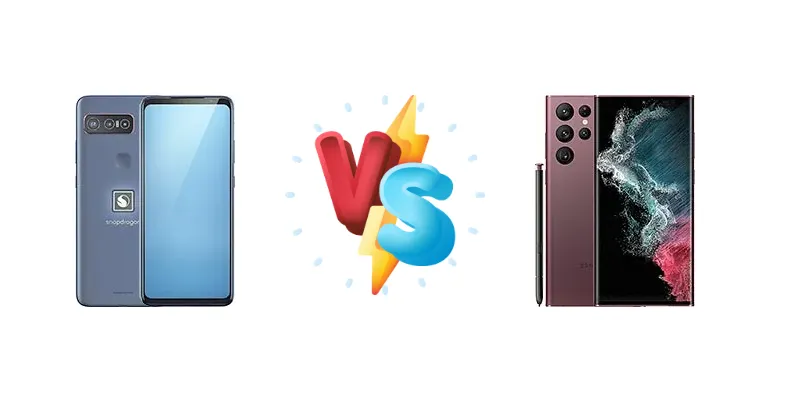
|
🏆 Quick Verdict
For dedicated mobile gamers, the Asus ROG Phone 6D Ultimate offers a more focused and powerful experience, leveraging its Snapdragon 888 and aggressive cooling. However, the Samsung Galaxy S22 Ultra wins for the average user due to its superior camera system, brighter display, and broader feature set, despite the potential for thermal throttling with the Exynos variant.
| PHONES | ||
|---|---|---|
| Phone Names | Asus Smartphone for Snapdragon Insiders | Samsung Galaxy S22 Ultra 5G |
| Network | ||
|---|---|---|
| 2G bands | GSM 850 / 900 / 1800 / 1900 | GSM 850 / 900 / 1800 / 1900 |
| 3G bands | HSDPA 800 / 850 / 900 / 1700(AWS) / 1900 / 2100 | HSDPA 850 / 900 / 1700(AWS) / 1900 / 2100 |
| 4G bands | 1, 2, 3, 4, 5, 7, 8, 11, 12, 13, 14, 17, 18, 19, 20, 21, 25, 26, 28, 29, 30, 32, 34, 38, 39, 40, 41, 42, 43, 46, 48, 66, 71 | 1, 2, 3, 4, 5, 7, 8, 12, 13, 17, 18, 19, 20, 25, 26, 28, 32, 38, 39, 40, 41, 66 - International |
| 5G bands | 1, 2, 3, 5, 7, 8, 11, 12, 13, 14, 18, 20, 21, 25, 26, 28, 30, 38, 40, 41, 42, 43, 46, 48, 66, 71, 77, 78, 79, 257, 258, 260, 261 SA/NSA/Sub6/mmWave | 1, 2, 3, 5, 7, 8, 12, 20, 25, 28, 38, 40, 41, 66, 75, 77, 78 SA/NSA/Sub6 - International |
| Speed | HSPA 42.2/5.76 Mbps, LTE (6CA) Cat20 2000/150 Mbps, 5G | HSPA 42.2/5.76 Mbps, LTE (7CA) Cat20 2000/200 Mbps, 5G (5+ Gbps DL) |
| Technology | GSM / HSPA / LTE / 5G | GSM / CDMA / HSPA / EVDO / LTE / 5G |
| - | 1, 3, 5, 7, 8, 20, 28, 38, 41, 66, 71, 260, 261 SA/NSA/Sub6/mmWave - USA | |
| Launch | ||
|---|---|---|
| Announced | 2021, July 08 | 2022, February 09 |
| Status | Available. Released 2021, August 31 | Available. Released 2022, February 25 |
| Body | ||
|---|---|---|
| Build | - | Glass front (Gorilla Glass Victus+), glass back (Gorilla Glass Victus+), aluminum frame |
| Dimensions | 173.2 x 77.3 x 9.6 mm (6.82 x 3.04 x 0.38 in) | 163.3 x 77.9 x 8.9 mm (6.43 x 3.07 x 0.35 in) |
| SIM | Nano-SIM + Nano-SIM | · Nano-SIM + eSIM· Nano-SIM + Nano-SIM + eSIM (max 2 at a time) |
| Weight | 210 g (7.41 oz) | 228 g / 229 g (mmWave) (8.04 oz) |
| - | IP68 dust/water resistant (up to 1.5m for 30 min) Armor aluminum frame with tougher drop and scratch resistance (advertised) Stylus, 2.8ms latency (Bluetooth integration, accelerometer, gyro) | |
| Display | ||
|---|---|---|
| Protection | Corning Gorilla Glass Victus | Corning Gorilla Glass Victus+ |
| Resolution | 1080 x 2400 pixels (~395 ppi density) | 1440 x 3088 pixels, 19.3:9 ratio (~500 ppi density) |
| Size | 6.78 inches, 109.5 cm2 (~81.8% screen-to-body ratio) | 6.8 inches, 114.7 cm2 (~90.2% screen-to-body ratio) |
| Type | Super AMOLED, 144Hz, HDR10+, 800 nits (HBM), 1200 nits (peak) | Dynamic AMOLED 2X, 120Hz, HDR10+, 1750 nits (peak) |
| Always-on display | Always-on display | |
| Platform | ||
|---|---|---|
| CPU | Octa-core (1x2.84 GHz Cortex-X1 & 3x2.42 GHz Cortex-A78 & 4x1.80 GHz Cortex-A55) | Octa-core (1x2.8 GHz Cortex-X2 & 3x2.50 GHz Cortex-A710 & 4x1.8 GHz Cortex-A510) - EuropeOcta-core (1x3.00 GHz Cortex-X2 & 3x2.50 GHz Cortex-A710 & 4x1.80 GHz Cortex-A510) - ROW |
| Chipset | Qualcomm SM8350 Snapdragon 888 5G (5 nm) | Exynos 2200 (4 nm) - EuropeQualcomm SM8450 Snapdragon 8 Gen 1 (4 nm) - ROW |
| GPU | Adreno 660 | Xclipse 920 - EuropeAdreno 730 - ROW |
| OS | Android 11 | Android 12, up to 4 major Android upgrades, One UI 8 |
| Memory | ||
|---|---|---|
| Card slot | No | No |
| Internal | 512GB 16GB RAM | 128GB 8GB RAM, 256GB 12GB RAM, 512GB 12GB RAM, 1TB 12GB RAM |
| UFS 3.1 | UFS 3.1 | |
| Main Camera | ||
|---|---|---|
| Features | Dual-LED flash, HDR, panorama | Laser AF, LED flash, auto-HDR, panorama |
| Quad | - | 108 MP, f/1.8, 23mm (wide), 1/1.33", 0.8µm, PDAF, OIS 10 MP, f/2.4, 70mm (telephoto), 1/3.52", 1.12µm, PDAF, OIS, 3x optical zoom 10 MP, f/4.9, 230mm (periscope telephoto), 1/3.52", 1.12µm, PDAF, OIS, 10x optical zoom 12 MP, f/2.2, 13mm, 120˚ (ultrawide), 1/2.55", 1.4µm, dual pixel PDAF, Super Steady video |
| Triple | 64 MP, f/1.8, 26mm (wide), 1/1.73", 0.8µm, PDAF, OIS 8 MP, f/2.4, 80mm (telephoto), PDAF, 3x optical zoom, OIS 12 MP, f/2.2, 112˚, 14mm (ultrawide), 1/2.55", 1.4µm, dual pixel PDAF | - |
| Video | 8K@30fps, 4K@30/60fps, 1080p@30/60fps, gyro-EIS, HDR | 8K@24fps, 4K@30/60fps, 1080p@30/60/120/240fps, HDR10+, stereo sound rec., gyro-EIS |
| Selfie camera | ||
|---|---|---|
| Features | HDR | HDR |
| Single | 24 MP, f/2.5, 27mm (wide), 0.9µm | 40 MP, f/2.2, 26mm (wide), 1/2.82", 0.7µm, PDAF |
| Video | 1080p@30fps | 4K@30/60fps, 1080p@30fps |
| Sound | ||
|---|---|---|
| 3.5mm jack | No | No |
| 35mm jack | No | No |
| Loudspeaker | Yes, with stereo speakers | Yes, with stereo speakers |
| Snapdragon Sound Technology 32-bit/384kHz audio | 32-bit/384kHz audio Tuned by AKG | |
| Comms | ||
|---|---|---|
| Bluetooth | 5.2, A2DP, LE, aptX HD, aptX Adaptive | 5.2, A2DP, LE |
| NFC | Yes | Yes |
| Positioning | GPS (L1+L5), GLONASS (L1), BDS (B1I+B1c+B2a), GALILEO (E1+E5a), QZSS (L1+L5), NavIC (L5) | GPS, GLONASS, BDS, GALILEO |
| Radio | No | No |
| USB | USB Type-C | USB Type-C 3.2, OTG |
| WLAN | Wi-Fi 802.11 a/b/g/n/ac/6e, dual-band, Wi-Fi Direct | Wi-Fi 802.11 a/b/g/n/ac/6e, dual-band, Wi-Fi Direct |
| Features | ||
|---|---|---|
| Sensors | Fingerprint (rear-mounted, ultrasonic), accelerometer, gyro, proximity, compass | Fingerprint (under display, ultrasonic), accelerometer, gyro, proximity, compass, barometer |
| Illuminated Snapdragon fireball icon on the back | Samsung DeX, Samsung Wireless DeX (desktop experience support) Bixby natural language commands and dictation Samsung Pay (Visa, MasterCard certified) Ultra Wideband (UWB) support | |
| Battery | ||
|---|---|---|
| Charging | 65W wired, PD3.0, QC5, 50% in 30 min, 100% in 50 min | 45W wired, PD3.0 15W wireless (Qi) 4.5W reverse wireless |
| Type | Li-Po 4000 mAh | Li-Ion 5000 mAh |
| Misc | ||
|---|---|---|
| Colors | Midnight blue | Phantom Black, White, Burgundy, Green, Graphite, Red, Sky Blue, Bora Purple |
| Models | I007D | SM-S908B, SM-S908B/DS, SM-S908U, SM-S908U1, SM-S908W, SM-S908N, SM-S9080, SM-S908E, SM-S908E/DS |
| Price | About 1270 EUR | € 397.07 / $ 269.98 / £ 304.99 / ₹ 63,899 |
| SAR | - | 1.18 W/kg (head) 0.98 W/kg (body) |
| SAR EU | - | 1.05 W/kg (head) 1.58 W/kg (body) |
| Tests | ||
|---|---|---|
| Battery life | - | Endurance rating 108h |
| Camera | - | Photo / Video |
| Display | - | Contrast ratio: Infinite (nominal) |
| Loudspeaker | - | -27.3 LUFS (Good) |
| Performance | - | AnTuTu: 968359 (v9) GeekBench: 3657 (v5.1) GFXBench: 37fps (ES 3.1 onscreen) |
Asus Smartphone for Snapdragon Insiders
- Significantly faster 65W wired charging
- Optimized for sustained gaming performance
- Aggressive cooling system minimizes throttling
- Camera system likely inferior to the S22 Ultra
- Less versatile feature set compared to Samsung
- Bulkier design geared towards gaming
Samsung Galaxy S22 Ultra 5G
- Superior camera system with versatile features
- Brighter and more vibrant display
- S Pen integration for productivity and creativity
- Slower 45W wired charging
- Potential for thermal throttling with Exynos variant
- Higher price point
Display Comparison
The Samsung Galaxy S22 Ultra boasts a significantly brighter display, peaking at 1266 nits measured, compared to the Asus ROG Phone 6D Ultimate (brightness data unavailable, but typically lower on gaming phones). While the Asus likely features a high refresh rate, the S22 Ultra’s contrast ratio is listed as infinite (nominal), suggesting deeper blacks and a more vibrant image. The S22 Ultra’s display is geared towards outdoor visibility and media consumption, while the Asus prioritizes responsiveness for gaming.
Camera Comparison
Samsung consistently excels in camera technology, and the S22 Ultra is no exception. While specific sensor details are missing for both, the S22 Ultra’s reputation for image processing and versatility is well-established. The Asus ROG Phone 6D Ultimate, while capable, typically prioritizes other features over camera innovation. The S22 Ultra’s camera system is designed for a wider range of shooting scenarios, from detailed landscapes to low-light portraits, while the Asus is likely more focused on quick snapshots and social media sharing. The absence of detailed camera specs for the Asus suggests it won't compete directly with the S22 Ultra's photographic prowess.
Performance
The core difference lies in the chipsets. The Asus ROG Phone 6D Ultimate utilizes the Qualcomm SM8350 Snapdragon 888 5G (5 nm), while the Samsung Galaxy S22 Ultra comes in two variants: Exynos 2200 (4 nm) for Europe and Snapdragon 8 Gen 1 (4 nm) for ROW. The 4nm process node of the Exynos 2200 and Snapdragon 8 Gen 1 theoretically offers better power efficiency than the 5nm Snapdragon 888. However, the Snapdragon 888 in the Asus is known for its strong sustained performance, and the ROG Phone’s cooling system is designed to mitigate throttling. The S22 Ultra’s CPU, with its Cortex-X2 core (2.8 GHz in Europe, 3.0 GHz ROW), offers a slight architectural advantage over the Snapdragon 888’s Cortex-X1 (2.84 GHz), but real-world gains depend heavily on thermal management.
Battery Life
Both devices have an endurance rating of 108h, suggesting similar overall battery life despite differing approaches. The Asus ROG Phone 6D Ultimate features 65W wired charging, significantly faster than the S22 Ultra’s 45W. This translates to a 50% charge in 30 minutes and 100% in 50 minutes for the Asus, while the S22 Ultra takes longer. The S22 Ultra compensates with 15W wireless charging and 4.5W reverse wireless charging, features absent on the Asus. The Asus prioritizes rapid refueling, while the Samsung offers more charging flexibility.
Buying Guide
Buy the Asus ROG Phone 6D Ultimate if you demand maximum Android gaming performance, prioritize sustained frame rates over all else, and appreciate features like AirTriggers. Buy the Samsung Galaxy S22 Ultra if you value a versatile camera system, a stunning display, S Pen integration, and a more polished, all-around smartphone experience, even if it means potentially sacrificing some peak gaming performance.