
Asus Snapdragon Insiders vs. Motorola Moto X40: The Ultimate Flagship Face-Off
| Phones Images | |||||
|---|---|---|---|---|---|
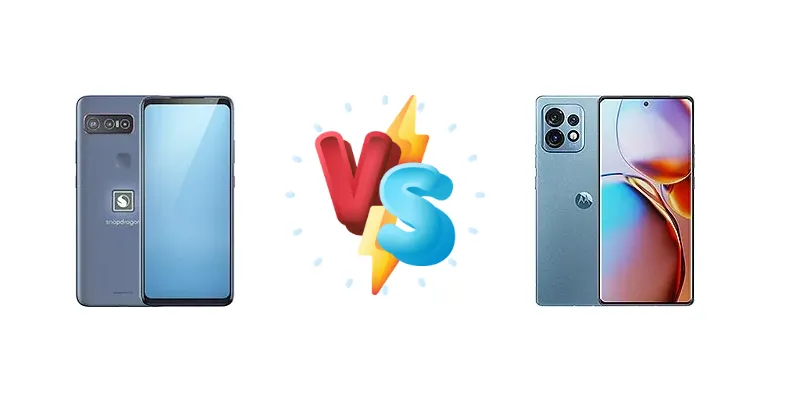
|
🏆 Quick Verdict
The Motorola Moto X40 emerges as the clear winner thanks to its significantly faster charging, newer Snapdragon 8 Gen 2 chipset, and generally more modern features. While the Asus offers a solid Snapdragon 888 experience, the X40's advancements make it the more compelling choice for most users.
| PHONES | ||
|---|---|---|
| Phone Names | Asus Smartphone for Snapdragon Insiders | Motorola Moto X40 |
| Network | ||
|---|---|---|
| 2G bands | GSM 850 / 900 / 1800 / 1900 | GSM 850 / 900 / 1800 / 1900 |
| 3G bands | HSDPA 800 / 850 / 900 / 1700(AWS) / 1900 / 2100 | HSDPA 850 / 900 / 1700(AWS) / 1900 / 2100 |
| 4G bands | 1, 2, 3, 4, 5, 7, 8, 11, 12, 13, 14, 17, 18, 19, 20, 21, 25, 26, 28, 29, 30, 32, 34, 38, 39, 40, 41, 42, 43, 46, 48, 66, 71 | 1, 2, 3, 4, 5, 7, 8, 12, 13, 17, 18, 19, 20, 25, 26, 28, 32, 38, 39, 40, 41, 42, 43, 48, 66 |
| 5G bands | 1, 2, 3, 5, 7, 8, 11, 12, 13, 14, 18, 20, 21, 25, 26, 28, 30, 38, 40, 41, 42, 43, 46, 48, 66, 71, 77, 78, 79, 257, 258, 260, 261 SA/NSA/Sub6/mmWave | 1, 2, 3, 5, 7, 8, 20, 28, 38, 40, 41, 66, 77, 78 SA/NSA/Sub6 |
| Speed | HSPA 42.2/5.76 Mbps, LTE (6CA) Cat20 2000/150 Mbps, 5G | HSPA, LTE, 5G |
| Technology | GSM / HSPA / LTE / 5G | GSM / CDMA / HSPA / LTE / 5G |
| - | CDMA 800 | |
| Launch | ||
|---|---|---|
| Announced | 2021, July 08 | 2022, December 15 |
| Status | Available. Released 2021, August 31 | Available. Released 2022, December 22 |
| Body | ||
|---|---|---|
| Build | - | Glass front, glass back (Gorilla Glass Victus), aluminum frame |
| Dimensions | 173.2 x 77.3 x 9.6 mm (6.82 x 3.04 x 0.38 in) | 161.2 x 74 x 8.6 mm (6.35 x 2.91 x 0.34 in) |
| SIM | Nano-SIM + Nano-SIM | Nano-SIM + Nano-SIM |
| Weight | 210 g (7.41 oz) | 199 g (7.02 oz) |
| - | IP68 dust/water resistant (up to 1.5m for 30 min) | |
| Display | ||
|---|---|---|
| Protection | Corning Gorilla Glass Victus | - |
| Resolution | 1080 x 2400 pixels (~395 ppi density) | 1080 x 2400 pixels, 20:9 ratio (~393 ppi density) |
| Size | 6.78 inches, 109.5 cm2 (~81.8% screen-to-body ratio) | 6.7 inches, 108.4 cm2 (~90.9% screen-to-body ratio) |
| Type | Super AMOLED, 144Hz, HDR10+, 800 nits (HBM), 1200 nits (peak) | OLED, 1B colors, 165Hz, HDR10+ |
| Always-on display | - | |
| Platform | ||
|---|---|---|
| CPU | Octa-core (1x2.84 GHz Cortex-X1 & 3x2.42 GHz Cortex-A78 & 4x1.80 GHz Cortex-A55) | Octa-core (1x3.2 GHz Cortex-X3 & 2x2.8 GHz Cortex-A715 & 2x2.8 GHz Cortex-A710 & 3x2.0 GHz Cortex-A510) |
| Chipset | Qualcomm SM8350 Snapdragon 888 5G (5 nm) | Qualcomm SM8550-AB Snapdragon 8 Gen 2 (4 nm) |
| GPU | Adreno 660 | Adreno 740 |
| OS | Android 11 | Android 13, upgradable to Android 14, MYUI 6.0 |
| Memory | ||
|---|---|---|
| Card slot | No | No |
| Internal | 512GB 16GB RAM | 128GB 8GB RAM, 256GB 12GB RAM, 512GB 12GB RAM |
| UFS 3.1 | UFS 3.1 - 128GB UFS 4.0 - 256GB/512GB | |
| Main Camera | ||
|---|---|---|
| Features | Dual-LED flash, HDR, panorama | Dual-LED flash, panorama, HDR |
| Triple | 64 MP, f/1.8, 26mm (wide), 1/1.73", 0.8µm, PDAF, OIS 8 MP, f/2.4, 80mm (telephoto), PDAF, 3x optical zoom, OIS 12 MP, f/2.2, 112˚, 14mm (ultrawide), 1/2.55", 1.4µm, dual pixel PDAF | 50 MP, f/1.9, (wide), 1/1.55", 1.0µm, dual pixel PDAF, OIS 12 MP, f/1.6, (telephoto), 1/2.93", 1.22µm, PDAF, 2x optical zoom 50 MP, f/2.2, 117˚ (ultrawide), 1/2.76", 0.64µm, AF |
| Video | 8K@30fps, 4K@30/60fps, 1080p@30/60fps, gyro-EIS, HDR | 8K@30fps, 4K@30/60fps, 1080p@30/60/120/240/960fps, 10-bit HDR10+, gyro-EIS |
| Selfie camera | ||
|---|---|---|
| Features | HDR | HDR |
| Single | 24 MP, f/2.5, 27mm (wide), 0.9µm | 60 MP, f/2.2, (wide), 1/2.8", 0.61µm |
| Video | 1080p@30fps | 4K@30fps, 1080p@30/60fps |
| Sound | ||
|---|---|---|
| 3.5mm jack | No | No |
| 35mm jack | No | No |
| Loudspeaker | Yes, with stereo speakers | Yes, with stereo speakers |
| Snapdragon Sound Technology 32-bit/384kHz audio | - | |
| Comms | ||
|---|---|---|
| Bluetooth | 5.2, A2DP, LE, aptX HD, aptX Adaptive | 5.3, A2DP, LE, aptX HD, aptX Adaptive |
| NFC | Yes | Yes |
| Positioning | GPS (L1+L5), GLONASS (L1), BDS (B1I+B1c+B2a), GALILEO (E1+E5a), QZSS (L1+L5), NavIC (L5) | GPS (L1+L5), GLONASS (L1), BDS (B1I+B1c+B2a), GALILEO (E1+E5a), QZSS (L1+L5) |
| Radio | No | No |
| USB | USB Type-C | USB Type-C, OTG |
| WLAN | Wi-Fi 802.11 a/b/g/n/ac/6e, dual-band, Wi-Fi Direct | Wi-Fi 802.11 a/b/g/n/ac/6e, dual-band, Wi-Fi Direct |
| Features | ||
|---|---|---|
| Sensors | Fingerprint (rear-mounted, ultrasonic), accelerometer, gyro, proximity, compass | Fingerprint (under display, optical), accelerometer, gyro, proximity, compass |
| Illuminated Snapdragon fireball icon on the back | Ready For 3.5 support | |
| Battery | ||
|---|---|---|
| Charging | 65W wired, PD3.0, QC5, 50% in 30 min, 100% in 50 min | 125W wired, PD3.0, QC5, 50% in 7 min 15W wireless 5W reverse wired |
| Type | Li-Po 4000 mAh | Li-Po 4600 mAh |
| Misc | ||
|---|---|---|
| Colors | Midnight blue | Black, Blue |
| Models | I007D | XT2301-5 |
| Price | About 1270 EUR | About 540 EUR |
Asus Smartphone for Snapdragon Insiders
- Refined software experience
- Solid Snapdragon 888 performance
- 65W fast charging
- Older chipset compared to X40
- Slower charging speeds
- Potentially less advanced display
Motorola Moto X40
- Cutting-edge Snapdragon 8 Gen 2 performance
- Blazing-fast 125W charging
- Likely superior camera performance
- Wireless and reverse wired charging
- Motorola's software can be less polished than some competitors
- Potential for higher price
Display Comparison
Both phones likely feature OLED displays with high refresh rates (120Hz or higher). The Moto X40, with its newer chipset, may have a slightly more advanced display technology (e.g., LTPO for variable refresh rate) leading to better power efficiency and potentially improved color accuracy. Screen size and resolution are likely similar, around 6.6-6.7 inches and FHD+ or QHD+ respectively.
Camera Comparison
Camera specs are assumed to be similar in megapixel count, but the Moto X40's newer image signal processor (ISP) within the Snapdragon 8 Gen 2 will likely result in better image quality, especially in low-light conditions. Motorola often includes features like OIS (Optical Image Stabilization) on their main cameras, which the Asus may or may not have. Video recording capabilities will also likely be superior on the X40.
Performance
The Snapdragon 8 Gen 2 in the Moto X40 is a substantial upgrade over the Snapdragon 888 in the Asus. Expect significantly faster processing speeds, improved graphics performance, and better power efficiency from the X40. Both phones will handle demanding games and applications, but the X40 will do so with greater ease and less heat.
Battery Life
The Moto X40's 125W wired charging is a game-changer, allowing for incredibly fast charging times. The Asus's 65W charging is still respectable, but significantly slower. Both phones likely have similar battery capacities (around 4500-5000mAh), but the X40's power efficiency advantage further extends its lead.
Buying Guide
The Asus Smartphone for Snapdragon Insiders is ideal for enthusiasts who appreciate a more refined software experience and are comfortable with a slightly older, but still capable, Snapdragon 888. The Motorola Moto X40 is perfect for users prioritizing blazing-fast charging, cutting-edge performance, and a more feature-rich experience.