
Asus Snapdragon Insiders vs. Google Pixel 6: The Ultimate Showdown
| Phones Images | |||||
|---|---|---|---|---|---|
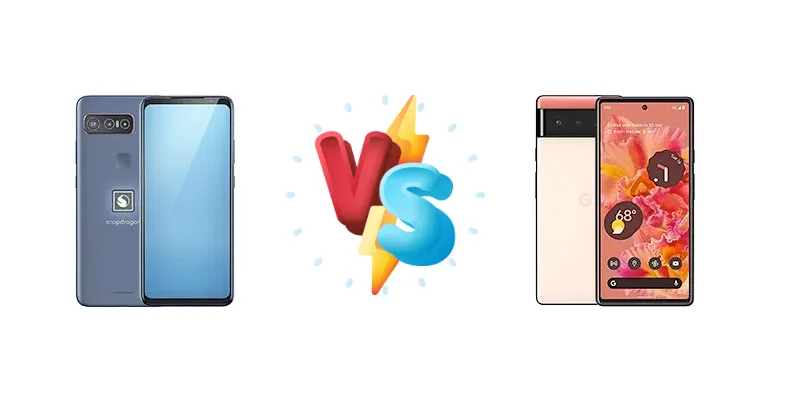
|
🏆 Quick Verdict
The Asus Snapdragon Insiders boasts superior charging speeds and raw performance thanks to the Snapdragon 888. The Pixel 6 shines with its exceptional camera, clean Android experience, and long-lasting battery. Ultimately, the choice depends on whether you prioritize speed and power or photography and software.
| PHONES | ||
|---|---|---|
| Phone Names | Asus Smartphone for Snapdragon Insiders | Google Pixel 6 |
| Network | ||
|---|---|---|
| 2G bands | GSM 850 / 900 / 1800 / 1900 | GSM 850 / 900 / 1800 / 1900 |
| 3G bands | HSDPA 800 / 850 / 900 / 1700(AWS) / 1900 / 2100 | HSDPA 800 / 850 / 900 / 1700(AWS) / 1900 / 2100 |
| 4G bands | 1, 2, 3, 4, 5, 7, 8, 11, 12, 13, 14, 17, 18, 19, 20, 21, 25, 26, 28, 29, 30, 32, 34, 38, 39, 40, 41, 42, 43, 46, 48, 66, 71 | 1, 2, 3, 4, 5, 7, 8, 12, 13, 14, 17, 18, 19, 20, 25, 26, 28, 29, 30, 32, 38, 39, 40, 41, 42, 46, 48, 66, 71 - GB7N6, G9S9B16 |
| 5G bands | 1, 2, 3, 5, 7, 8, 11, 12, 13, 14, 18, 20, 21, 25, 26, 28, 30, 38, 40, 41, 42, 43, 46, 48, 66, 71, 77, 78, 79, 257, 258, 260, 261 SA/NSA/Sub6/mmWave | 1, 2, 3, 5, 7, 8, 12, 14, 20, 25, 28, 30, 38, 40, 41, 48, 66, 71, 77, 78, 257, 258, 260, 261 SA/NSA/Sub6/mmWave - G9S9B |
| Speed | HSPA 42.2/5.76 Mbps, LTE (6CA) Cat20 2000/150 Mbps, 5G | HSPA, LTE, 5G |
| Technology | GSM / HSPA / LTE / 5G | GSM / CDMA / HSPA / EVDO / LTE / 5G |
| - | 1, 2, 3, 5, 7, 8, 12, 14, 20, 25, 28, 30, 38, 40, 41, 48, 66, 71, 77, 78 SA/NSA/Sub6 - GB7N6 | |
| Launch | ||
|---|---|---|
| Announced | 2021, July 08 | 2021, October 19 |
| Status | Available. Released 2021, August 31 | Available. Released 2021, October 28 |
| Body | ||
|---|---|---|
| Build | - | Glass front (Gorilla Glass Victus), glass back (Gorilla Glass 6), aluminum frame |
| Dimensions | 173.2 x 77.3 x 9.6 mm (6.82 x 3.04 x 0.38 in) | 158.6 x 74.8 x 8.9 mm (6.24 x 2.94 x 0.35 in) |
| SIM | Nano-SIM + Nano-SIM | Nano-SIM + eSIM |
| Weight | 210 g (7.41 oz) | 207 g (7.30 oz) |
| - | IP68 dust/water resistant (up to 1.5m for 30 min) | |
| Display | ||
|---|---|---|
| Protection | Corning Gorilla Glass Victus | Corning Gorilla Glass Victus |
| Resolution | 1080 x 2400 pixels (~395 ppi density) | 1080 x 2400 pixels, 20:9 ratio (~411 ppi density) |
| Size | 6.78 inches, 109.5 cm2 (~81.8% screen-to-body ratio) | 6.4 inches, 98.9 cm2 (~83.4% screen-to-body ratio) |
| Type | Super AMOLED, 144Hz, HDR10+, 800 nits (HBM), 1200 nits (peak) | AMOLED, 90Hz, HDR10+ |
| Always-on display | Always-on display | |
| Platform | ||
|---|---|---|
| CPU | Octa-core (1x2.84 GHz Cortex-X1 & 3x2.42 GHz Cortex-A78 & 4x1.80 GHz Cortex-A55) | Octa-core (2x2.80 GHz Cortex-X1 & 2x2.25 GHz Cortex-A76 & 4x1.80 GHz Cortex-A55) |
| Chipset | Qualcomm SM8350 Snapdragon 888 5G (5 nm) | Google Tensor (5 nm) |
| GPU | Adreno 660 | Mali-G78 MP20 |
| OS | Android 11 | Android 12, upgradable to Android 15, up to 5 major Android upgrades |
| Memory | ||
|---|---|---|
| Card slot | No | No |
| Internal | 512GB 16GB RAM | 128GB 8GB RAM, 256GB 8GB RAM |
| UFS 3.1 | UFS 3.1 | |
| Main Camera | ||
|---|---|---|
| Dual | - | 50 MP, f/1.9, 25mm (wide), 1/1.31", 1.2µm, dual pixel PDAF, OIS 12 MP, f/2.2, 17mm, 114˚ (ultrawide), 1.25µm |
| Features | Dual-LED flash, HDR, panorama | Laser AF, Dual-LED flash, Pixel Shift, Auto-HDR, panorama |
| Single | - | 8 MP, f/2.0, 24mm (wide), 1.12µm |
| Triple | 64 MP, f/1.8, 26mm (wide), 1/1.73", 0.8µm, PDAF, OIS 8 MP, f/2.4, 80mm (telephoto), PDAF, 3x optical zoom, OIS 12 MP, f/2.2, 112˚, 14mm (ultrawide), 1/2.55", 1.4µm, dual pixel PDAF | - |
| Video | 8K@30fps, 4K@30/60fps, 1080p@30/60fps, gyro-EIS, HDR | 4K@30/60fps, 1080p@30/60/120/240fps; gyro-EIS, OIS |
| Selfie camera | ||
|---|---|---|
| Features | HDR | HDR, panorama |
| Single | 24 MP, f/2.5, 27mm (wide), 0.9µm | 8 MP, f/2.0, 24mm (wide), 1.12µm |
| Video | 1080p@30fps | 1080p@30fps |
| Sound | ||
|---|---|---|
| 3.5mm jack | No | No |
| 35mm jack | No | No |
| Loudspeaker | Yes, with stereo speakers | Yes, with stereo speakers |
| Snapdragon Sound Technology 32-bit/384kHz audio | - | |
| Comms | ||
|---|---|---|
| Bluetooth | 5.2, A2DP, LE, aptX HD, aptX Adaptive | 5.2, A2DP, LE, aptX HD |
| NFC | Yes | Yes |
| Positioning | GPS (L1+L5), GLONASS (L1), BDS (B1I+B1c+B2a), GALILEO (E1+E5a), QZSS (L1+L5), NavIC (L5) | GPS (L1+L5), GLONASS (G1), BDS (B1I+B1c+B2a), GALILEO (E1+E5a), QZSS (L1+L5) |
| Radio | No | No |
| USB | USB Type-C | USB Type-C 3.1 |
| WLAN | Wi-Fi 802.11 a/b/g/n/ac/6e, dual-band, Wi-Fi Direct | Wi-Fi 802.11 a/b/g/n/ac/6e, dual-band, Wi-Fi Direct |
| Features | ||
|---|---|---|
| Sensors | Fingerprint (rear-mounted, ultrasonic), accelerometer, gyro, proximity, compass | Fingerprint (under display, optical), accelerometer, gyro, proximity, compass, barometer |
| Illuminated Snapdragon fireball icon on the back | - | |
| Battery | ||
|---|---|---|
| Charging | 65W wired, PD3.0, QC5, 50% in 30 min, 100% in 50 min | Wired (based on 30W charger), PD3.0, 50% in 30 min 21W wireless Reverse wireless |
| Type | Li-Po 4000 mAh | Li-Ion 4614 mAh |
| Misc | ||
|---|---|---|
| Colors | Midnight blue | Sorta Seafoam, Kinda Coral, Stormy Black |
| Models | I007D | GB7N6, G9S9B16, G9S9B, GR1YH |
| Price | About 1270 EUR | $ 172.48 / C$ 238.84 / £ 169.99 / € 191.89 / ₹ 23,719 |
| Tests | ||
|---|---|---|
| Battery life | - | Endurance rating 86h |
| Camera | - | Photo / Video |
| Display | - | Contrast ratio: Infinite (nominal) |
| Loudspeaker | - | -26.9 LUFS (Good) |
| Performance | - | AnTuTu: 676831 (v9) GeekBench: 2899 (v5.1) GFXBench: 57fps (ES 3.1 onscreen) |
Asus Smartphone for Snapdragon Insiders
- Blazing-fast 65W charging
- Superior raw performance (Snapdragon 888)
- Likely higher refresh rate display
- Potentially more RAM/storage options
- Battery life likely shorter than Pixel 6
- Camera may not match Pixel 6's quality
- Software experience may be less polished than Pixel 6
Google Pixel 6
- Exceptional camera with computational photography
- Clean and optimized Android experience
- Long-lasting battery life
- Wireless and reverse wireless charging
- Timely software updates
- Slower charging speeds (30W wired)
- Google Tensor chip not as powerful as Snapdragon 888
- Potential for Tensor-related software bugs
Display Comparison
Both phones feature OLED displays with excellent contrast ratios (nominally infinite). The Pixel 6 likely has slightly better color accuracy due to Google's calibration, while the Asus may offer a higher refresh rate (likely 120Hz) for smoother scrolling and animations. Screen size is likely similar, around 6.5 inches for the Asus and 6.4 inches for the Pixel 6.
Camera Comparison
The Google Pixel 6 is widely recognized for its exceptional camera capabilities. Its computational photography prowess delivers stunning images in various conditions. While the Asus likely has a capable camera system, it's unlikely to match the Pixel 6's image quality and software features. The Pixel 6's Magic Eraser and other AI-powered tools are a significant draw.
Performance
The Asus Snapdragon Insiders holds a clear advantage in raw processing power with the Snapdragon 888. Its Cortex-X1 core provides a significant boost for demanding tasks and gaming. The Pixel 6's Google Tensor chip is optimized for AI and machine learning tasks, offering smooth performance but not matching the Snapdragon 888's peak speeds. Expect faster app loading and multitasking on the Asus.
Battery Life
The Pixel 6 boasts an impressive endurance rating of 86 hours, suggesting significantly better battery life than the Asus. While the Asus's 65W charging is incredibly fast, the Pixel 6's larger battery capacity provides longer usage between charges. The Pixel 6 also offers wireless and reverse wireless charging.
Buying Guide
The Asus Smartphone for Snapdragon Insiders is ideal for power users, gamers, and those who demand the fastest possible performance and charging. The Google Pixel 6 is perfect for photography enthusiasts, those who value a pure Android experience, and users seeking excellent battery life and timely software updates.