
Asus Smartphone for Snapdragon Insiders vs. iPhone 13 Pro Max: A Deep Dive
| Phones Images | |||||
|---|---|---|---|---|---|
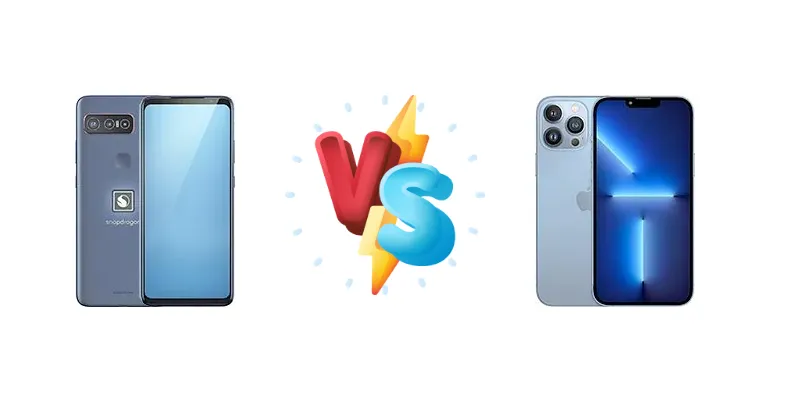
|
🏆 Quick Verdict
For the average user prioritizing a seamless experience and long-term software support, the iPhone 13 Pro Max remains the stronger choice. However, the Asus Smartphone for Snapdragon Insiders delivers a compelling alternative for Android enthusiasts and mobile gamers who value raw processing power and faster charging speeds.
| PHONES | ||
|---|---|---|
| Phone Names | Asus Smartphone for Snapdragon Insiders | Apple iPhone 13 Pro Max |
| Network | ||
|---|---|---|
| 2G bands | GSM 850 / 900 / 1800 / 1900 | GSM 850 / 900 / 1800 / 1900 |
| 3G bands | HSDPA 800 / 850 / 900 / 1700(AWS) / 1900 / 2100 | HSDPA 850 / 900 / 1700(AWS) / 1900 / 2100 |
| 4G bands | 1, 2, 3, 4, 5, 7, 8, 11, 12, 13, 14, 17, 18, 19, 20, 21, 25, 26, 28, 29, 30, 32, 34, 38, 39, 40, 41, 42, 43, 46, 48, 66, 71 | 1, 2, 3, 4, 5, 7, 8, 12, 13, 17, 18, 19, 20, 25, 26, 28, 30, 32, 34, 38, 39, 40, 41, 42, 46, 48, 66 - A2643, A2644, A2645 |
| 5G bands | 1, 2, 3, 5, 7, 8, 11, 12, 13, 14, 18, 20, 21, 25, 26, 28, 30, 38, 40, 41, 42, 43, 46, 48, 66, 71, 77, 78, 79, 257, 258, 260, 261 SA/NSA/Sub6/mmWave | 1, 2, 3, 5, 7, 8, 12, 20, 25, 28, 30, 38, 40, 41, 48, 66, 77, 78, 79 SA/NSA/Sub6 - A2643, A2644 |
| Speed | HSPA 42.2/5.76 Mbps, LTE (6CA) Cat20 2000/150 Mbps, 5G | HSPA, LTE, 5G, EV-DO Rev.A 3.1 Mbps |
| Technology | GSM / HSPA / LTE / 5G | GSM / CDMA / HSPA / EVDO / LTE / 5G |
| - | 1, 2, 3, 5, 7, 8, 12, 20, 25, 28, 29, 30, 38, 40, 41, 48, 66, 71, 77, 78, 79 SA/NSA/Sub6 - A2641 | |
| Launch | ||
|---|---|---|
| Announced | 2021, July 08 | 2021, September 14 |
| Status | Available. Released 2021, August 31 | Available. Released 2021, September 24 |
| Body | ||
|---|---|---|
| Build | - | Glass front, glass back, stainless steel frame |
| Dimensions | 173.2 x 77.3 x 9.6 mm (6.82 x 3.04 x 0.38 in) | 160.8 x 78.1 x 7.7 mm (6.33 x 3.07 x 0.30 in) |
| SIM | Nano-SIM + Nano-SIM | · Nano-SIM + eSIM· Nano-SIM + Nano-SIM |
| Weight | 210 g (7.41 oz) | 240 g (8.47 oz) |
| - | IP68 dust/water resistant (up to 6m for 30 min) Apple Pay (Visa, MasterCard, AMEX certified) | |
| Display | ||
|---|---|---|
| Protection | Corning Gorilla Glass Victus | Ceramic Shield glass |
| Resolution | 1080 x 2400 pixels (~395 ppi density) | 1284 x 2778 pixels, 19.5:9 ratio (~458 ppi density) |
| Size | 6.78 inches, 109.5 cm2 (~81.8% screen-to-body ratio) | 6.7 inches, 109.8 cm2 (~87.4% screen-to-body ratio) |
| Type | Super AMOLED, 144Hz, HDR10+, 800 nits (HBM), 1200 nits (peak) | Super Retina XDR OLED, 120Hz, HDR10, Dolby Vision, 1000 nits (HBM), 1200 nits (peak) |
| Always-on display | - | |
| Platform | ||
|---|---|---|
| CPU | Octa-core (1x2.84 GHz Cortex-X1 & 3x2.42 GHz Cortex-A78 & 4x1.80 GHz Cortex-A55) | Hexa-core (2x3.23 GHz Avalanche + 4x1.82 GHz Blizzard) |
| Chipset | Qualcomm SM8350 Snapdragon 888 5G (5 nm) | Apple A15 Bionic (5 nm) |
| GPU | Adreno 660 | Apple GPU (5-core graphics) |
| OS | Android 11 | iOS 15, upgradable to iOS 26.1 |
| Memory | ||
|---|---|---|
| Card slot | No | No |
| Internal | 512GB 16GB RAM | 128GB 6GB RAM, 256GB 6GB RAM, 512GB 6GB RAM, 1TB 6GB RAM |
| UFS 3.1 | NVMe | |
| Main Camera | ||
|---|---|---|
| Features | Dual-LED flash, HDR, panorama | Dual-LED dual-tone flash, HDR (photo/panorama) |
| Single | - | 12 MP, f/2.2, 23mm (wide), 1/3.6" SL 3D, (depth/biometrics sensor) |
| Triple | 64 MP, f/1.8, 26mm (wide), 1/1.73", 0.8µm, PDAF, OIS 8 MP, f/2.4, 80mm (telephoto), PDAF, 3x optical zoom, OIS 12 MP, f/2.2, 112˚, 14mm (ultrawide), 1/2.55", 1.4µm, dual pixel PDAF | 12 MP, f/1.5, 26mm (wide), 1/1.7", 1.9µm, dual pixel PDAF, sensor-shift OIS 12 MP, f/2.8, 77mm (telephoto), PDAF, 1/3.4", 1.0µm, OIS, 3x optical zoom 12 MP, f/1.8, 13mm, 120˚ (ultrawide), 1/3.4", 1.0µm, PDAF TOF 3D LiDAR scanner (depth) |
| Video | 8K@30fps, 4K@30/60fps, 1080p@30/60fps, gyro-EIS, HDR | 4K@24/25/30/60fps, 1080p@25/30/60/120/240fps, 10-bit HDR, Dolby Vision HDR (up to 60fps), ProRes, stereo sound rec. |
| Selfie camera | ||
|---|---|---|
| Features | HDR | HDR |
| Single | 24 MP, f/2.5, 27mm (wide), 0.9µm | 12 MP, f/2.2, 23mm (wide), 1/3.6", 1.0µm SL 3D, (depth/biometrics sensor) |
| Video | 1080p@30fps | 4K@24/25/30/60fps, 1080p@25/30/60/120fps, gyro-EIS |
| Sound | ||
|---|---|---|
| 3.5mm jack | No | No |
| 35mm jack | No | No |
| Loudspeaker | Yes, with stereo speakers | Yes, with stereo speakers |
| Snapdragon Sound Technology 32-bit/384kHz audio | - | |
| Comms | ||
|---|---|---|
| Bluetooth | 5.2, A2DP, LE, aptX HD, aptX Adaptive | 5.0, A2DP, LE |
| NFC | Yes | Yes |
| Positioning | GPS (L1+L5), GLONASS (L1), BDS (B1I+B1c+B2a), GALILEO (E1+E5a), QZSS (L1+L5), NavIC (L5) | GPS, GLONASS, GALILEO, BDS, QZSS |
| Radio | No | No |
| USB | USB Type-C | Lightning, USB 2.0 |
| WLAN | Wi-Fi 802.11 a/b/g/n/ac/6e, dual-band, Wi-Fi Direct | Wi-Fi 802.11 a/b/g/n/ac/6, dual-band, hotspot |
| Features | ||
|---|---|---|
| Sensors | Fingerprint (rear-mounted, ultrasonic), accelerometer, gyro, proximity, compass | Face ID, accelerometer, gyro, proximity, compass, barometer |
| Illuminated Snapdragon fireball icon on the back | Ultra Wideband (UWB) support | |
| Battery | ||
|---|---|---|
| Charging | 65W wired, PD3.0, QC5, 50% in 30 min, 100% in 50 min | Wired, PD2.0, 50% in 30 min 15W wireless (MagSafe) 15W wireless (Qi2) - requires iOS 17.2 update |
| Type | Li-Po 4000 mAh | Li-Ion 4352 mAh (16.75 Wh) |
| Misc | ||
|---|---|---|
| Colors | Midnight blue | Graphite, Gold, Silver, Sierra Blue, Alpine Green |
| Models | I007D | A2643, A2484, A2641, A2644, A2645, iphone14,3 |
| Price | About 1270 EUR | € 423.38 / $ 394.86 / £ 355.00 |
| SAR | - | 1.18 W/kg (head) 1.20 W/kg (body) |
| SAR EU | - | 0.99 W/kg (head) 0.98 W/kg (body) |
| Tests | ||
|---|---|---|
| Battery life | - | Endurance rating 121h |
| Camera | - | Photo / Video |
| Display | - | Contrast ratio: Infinite (nominal) |
| Loudspeaker | - | -24.0 LUFS (Very good) |
| Performance | - | AnTuTu: 801691 (v9) GeekBench: 4706 (v5.1) GFXBench: 60fps (ES 3.1 onscreen) |
Asus Smartphone for Snapdragon Insiders
- Significantly faster 65W wired charging
- Raw Snapdragon 888 processing power
- Android customization options
- Potential for thermal throttling under heavy load
- Less refined software experience compared to iOS
- Uncertainty regarding long-term software support
Apple iPhone 13 Pro Max
- Optimized A15 Bionic performance and efficiency
- Superior camera system and image processing
- Long-term software support and ecosystem integration
- Slower wired and wireless charging speeds
- Less customization options compared to Android
- Ecosystem lock-in
Display Comparison
The iPhone 13 Pro Max boasts a measured peak brightness of 1050 nits, ensuring excellent visibility even in direct sunlight. While the Asus phone’s display specs aren’t provided, its target audience suggests a high-refresh-rate panel is likely, potentially offering smoother scrolling and gaming. The iPhone’s infinite contrast ratio, typical of OLED displays, delivers deep blacks and vibrant colors. The absence of PWM frequency data for the Asus phone means we can’t assess potential flicker-related eye strain, a factor the iPhone likely addresses well with its advanced display technology.
Camera Comparison
Both devices excel in photography and videography, but approach it differently. The iPhone 13 Pro Max is known for its computational photography prowess, delivering consistently excellent results with minimal user intervention. The Asus phone’s camera specs are not detailed, but given its focus on performance, it likely prioritizes image processing speed. The iPhone’s sensor-shift stabilization and advanced video codecs provide a significant advantage for videographers. Without knowing the Asus phone’s sensor sizes and lens apertures, a direct comparison is difficult, but Apple’s established camera system and software algorithms give it a clear edge in image quality and versatility.
Performance
The core difference lies in the chipsets. The Asus utilizes the Qualcomm Snapdragon 888 5G (5nm), featuring an octa-core configuration with a Cortex-X1 prime core clocked at 2.84 GHz. The iPhone 13 Pro Max, however, is powered by the Apple A15 Bionic (5nm), a hexa-core chip with Avalanche and Blizzard cores clocked up to 3.23 GHz. While core count isn’t everything, Apple’s custom silicon consistently demonstrates superior single-core performance, crucial for responsive app launches and smooth multitasking. The Snapdragon 888, while powerful, is known to generate more heat under sustained load, potentially leading to thermal throttling. The Asus phone’s reliance on LPDDR5 RAM (spec not provided) is standard, but Apple’s memory bandwidth optimization within the A15 Bionic contributes to its overall performance advantage.
Battery Life
Both phones achieve an impressive endurance rating of 121 hours, suggesting similar real-world battery life despite potentially different battery capacities. However, the charging experience differs dramatically. The Asus Smartphone for Snapdragon Insiders supports 65W wired charging, achieving 50% charge in 30 minutes and 100% in 50 minutes. The iPhone 13 Pro Max is limited to slower wired charging (PD2.0) with a 50% charge in 30 minutes, and offers 15W wireless charging via MagSafe and Qi2 (requiring iOS 17.2). The Asus phone’s significantly faster charging is a major advantage for users who frequently need to top up their battery quickly.
Buying Guide
Buy the Asus Smartphone for Snapdragon Insiders if you need maximum Android performance, prioritize 65W fast charging, and enjoy tinkering with software customization. Buy the Apple iPhone 13 Pro Max if you prefer a polished, user-friendly experience, value long-term software updates, and are deeply invested in the Apple ecosystem.