
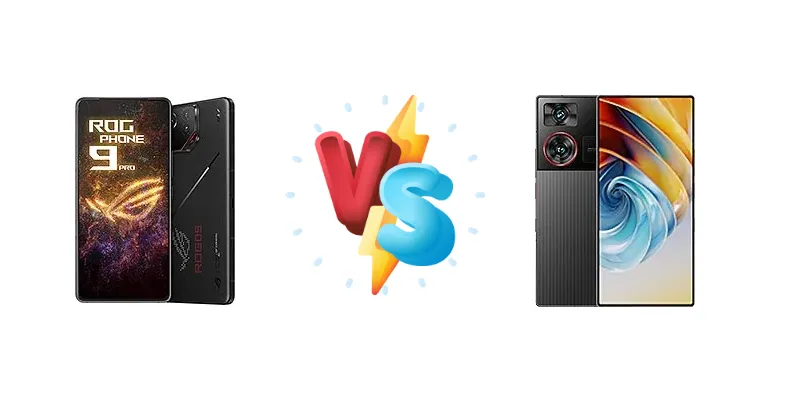
Asus ROG Phone 9 Pro vs. ZTE nubia Z60 Ultra: A Deep Dive into Gaming and Charging Champions
| Phones Images | |||||
|---|---|---|---|---|---|
|
🏆 Quick Verdict
For dedicated mobile gamers prioritizing sustained performance and battery life, the Asus ROG Phone 9 Pro is the clear winner. Its Snapdragon 8 Elite and 16:41 active use score provide a superior gaming experience. However, the ZTE nubia Z60 Ultra appeals to users who value rapid charging and a more conventional flagship form factor.
| PHONES | ||
|---|---|---|
| Phone Names | Asus ROG Phone 9 Pro | ZTE nubia Z60 Ultra Leading |
| Network | ||
|---|---|---|
| 2G bands | GSM 850 / 900 / 1800 / 1900 | GSM 850 / 900 / 1800 / 1900 |
| 3G bands | HSDPA 800 / 850 / 900 / 1700(AWS) / 1900 / 2100 - Global | HSDPA 850 / 900 / 1700(AWS) / 1900 / 2100 |
| 4G bands | 1, 2, 3, 4, 5, 7, 8, 12, 17, 18, 19, 20, 25, 26, 28, 32, 34, 38, 39, 40, 41, 42, 43, 48, 66 - International | 1, 2, 3, 4, 5, 7, 8, 12, 17, 18, 19, 20, 26, 28, 34, 38, 39, 40, 41, 66 - International |
| 5G bands | 1, 2, 3, 5, 7, 8, 12, 18, 20, 25, 26, 28, 38, 40, 41, 48, 66, 77, 78, 79 SA/NSA/Sub6 - International | 1, 2, 3, 5, 7, 8, 28, 38, 40, 41, 66, 77, 78 SA/NSA - International |
| Speed | HSPA, LTE (Up to 7CA), 5G | HSPA, LTE, 5G |
| Technology | GSM / HSPA / LTE / 5G | GSM / CDMA / HSPA / CDMA2000 / LTE / 5G |
| Launch | ||
|---|---|---|
| Announced | 2024, November 19 | 2024, July 23 |
| Status | Available. Released 2024, November 20 | Available. Released 2024, August 12 |
| Body | ||
|---|---|---|
| Build | Glass front (Gorilla Glass Victus 2), glass back (Gorilla Glass), aluminum frame | Glass front, aluminum frame, glass back |
| Dimensions | 163.8 x 76.8 x 8.9 mm (6.45 x 3.02 x 0.35 in) | 164 x 76.4 x 8.8 mm (6.46 x 3.01 x 0.35 in) |
| SIM | · Nano-SIM + eSIM· Nano-SIM + Nano-SIM | Nano-SIM + Nano-SIM |
| Weight | 227 g (8.01 oz) | 246 g (8.68 oz) |
| Display | ||
|---|---|---|
| Protection | Corning Gorilla Glass Victus 2 | - |
| Resolution | 1080 x 2400 pixels, 20:9 ratio (~388 ppi density) | 1116 x 2480 pixels, 20:9 ratio (~400 ppi density) |
| Size | 6.78 inches, 111.0 cm2 (~88.2% screen-to-body ratio) | 6.8 inches, 111.6 cm2 (~89.1% screen-to-body ratio) |
| Type | LTPO AMOLED, 1B colors, 185Hz, 670Hz PWM, HDR10, 1600 nits (HBM), 2500 nits (peak) | AMOLED, 1B colors, 120Hz, HDR10, 1500 nits (peak) |
| Platform | ||
|---|---|---|
| CPU | Octa-core (2x4.32 GHz Oryon V2 Phoenix L + 6x3.53 GHz Oryon V2 Phoenix M) | Octa-core (1x3.4 GHz Cortex-X4 & 3x3.2 GHz Cortex-A720 & 2x3.0 GHz Cortex-A720 & 2x2.3 GHz Cortex-A520) |
| Chipset | Qualcomm SM8750-AB Snapdragon 8 Elite (3 nm) | Qualcomm SM8650-AC Snapdragon 8 Gen 3 (4 nm) |
| GPU | Adreno 830 | Adreno 750 (1 GHz) |
| OS | Android 15, up to 2 major Android upgrades | Android 14, MyOS 14 (International), MyOS 14.5 (China) |
| Memory | ||
|---|---|---|
| Card slot | No | No |
| Internal | 512GB 16GB RAM, 1TB 24GB RAM | 256GB 8GB RAM, 256GB 12GB RAM, 512GB 16GB RAM, 1TB 16GB RAM, 1TB 24GB RAM |
| Main Camera | ||
|---|---|---|
| Features | LED flash, HDR, panorama | Laser AF, color spectrum sensor, Ring-LED, dual-tone flash, panorama, HDR |
| Triple | 50 MP, f/1.9, 24mm (wide), 1/1.56", 1.0µm, PDAF, gimbal OIS 32 MP, f/2.4, (telephoto), 1/3.2", 0.7µm, PDAF, OIS, 3x optical zoom 13 MP, f/2.2, 13mm, 120˚ (ultrawide) | 50 MP, f/1.6, 35mm (standard), 1/1.56", 1.0µm, PDAF, OIS 64 MP, f/3.3, 85mm (periscope telephoto), 1/2.0", PDAF, OIS, 3.3x optical zoom (vs. 26mm cam) 50 MP, f/1.8, 18mm, 100˚ (ultrawide), 1/1.55", 1.0µm, PDAF, OIS |
| Video | 8K@30fps, 4K@30/60/120fps, 1080p@30/60/120/240fps, 720p@480fps; gyro-EIS, HDR10+ | 8K@30fps, 4K@30/60/120fps, 1080p@30/60fps, gyro-EIS, HDR10, 10‑bit video |
| Selfie camera | ||
|---|---|---|
| Features | Panorama, HDR | HDR |
| Single | 32 MP, f/2.5, 22mm (wide), 1/3.2", 0.7µm | 12 MP, under display |
| Video | 1080p@30fps | 1080p@30fps |
| Sound | ||
|---|---|---|
| 35mm jack | Yes | No |
| Loudspeaker | Yes, with stereo speakers | Yes, with stereo speakers |
| Comms | ||
|---|---|---|
| Bluetooth | 5.4, A2DP, LE, aptX HD, aptX Adaptive, aptX Lossless | 5.4, A2DP, LE, aptX HD, aptX Adaptive, aptX Lossless |
| Infrared port | - | Yes |
| NFC | Yes | Yes (market/region dependent) |
| Positioning | GPS (L1+L5), BDS (B1I+B1c+B2a), GALILEO (E1+E5a), QZSS (L1+L5), NavIC (L5), GLONASS | GPS (L1+L2+L5), GLONASS (G1+G5), BDS (B1I+B1C+B2a+B2b), GALILEO (E1+E5a), QZSS (L1+L5) |
| Radio | No | No |
| USB | USB Type-C (side), DisplayPort 1.4; USB Type-C (bottom), OTG | USB Type-C 3.1, OTG |
| WLAN | Wi-Fi 802.11 a/b/g/n/ac/6e/7, tri-band, Wi-Fi Direct | Wi-Fi 802.11 a/b/g/n/ac/6e/7, dual-band, Wi-Fi Direct |
| Features | ||
|---|---|---|
| Sensors | Fingerprint (under display, optical), accelerometer, gyro, proximity, compass | Fingerprint (under display, optical), accelerometer, gyro, proximity, compass |
| Battery | ||
|---|---|---|
| Charging | 65W wired, PD3.0, PPS, QC5, 100% in 46 min 15W wireless (Qi) 10W reverse wired | 80W wired, PD3.0, QC4 |
| Type | 5800 mAh | Li-Po 6000 mAh |
| Misc | ||
|---|---|---|
| Colors | Phantom Black | Black, Silver |
| Models | AI2501-16G512G-BK, AI2501-24G1T-BK | - |
| Price | € 1,139.00 / $ 1,290.00 / £ 1,224.17 | About 730 EUR |
Asus ROG Phone 9 Pro
- Superior gaming performance with Snapdragon 8 Elite
- Exceptional battery life (16:41h active use)
- Faster wireless and reverse wired charging
- Gamer-centric design may not appeal to everyone
- Potentially bulkier form factor
ZTE nubia Z60 Ultra Leading
- Faster wired charging (80W)
- Sleek and modern flagship design
- Potentially more versatile camera system
- Shorter battery life (14:04h active use)
- Lacks wireless and reverse wired charging
Display Comparison
The Asus ROG Phone 9 Pro boasts a display capable of reaching 1958 nits of peak brightness, ensuring excellent visibility even in direct sunlight. While the nubia Z60 Ultra’s display specs aren’t provided, ZTE typically employs high-quality panels. The ROG Phone’s focus on gaming suggests a potentially higher refresh rate and lower response time, crucial for competitive play. The ROG Phone’s display technology is likely optimized for color accuracy and low latency, enhancing the visual experience for gamers.
Camera Comparison
Without detailed camera specifications for the nubia Z60 Ultra, a direct comparison is limited. However, both phones likely feature flagship-level camera systems. The ROG Phone 9 Pro, while gaming-focused, typically includes capable cameras. The nubia Z60 Ultra, given ZTE’s history, likely prioritizes image quality and features. The absence of information regarding sensor sizes and lens apertures makes a definitive judgment impossible, but the nubia Z60 Ultra may offer a more versatile camera experience for general photography.
Performance
The core difference lies in the chipsets. The Asus ROG Phone 9 Pro utilizes the Qualcomm SM8750-AB Snapdragon 8 Elite (3nm), featuring a unique octa-core configuration with Oryon V2 Phoenix cores clocked up to 4.32 GHz. This architecture is designed for sustained peak performance, crucial for demanding games. The ZTE nubia Z60 Ultra, powered by the Snapdragon 8 Gen 3 (4nm), employs a more conventional octa-core setup with Cortex-X4 and Cortex-A720 cores peaking at 3.4 GHz. While the Gen 3 is powerful, the 3nm process and Oryon architecture of the Snapdragon 8 Elite in the ROG Phone 9 Pro likely provide superior thermal efficiency and sustained performance under heavy load. The ROG Phone’s focus on gaming also suggests optimized thermal management solutions.
Battery Life
The Asus ROG Phone 9 Pro achieves an impressive 16:41 hours of active use, demonstrating exceptional battery life. This is likely due to the efficient Snapdragon 8 Elite chipset and optimized power management. The ZTE nubia Z60 Ultra offers 14:04 hours of active use, a respectable figure but noticeably less than the ROG Phone. However, the nubia Z60 Ultra compensates with significantly faster charging – 80W wired versus 65W on the ROG Phone. The ROG Phone 9 Pro also supports 15W wireless and 10W reverse wired charging, features absent in the nubia Z60 Ultra’s provided specs. The nubia Z60 Ultra’s 80W charging can replenish the battery faster, minimizing downtime.
Buying Guide
Buy the Asus ROG Phone 9 Pro if you need uncompromising gaming performance, exceptional battery endurance for extended play sessions, and are willing to accept a more gamer-centric design. Buy the ZTE nubia Z60 Ultra Leading if you prefer a sleek, modern flagship with incredibly fast 80W charging, and prioritize a balance between performance and everyday usability over raw gaming power.