
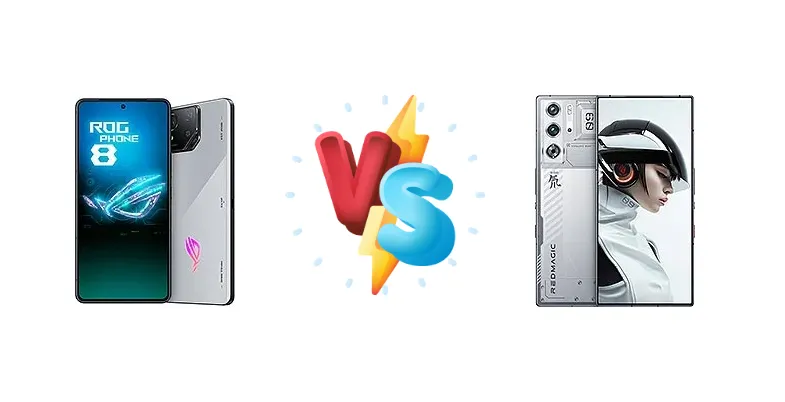
Asus ROG Phone 8 vs. ZTE nubia RedMagic 9 Pro+: Which Gaming Beast Reigns Supreme?
| Phones Images | |||||
|---|---|---|---|---|---|
|
🏆 Quick Verdict
For the average gamer prioritizing a balanced experience with wider availability, the Asus ROG Phone 8 is the better choice. Its more refined software, broader feature set, and international 65W charging offer a more complete package. However, the RedMagic 9 Pro+’s blistering 165W charging is unmatched for those who value minimizing downtime.
| PHONES | ||
|---|---|---|
| Phone Names | Asus ROG Phone 8 | ZTE nubia RedMagic 9 Pro+ |
| Network | ||
|---|---|---|
| 2G bands | GSM 850 / 900 / 1800 / 1900 | GSM 850 / 900 / 1800 / 1900 |
| 3G bands | HSDPA 850 / 900 / 1700(AWS) / 1800 / 1900 / 2100 - International | HSDPA 850 / 900 / 1700(AWS) / 1900 / 2100 |
| 4G bands | 1, 2, 3, 4, 5, 7, 8, 12, 17, 18, 19, 20, 25, 26, 28, 32, 34, 38, 39, 40, 41, 42, 43, 48, 66 - International | LTE |
| 5G bands | 1, 2, 3, 5, 7, 8, 12, 18, 20, 25, 26, 28, 38, 40, 41, 48, 66, 77, 78, 79 SA/NSA/Sub6 - International | SA/NSA |
| Speed | HSPA, LTE (Up to 7CA), 5G | HSPA, LTE, 5G |
| Technology | GSM / CDMA / HSPA / LTE / 5G | GSM / CDMA / HSPA / EVDO / LTE / 5G |
| Launch | ||
|---|---|---|
| Announced | 2024, January 08 | 2023, November 23 |
| Status | Available. Released 2024, January 18 | Available. Released 2023, November 23 |
| Body | ||
|---|---|---|
| Build | Glass front (Gorilla Glass Victus 2), glass back (Gorilla Glass), aluminum frame | Glass front (Gorilla Glass 5), aluminum frame, glass back |
| Dimensions | 163.8 x 76.8 x 8.9 mm (6.45 x 3.02 x 0.35 in) | 164 x 76.4 x 8.9 mm (6.46 x 3.01 x 0.35 in) |
| SIM | Nano-SIM + Nano-SIM | Nano-SIM + Nano-SIM |
| Weight | 225 g (7.94 oz) | 229 g (8.08 oz) |
| Display | ||
|---|---|---|
| Protection | Corning Gorilla Glass Victus 2 | Corning Gorilla Glass 5 |
| Resolution | 1080 x 2400 pixels, 20:9 ratio (~388 ppi density) | 1116 x 2480 pixels, 20:9 ratio (~400 ppi density) |
| Size | 6.78 inches, 111.0 cm2 (~88.2% screen-to-body ratio) | 6.8 inches, 111.6 cm2 (~89.1% screen-to-body ratio) |
| Type | LTPO AMOLED, 1B colors, 165Hz, HDR10, 1600 nits (HBM), 2500 nits (peak) | AMOLED, 1B colors, 120Hz, 1600 nits (peak) |
| Platform | ||
|---|---|---|
| CPU | Octa-core (1x3.3 GHz Cortex-X4 & 3x3.2 GHz Cortex-A720 & 2x3.0 GHz Cortex-A720 & 2x2.3 GHz Cortex-A520) | Octa-core (1x3.3 GHz Cortex-X4 & 3x3.2 GHz Cortex-A720 & 2x3.0 GHz Cortex-A720 & 2x2.3 GHz Cortex-A520) |
| Chipset | Qualcomm SM8650-AB Snapdragon 8 Gen 3 (4 nm) | Qualcomm SM8650-AB Snapdragon 8 Gen 3 (4 nm) |
| GPU | Adreno 750 | Adreno 750 |
| OS | Android 14, up to 2 major Android upgrades | Android 14, Redmagic OS 9 |
| Memory | ||
|---|---|---|
| Card slot | No | No |
| Internal | 256GB 12GB RAM, 256GB 16GB RAM | 256GB 16GB RAM, 512GB 16GB RAM, 1TB 24GB RAM |
| Main Camera | ||
|---|---|---|
| Features | LED flash, HDR, panorama | LED flash, HDR, panorama |
| Triple | - International model - 50 MP, f/1.9, 24mm (wide), 1/1.56", 1.0µm, PDAF, gimbal OIS 32 MP, f/2.4, (telephoto), 1/3.2", 0.7µm, PDAF, OIS, 3x optical zoom 13 MP, f/2.2, 13mm, 120˚ (ultrawide), 1/3.0", 1.12µm - SEA/China/India model - 50 MP, f/1.9, 24mm (wide), 1/1.56", 1.0µm, PDAF, gimbal OIS 13 MP, f/2.2, 13mm, 120˚ (ultrawide), 1/3.0", 1.12µm 5 MP (macro) | 50 MP, (wide), 1/1.57", 1.0µm, PDAF, OIS 50 MP, f/2.2, (ultrawide), 1/2.76", 0.64µm 2 MP (macro) |
| Video | 8K@24fps, 4K@30/60fps, 1080p@30/60/120/240fps, 720p@480fps; gyro-EIS, HDR10+ | 8K@30fps, 4K@30/60fps, 1080p@30/60/120/240fps |
| Selfie camera | ||
|---|---|---|
| Features | Panorama, HDR | HDR |
| Single | 32 MP, f/2.5, 22mm (wide), 1/3.2", 0.7µm | 16 MP, f/2.0, (wide), 1.12µm, under display |
| Video | 1080p@30fps | 1080p@30/60fps |
| Sound | ||
|---|---|---|
| 35mm jack | Yes | Yes |
| Loudspeaker | Yes, with stereo speakers | Yes, with stereo speakers |
| Comms | ||
|---|---|---|
| Bluetooth | 5.4, A2DP, LE, aptX HD, aptX Adaptive, aptX Lossless | 5.3, A2DP, LE, aptX HD, aptX Adaptive, aptX Lossless |
| Infrared port | - | Yes |
| NFC | Yes | Yes (market/region dependent) |
| Positioning | GPS (L1+L5), BDS (B1I+B1c+B2a), GALILEO (E1+E5a), QZSS (L1+L5), NavIC (L5), GLONASS | GPS (L1+L5), GLONASS, BDS, GALILEO |
| Radio | No | No |
| USB | USB Type-C (side), DisplayPort 1.4; USB Type-C (bottom), OTG | USB Type-C 3.2 Gen 2, OTG, accessory connector, DisplayPort |
| WLAN | Wi-Fi 802.11 a/b/g/n/ac/6e/7, tri-band, Wi-Fi Direct | Wi-Fi 802.11 a/b/g/n/ac/6e/7, tri-band, Wi-Fi Direct |
| Features | ||
|---|---|---|
| Sensors | Fingerprint (under display, optical), accelerometer, gyro, proximity, compass | Fingerprint (under display, optical), accelerometer, gyro, proximity, compass |
| Battery | ||
|---|---|---|
| Charging | 65W wired, PD3.0, PPS, QC5, 100% in 39 min - International 30W wired, PD3.0, PPS - India 15W wireless (Qi) 10W reverse wired | 165W wired, PD3.0, 100% in 16 min |
| Type | 5500 mAh | Li-Ion 5500 mAh |
| Misc | ||
|---|---|---|
| Colors | Phantom Black, Rebel Grey | Sleet (Black), Snowfall (Silver), Cyclone (Transparent Black) |
| Models | AI2401, AI2401_A | - |
| Price | € 879.99 | About 710 EUR |
Asus ROG Phone 8
- More versatile software features
- Wider international availability and support
- Wireless charging and reverse wired charging
- Slower charging speed (65W/30W)
- Potentially less aggressive cooling
ZTE nubia RedMagic 9 Pro+
- Blazing-fast 165W wired charging
- Aggressive cooling system for sustained performance
- Potentially larger screen-to-body ratio
- Lacks wireless charging
- Potentially less refined software experience
Display Comparison
Both phones utilize the Snapdragon 8 Gen 3’s capabilities to drive high-refresh-rate displays, but details beyond that are missing. Given the ROG Phone’s history, it likely features a higher PWM dimming rate for reduced flicker, benefiting users sensitive to screen flicker. The RedMagic 9 Pro+ often prioritizes maximizing screen real estate, potentially resulting in slightly smaller bezels. Color accuracy will likely be excellent on both, but the ROG Phone may offer more granular calibration options within its gaming-focused software.
Camera Comparison
Camera details are absent from the provided data. However, given the market positioning, the ROG Phone 8 is likely to offer a more versatile camera system with a focus on everyday photography, while the RedMagic 9 Pro+ may prioritize video recording capabilities for streaming. Both will likely feature capable main sensors, but the ROG Phone may include additional lenses (ultrawide, telephoto) for greater flexibility. Image processing styles will also differ, with Asus aiming for more natural colors and the RedMagic potentially favoring a more vibrant look.
Performance
Both the Asus ROG Phone 8 and ZTE nubia RedMagic 9 Pro+ are powered by the Qualcomm SM8650-AB Snapdragon 8 Gen 3 (4 nm) with an identical CPU configuration – 1x3.3 GHz Cortex-X4, 3x3.2 GHz Cortex-A720, 2x3.0 GHz Cortex-A720, and 2x2.3 GHz Cortex-A520. This means raw processing power will be nearly identical. The key differentiator will be thermal management. RedMagic phones are renowned for their aggressive cooling solutions, potentially allowing for sustained peak performance for longer durations. Asus typically employs a more balanced approach, prioritizing sustained performance *and* preventing localized hotspots. RAM speed (likely LPDDR5x on both) is not specified, but will contribute to overall system responsiveness.
Battery Life
The most significant difference lies in charging speed. The ZTE nubia RedMagic 9 Pro+ boasts a staggering 165W wired charging, capable of fully charging the device in just 16 minutes. In contrast, the Asus ROG Phone 8 offers 65W wired charging (International) or 30W (India), taking approximately 39 minutes for a full charge. While the ROG Phone 8 includes 15W wireless charging and 10W reverse wired charging, the RedMagic 9 Pro+ lacks wireless charging. The faster charging of the RedMagic 9 Pro+ is a game-changer for users who frequently top up their battery throughout the day, while the ROG Phone 8 offers more versatile charging options.
Buying Guide
Buy the Asus ROG Phone 8 if you need a phone with a more polished software experience, reliable international support, and a versatile feature set beyond just gaming. It’s ideal for users who want a flagship phone that *also* excels at gaming. Buy the ZTE nubia RedMagic 9 Pro+ if you prioritize absolute charging speed above all else, and are comfortable with a more gaming-centric, potentially less refined software experience. This phone is for the gamer who needs to get back into the action as quickly as possible.