
Asus ROG Phone 8 vs. Samsung Galaxy S24 Ultra: Which Flagship Reigns Supreme?
| Phones Images | |||||
|---|---|---|---|---|---|
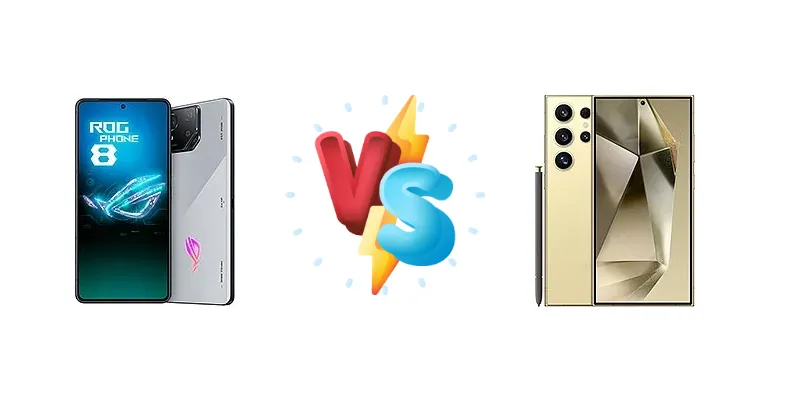
|
🏆 Quick Verdict
For the average user, the Samsung Galaxy S24 Ultra is the more compelling choice. Its superior camera system, longer battery life, and broader feature set offer a more well-rounded experience. However, dedicated mobile gamers will find the ROG Phone 8’s optimized performance and gaming-centric features invaluable.
| PHONES | ||
|---|---|---|
| Phone Names | Asus ROG Phone 8 | Samsung Galaxy S24 Ultra |
| Network | ||
|---|---|---|
| 2G bands | GSM 850 / 900 / 1800 / 1900 | GSM 850 / 900 / 1800 / 1900 |
| 3G bands | HSDPA 850 / 900 / 1700(AWS) / 1800 / 1900 / 2100 - International | HSDPA 850 / 900 / 1700(AWS) / 1900 / 2100 |
| 4G bands | 1, 2, 3, 4, 5, 7, 8, 12, 17, 18, 19, 20, 25, 26, 28, 32, 34, 38, 39, 40, 41, 42, 43, 48, 66 - International | 1, 2, 3, 4, 5, 7, 8, 12, 13, 17, 18, 19, 20, 25, 26, 28, 32, 38, 39, 40, 41, 66 - International |
| 5G bands | 1, 2, 3, 5, 7, 8, 12, 18, 20, 25, 26, 28, 38, 40, 41, 48, 66, 77, 78, 79 SA/NSA/Sub6 - International | 1, 2, 3, 5, 7, 8, 12, 20, 25, 26, 28, 38, 40, 41, 66, 75, 77, 78 SA/NSA/Sub6 - International |
| Speed | HSPA, LTE (Up to 7CA), 5G | HSPA, LTE (up to 7CA), 5G |
| Technology | GSM / CDMA / HSPA / LTE / 5G | GSM / CDMA / HSPA / EVDO / LTE / 5G |
| Launch | ||
|---|---|---|
| Announced | 2024, January 08 | 2024, January 17 |
| Status | Available. Released 2024, January 18 | Available. Released 2024, January 24 |
| Body | ||
|---|---|---|
| Build | Glass front (Gorilla Glass Victus 2), glass back (Gorilla Glass), aluminum frame | Glass front (Corning Gorilla Armor), glass back (Corning Gorilla Armor), titanium frame (grade 2) |
| Dimensions | 163.8 x 76.8 x 8.9 mm (6.45 x 3.02 x 0.35 in) | 162.3 x 79 x 8.6 mm (6.39 x 3.11 x 0.34 in) |
| SIM | Nano-SIM + Nano-SIM | · Nano-SIM + Nano-SIM + eSIM + eSIM (max 2 at a time) - INT· Nano-SIM + eSIM + eSIM (max 2 at a time) - USA· Nano-SIM + Nano-SIM - CN |
| Weight | 225 g (7.94 oz) | 232 g or 233 g (8.18 oz) |
| Display | ||
|---|---|---|
| Protection | Corning Gorilla Glass Victus 2 | Corning Gorilla Armor |
| Resolution | 1080 x 2400 pixels, 20:9 ratio (~388 ppi density) | 1440 x 3120 pixels, 19.5:9 ratio (~505 ppi density) |
| Size | 6.78 inches, 111.0 cm2 (~88.2% screen-to-body ratio) | 6.8 inches, 113.5 cm2 (~88.5% screen-to-body ratio) |
| Type | LTPO AMOLED, 1B colors, 165Hz, HDR10, 1600 nits (HBM), 2500 nits (peak) | Dynamic LTPO AMOLED 2X, 120Hz, HDR10+, 2600 nits (peak) |
| Platform | ||
|---|---|---|
| CPU | Octa-core (1x3.3 GHz Cortex-X4 & 3x3.2 GHz Cortex-A720 & 2x3.0 GHz Cortex-A720 & 2x2.3 GHz Cortex-A520) | 8-core (1x3.39GHz Cortex-X4 & 3x3.1GHz Cortex-A720 & 2x2.9GHz Cortex-A720 & 2x2.2GHz Cortex-A520) |
| Chipset | Qualcomm SM8650-AB Snapdragon 8 Gen 3 (4 nm) | Qualcomm SM8650-AC Snapdragon 8 Gen 3 (4 nm) |
| GPU | Adreno 750 | Adreno 750 (1 GHz) |
| OS | Android 14, up to 2 major Android upgrades | Android 14, up to 7 major Android upgrades, One UI 8.0 |
| Memory | ||
|---|---|---|
| Card slot | No | No |
| Internal | 256GB 12GB RAM, 256GB 16GB RAM | 256GB 12GB RAM, 512GB 12GB RAM, 1TB 12GB RAM |
| Main Camera | ||
|---|---|---|
| Features | LED flash, HDR, panorama | Laser AF, LED flash, auto-HDR, panorama |
| Quad | - | 200 MP, f/1.7, 24mm (wide), 1/1.3", 0.6µm, multi-directional PDAF, OIS 10 MP, f/2.4, 67mm (telephoto), 1/3.52", 1.12µm, PDAF, OIS, 3x optical zoom 50 MP, f/3.4, 111mm (periscope telephoto), 1/2.52", 0.7µm, PDAF, OIS, 5x optical zoom 12 MP, f/2.2, 13mm, 120˚ (ultrawide), 1/2.55", 1.4µm, dual pixel PDAF, Super Steady video |
| Triple | - International model - 50 MP, f/1.9, 24mm (wide), 1/1.56", 1.0µm, PDAF, gimbal OIS 32 MP, f/2.4, (telephoto), 1/3.2", 0.7µm, PDAF, OIS, 3x optical zoom 13 MP, f/2.2, 13mm, 120˚ (ultrawide), 1/3.0", 1.12µm - SEA/China/India model - 50 MP, f/1.9, 24mm (wide), 1/1.56", 1.0µm, PDAF, gimbal OIS 13 MP, f/2.2, 13mm, 120˚ (ultrawide), 1/3.0", 1.12µm 5 MP (macro) | - |
| Video | 8K@24fps, 4K@30/60fps, 1080p@30/60/120/240fps, 720p@480fps; gyro-EIS, HDR10+ | 8K@24/30fps, 4K@30/60/120fps, 1080p@30/60/120/240fps, HDR10+, stereo sound rec., gyro-EIS |
| Selfie camera | ||
|---|---|---|
| Features | Panorama, HDR | HDR, HDR10+ |
| Single | 32 MP, f/2.5, 22mm (wide), 1/3.2", 0.7µm | 12 MP, f/2.2, 26mm (wide), 1/3.2", 1.12µm, dual pixel PDAF |
| Video | 1080p@30fps | 4K@30/60fps, 1080p@30fps |
| Sound | ||
|---|---|---|
| 35mm jack | Yes | No |
| Loudspeaker | Yes, with stereo speakers | Yes, with stereo speakers |
| Comms | ||
|---|---|---|
| Bluetooth | 5.4, A2DP, LE, aptX HD, aptX Adaptive, aptX Lossless | 5.3, A2DP, LE |
| NFC | Yes | Yes |
| Positioning | GPS (L1+L5), BDS (B1I+B1c+B2a), GALILEO (E1+E5a), QZSS (L1+L5), NavIC (L5), GLONASS | GPS, GLONASS, BDS, GALILEO, QZSS |
| Radio | No | No |
| USB | USB Type-C (side), DisplayPort 1.4; USB Type-C (bottom), OTG | USB Type-C 3.2, DisplayPort 1.2, OTG |
| WLAN | Wi-Fi 802.11 a/b/g/n/ac/6e/7, tri-band, Wi-Fi Direct | Wi-Fi 802.11 a/b/g/n/ac/6e/7, tri-band, Wi-Fi Direct |
| Features | ||
|---|---|---|
| Sensors | Fingerprint (under display, optical), accelerometer, gyro, proximity, compass | Fingerprint (under display, ultrasonic), accelerometer, gyro, proximity, compass, barometer |
| Battery | ||
|---|---|---|
| Charging | 65W wired, PD3.0, PPS, QC5, 100% in 39 min - International 30W wired, PD3.0, PPS - India 15W wireless (Qi) 10W reverse wired | 45W wired, PD3.0, 65% in 30 min 15W wireless (Qi) 4.5W reverse wireless |
| Type | 5500 mAh | Li-Ion 5000 mAh |
| Misc | ||
|---|---|---|
| Colors | Phantom Black, Rebel Grey | Titanium Black, Titanium Gray, Titanium Violet, Titanium Yellow, Titanium Blue, Titanium Green, Titanium Orange |
| Models | AI2401, AI2401_A | SM-S928B, SM-S928B/DS, SM-S928U, SM-S928U1, SM-S928W, SM-S928N, SM-S9280, SM-S928E, SM-S928E/DS |
| Price | € 879.99 | $ 514.94 / C$ 929.99 / £ 630.00 / € 658.53 / ₹ 84,999 |
| SAR | - | 1.26 W/kg (head) 0.62 W/kg (body) |
| SAR EU | - | 1.06 W/kg (head) 1.30 W/kg (body) |
Asus ROG Phone 8
- Superior gaming performance and cooling
- Compact flagship form factor
- Faster wired charging (International model)
- Potentially shorter battery life
- Less versatile camera system
Samsung Galaxy S24 Ultra
- Exceptional battery life
- Top-tier camera system with versatile zoom
- Brighter and larger display
- Slower wired charging
- Larger and heavier form factor
Display Comparison
The Samsung Galaxy S24 Ultra boasts a significantly brighter display, reaching a measured 1447 nits, ensuring excellent visibility even in direct sunlight. While the ROG Phone 8’s display specs aren’t provided, Asus typically prioritizes refresh rate and color accuracy for gaming. The S24 Ultra’s panel likely utilizes LTPO technology for adaptive refresh rates, conserving battery life. The S24 Ultra’s larger screen size also benefits content consumption and multitasking, while the ROG Phone 8’s smaller size enhances portability.
Camera Comparison
The S24 Ultra is expected to feature a more sophisticated camera system, leveraging larger sensors and advanced image processing algorithms. While specific details are missing, Samsung’s history suggests a focus on computational photography and versatile zoom capabilities. The ROG Phone 8, while capable, likely prioritizes image quality for social media sharing rather than professional-grade photography. The S24 Ultra’s OIS (Optical Image Stabilization) will likely be more advanced, resulting in sharper images and smoother video recording. Ignoring the typical 2MP macro lens found on many phones, the S24 Ultra’s main sensor size and aperture will be key differentiators.
Performance
Both devices are powered by the Qualcomm SM8650-AB/AC Snapdragon 8 Gen 3 (4nm), but subtle CPU clock speed differences exist. The S24 Ultra’s CPU reaches 3.39GHz, slightly exceeding the ROG Phone 8’s 3.3 GHz peak. This difference, coupled with potentially more aggressive thermal management in the S24 Ultra, could translate to sustained performance in demanding tasks. Both utilize LPDDR5x RAM, but the ROG Phone 8’s cooling system is specifically designed to minimize thermal throttling during extended gaming sessions, potentially offsetting the S24 Ultra’s clock speed advantage. The ROG Phone 8’s focus on gaming also suggests software optimizations geared towards maximizing frame rates and minimizing latency.
Battery Life
The Samsung Galaxy S24 Ultra demonstrates a clear advantage in battery life, achieving 13:49 hours of active use. The ROG Phone 8’s battery capacity isn’t specified, but its focus on high performance likely results in faster battery drain. The S24 Ultra’s 45W wired charging is slower than the ROG Phone 8’s 65W (International) or 30W (India) charging, but the S24 Ultra’s larger battery and efficient power management compensate for this. Both support 15W wireless charging, while the ROG Phone 8 offers 10W reverse wired charging compared to the S24 Ultra’s 4.5W reverse wireless, making the ROG Phone 8 a more effective power bank for accessories.
Buying Guide
Buy the Asus ROG Phone 8 if you prioritize mobile gaming above all else, demand a compact flagship form factor, and appreciate features like AirTriggers. Buy the Samsung Galaxy S24 Ultra if you need a top-tier camera system, exceptional battery life for all-day use, and a feature-rich experience encompassing productivity, entertainment, and photography.