
Asus ROG Phone 8 vs ROG Phone 7 Ultimate: A Deep Dive into Gaming Power
| Phones Images | |||||
|---|---|---|---|---|---|
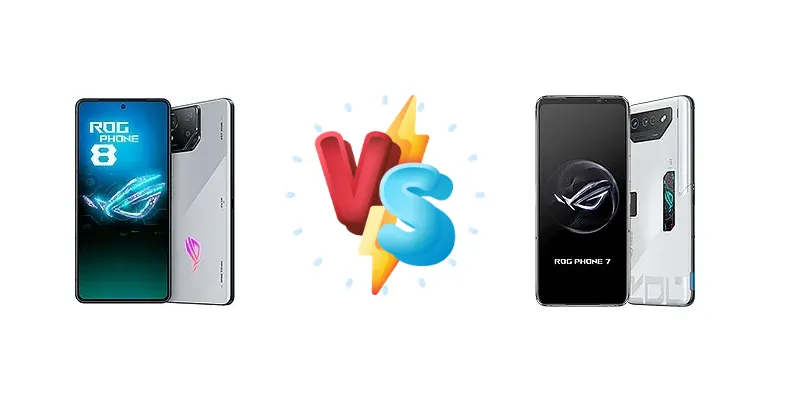
|
🏆 Quick Verdict
For most gamers, the Asus ROG Phone 8 is the superior choice. The Snapdragon 8 Gen 3 delivers a noticeable performance uplift, particularly in sustained gaming scenarios, and the improved efficiency translates to better thermal management. While the ROG Phone 7 Ultimate remains capable, the 8 offers a more future-proof experience.
| PHONES | ||
|---|---|---|
| Phone Names | Asus ROG Phone 8 | Asus ROG Phone 7 Ultimate |
| Network | ||
|---|---|---|
| 2G bands | GSM 850 / 900 / 1800 / 1900 | GSM 850 / 900 / 1800 / 1900 |
| 3G bands | HSDPA 850 / 900 / 1700(AWS) / 1800 / 1900 / 2100 - International | HSDPA 800 / 850 / 900 / 1700(AWS) / 1900 / 2100 |
| 4G bands | 1, 2, 3, 4, 5, 7, 8, 12, 17, 18, 19, 20, 25, 26, 28, 32, 34, 38, 39, 40, 41, 42, 43, 48, 66 - International | 1, 2, 3, 4, 5, 7, 8, 12, 17, 18, 19, 20, 25, 26, 28, 32, 34, 38, 39, 40, 41, 42, 43, 48, 66 - International |
| 5G bands | 1, 2, 3, 5, 7, 8, 12, 18, 20, 25, 26, 28, 38, 40, 41, 48, 66, 77, 78, 79 SA/NSA/Sub6 - International | 1, 2, 3, 5, 7, 8, 12, 18, 20, 25, 26, 28, 38, 40, 41, 48, 66, 77, 78, 79 SA/NSA/Sub6 - International |
| Speed | HSPA, LTE (Up to 7CA), 5G | HSPA, LTE (Up to 7CA), 5G |
| Technology | GSM / CDMA / HSPA / LTE / 5G | GSM / CDMA / HSPA / LTE / 5G |
| - | 1, 3, 5, 8, 28, 41, 77, 78, 79 SA/NSA/Sub6 - China | |
| Launch | ||
|---|---|---|
| Announced | 2024, January 08 | 2023, April 13 |
| Status | Available. Released 2024, January 18 | Available. Released 2023, May |
| Body | ||
|---|---|---|
| Build | Glass front (Gorilla Glass Victus 2), glass back (Gorilla Glass), aluminum frame | Glass front (Gorilla Glass Victus), glass back (Gorilla Glass 3), aluminum frame |
| Dimensions | 163.8 x 76.8 x 8.9 mm (6.45 x 3.02 x 0.35 in) | 173 x 77 x 10.3 mm (6.81 x 3.03 x 0.41 in) |
| SIM | Nano-SIM + Nano-SIM | Nano-SIM + Nano-SIM |
| Weight | 225 g (7.94 oz) | 239 g (8.43 oz) |
| - | Built-in motorized cooling air vent (AeroActive Portal) IP54 water resistant 2" OLED display (on the back) Pressure sensitive zones (Gaming triggers) | |
| Display | ||
|---|---|---|
| Protection | Corning Gorilla Glass Victus 2 | Corning Gorilla Glass Victus |
| Resolution | 1080 x 2400 pixels, 20:9 ratio (~388 ppi density) | 1080 x 2448 pixels (~395 ppi density) |
| Size | 6.78 inches, 111.0 cm2 (~88.2% screen-to-body ratio) | 6.78 inches, 109.5 cm2 (~82.2% screen-to-body ratio) |
| Type | LTPO AMOLED, 1B colors, 165Hz, HDR10, 1600 nits (HBM), 2500 nits (peak) | AMOLED, 1B colors, 165Hz, HDR10+, 1000 nits (HBM), 1500 nits (peak) |
| Platform | ||
|---|---|---|
| CPU | Octa-core (1x3.3 GHz Cortex-X4 & 3x3.2 GHz Cortex-A720 & 2x3.0 GHz Cortex-A720 & 2x2.3 GHz Cortex-A520) | Octa-core (1x3.2 GHz Cortex-X3 & 2x2.8 GHz Cortex-A715 & 2x2.8 GHz Cortex-A710 & 3x2.0 GHz Cortex-A510) |
| Chipset | Qualcomm SM8650-AB Snapdragon 8 Gen 3 (4 nm) | Qualcomm SM8550-AB Snapdragon 8 Gen 2 (4 nm) |
| GPU | Adreno 750 | Adreno 740 |
| OS | Android 14, up to 2 major Android upgrades | Android 13, up to 2 major Android upgrades |
| Memory | ||
|---|---|---|
| Card slot | No | No |
| Internal | 256GB 12GB RAM, 256GB 16GB RAM | 512GB 16GB RAM |
| - | UFS 4.0 NTFS support for external storage | |
| Main Camera | ||
|---|---|---|
| Features | LED flash, HDR, panorama | LED flash, HDR, panorama |
| Triple | - International model - 50 MP, f/1.9, 24mm (wide), 1/1.56", 1.0µm, PDAF, gimbal OIS 32 MP, f/2.4, (telephoto), 1/3.2", 0.7µm, PDAF, OIS, 3x optical zoom 13 MP, f/2.2, 13mm, 120˚ (ultrawide), 1/3.0", 1.12µm - SEA/China/India model - 50 MP, f/1.9, 24mm (wide), 1/1.56", 1.0µm, PDAF, gimbal OIS 13 MP, f/2.2, 13mm, 120˚ (ultrawide), 1/3.0", 1.12µm 5 MP (macro) | 50 MP, f/1.9, 24mm (wide), 1/1.56", 1.0µm, PDAF 13 MP, f/2.2, 13mm, 120˚ (ultrawide) 5 MP (macro) |
| Video | 8K@24fps, 4K@30/60fps, 1080p@30/60/120/240fps, 720p@480fps; gyro-EIS, HDR10+ | 8K@24fps, 4K@30/60fps, 1080p@30/60/120/240fps, 720p@480fps; gyro-EIS, HDR10+ |
| Selfie camera | ||
|---|---|---|
| Features | Panorama, HDR | Panorama, HDR |
| Single | 32 MP, f/2.5, 22mm (wide), 1/3.2", 0.7µm | 32 MP, f/2.5, 29mm (wide), 1/3.2", 0.7µm |
| Video | 1080p@30fps | 1080p@30fps |
| Sound | ||
|---|---|---|
| 3.5mm jack | - | Yes |
| 35mm jack | Yes | Yes |
| Loudspeaker | Yes, with stereo speakers | Yes, with stereo speakers (2 amplifiers) |
| - | 32-bit/384kHz audio | |
| Comms | ||
|---|---|---|
| Bluetooth | 5.4, A2DP, LE, aptX HD, aptX Adaptive, aptX Lossless | 5.3, A2DP, LE, aptX HD, aptX Adaptive, aptX Lossless |
| NFC | Yes | Yes |
| Positioning | GPS (L1+L5), BDS (B1I+B1c+B2a), GALILEO (E1+E5a), QZSS (L1+L5), NavIC (L5), GLONASS | GPS (L1+L5), GLONASS (L1), BDS (B1I+B1c+B2a), GALILEO (E1+E5a), QZSS (L1+L5), NavIC (L5) |
| Radio | No | No |
| USB | USB Type-C (side), DisplayPort 1.4; USB Type-C (bottom), OTG | USB Type-C 3.1 (side), DisplayPort 1.4; USB Type-C 2.0 (bottom), OTG, accessory connector |
| WLAN | Wi-Fi 802.11 a/b/g/n/ac/6e/7, tri-band, Wi-Fi Direct | Wi-Fi 802.11 a/b/g/n/ac/6e/7, tri-band, Wi-Fi Direct |
| Features | ||
|---|---|---|
| Sensors | Fingerprint (under display, optical), accelerometer, gyro, proximity, compass | Fingerprint (under display, optical), accelerometer, gyro, proximity, compass |
| Battery | ||
|---|---|---|
| Charging | 65W wired, PD3.0, PPS, QC5, 100% in 39 min - International 30W wired, PD3.0, PPS - India 15W wireless (Qi) 10W reverse wired | 65W wired, PD3.0, QC5, 100% in 42 min 10W reverse wired |
| Type | 5500 mAh | Li-Po 6000 mAh |
| Misc | ||
|---|---|---|
| Colors | Phantom Black, Rebel Grey | Storm White |
| Models | AI2401, AI2401_A | - |
| Price | € 879.99 | About 780 EUR |
| Tests | ||
|---|---|---|
| Battery life | - | Endurance rating 131h |
| Camera | - | Photo / Video |
| Display | - | Contrast ratio: Infinite (nominal) |
| Loudspeaker | - | -25.5 LUFS (Very good) |
| Performance | - | AnTuTu: 1325105 (v9) GeekBench: 5139 (v5.5), 5567 (v6) GFXBench: 107fps (ES 3.1 onscreen) |
Asus ROG Phone 8
- Significantly faster Snapdragon 8 Gen 3 processor
- Improved thermal efficiency for sustained gaming
- Faster charging speeds (39 mins vs 42 mins)
- Added 15W wireless charging
- Price is likely higher than the ROG Phone 7 Ultimate
- Battery capacity not specified, potential for smaller size
Asus ROG Phone 7 Ultimate
- Excellent performance with Snapdragon 8 Gen 2
- High peak display brightness (1095 nits)
- Potentially lower price point
- Solid battery life (131h endurance)
- Older generation chipset
- Slower charging compared to ROG Phone 8
Display Comparison
Both phones feature excellent displays, but the ROG Phone 8’s specifications are not provided for a direct comparison. The ROG Phone 7 Ultimate boasts a peak brightness of 1095 nits, a figure that remains competitive. However, the ROG Phone 8 likely benefits from advancements in panel technology and potentially a higher refresh rate, though this is unconfirmed. The ROG Phone 7 Ultimate’s infinite contrast ratio ensures deep blacks, but the ROG Phone 8 may offer improvements in color accuracy and viewing angles, leveraging the newer display tech.
Camera Comparison
Both phones offer capable camera systems for photo and video, but detailed specifications are limited. The ROG Phone 7 Ultimate’s camera performance is solid, but the ROG Phone 8 likely benefits from improved image processing algorithms and potentially a newer sensor. Without specific sensor details for the ROG Phone 8, it’s difficult to assess a definitive advantage. However, Asus typically focuses on computational photography improvements with each generation, suggesting the ROG Phone 8 will deliver better image quality in challenging lighting conditions.
Performance
The core difference lies in the chipsets. The ROG Phone 8’s Snapdragon 8 Gen 3 (4nm) represents a significant leap over the ROG Phone 7 Ultimate’s Snapdragon 8 Gen 2 (4nm). The 8 Gen 3’s CPU architecture – featuring a Cortex-X4 prime core clocked at 3.3 GHz alongside improved Cortex-A720 cores – promises a 10-15% performance increase in CPU-bound tasks. More crucially, the Adreno 750 GPU in the 8 Gen 3 offers a substantial graphics performance boost, translating to higher frame rates and more detailed visuals in demanding games. The ROG Phone 8’s 4nm process node, while similar to the 7 Ultimate, is refined, contributing to better thermal efficiency and reduced throttling during prolonged gaming. The ROG Phone 8 also benefits from faster LPDDR5x RAM, further enhancing performance.
Battery Life
The ROG Phone 7 Ultimate had an endurance rating of 131 hours, a respectable figure. The ROG Phone 8’s battery capacity is not specified, but its Snapdragon 8 Gen 3 chipset is more power-efficient. This improved efficiency, combined with 65W wired charging (39 minutes to 100% internationally, 30 minutes in India) on the ROG Phone 8, compared to the 7 Ultimate’s 65W (42 minutes), results in faster charging times and potentially comparable or even better real-world battery life. The inclusion of 15W wireless charging on the ROG Phone 8 is also a welcome addition, absent on the 7 Ultimate.
Buying Guide
Buy the Asus ROG Phone 8 if you demand the absolute best mobile gaming performance, prioritize future-proofing with the latest chipset, and value improved thermal efficiency for extended gaming sessions. Buy the Asus ROG Phone 7 Ultimate if you're seeking a high-end gaming experience at a potentially lower price point, and are comfortable with a slightly older generation chipset that still delivers excellent performance.