
Asus ROG Phone 8 vs. Apple iPhone 15 Pro Max: A Deep Dive for Power Users
| Phones Images | |||||
|---|---|---|---|---|---|
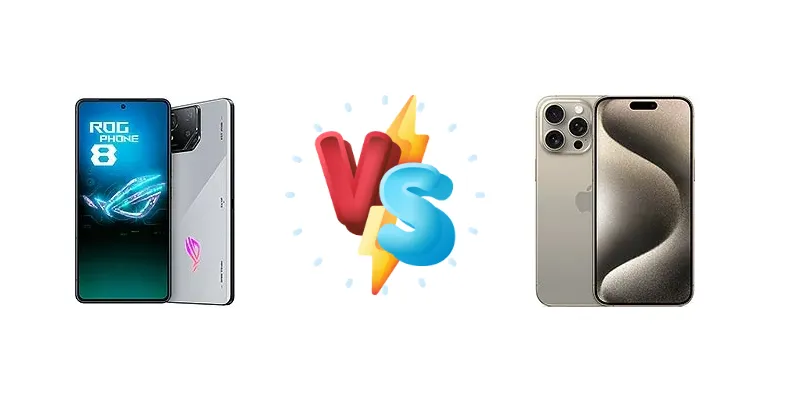
|
🏆 Quick Verdict
For the average user, the iPhone 15 Pro Max offers a more polished and versatile experience. However, the Asus ROG Phone 8 is the clear winner for dedicated mobile gamers, offering superior processing power and gaming-centric features that the iPhone simply can't match.
| PHONES | ||
|---|---|---|
| Phone Names | Asus ROG Phone 8 | Apple iPhone 15 Pro Max |
| Network | ||
|---|---|---|
| 2G bands | GSM 850 / 900 / 1800 / 1900 | GSM 850 / 900 / 1800 / 1900 |
| 3G bands | HSDPA 850 / 900 / 1700(AWS) / 1800 / 1900 / 2100 - International | HSDPA 850 / 900 / 1700(AWS) / 1900 / 2100 |
| 4G bands | 1, 2, 3, 4, 5, 7, 8, 12, 17, 18, 19, 20, 25, 26, 28, 32, 34, 38, 39, 40, 41, 42, 43, 48, 66 - International | 1, 2, 3, 4, 5, 7, 8, 12, 13, 17, 18, 19, 20, 25, 26, 28, 30, 32, 34, 38, 39, 40, 41, 42, 46, 48, 53, 66 - A3106 |
| 5G bands | 1, 2, 3, 5, 7, 8, 12, 18, 20, 25, 26, 28, 38, 40, 41, 48, 66, 77, 78, 79 SA/NSA/Sub6 - International | 1, 2, 3, 5, 7, 8, 12, 20, 25, 26, 28, 30, 38, 40, 41, 48, 53, 66, 70, 77, 78, 79 SA/NSA/Sub6 - A3106 |
| Speed | HSPA, LTE (Up to 7CA), 5G | HSPA, LTE, 5G, EV-DO Rev.A 3.1 Mbps |
| Technology | GSM / CDMA / HSPA / LTE / 5G | GSM / CDMA / HSPA / EVDO / LTE / 5G |
| Launch | ||
|---|---|---|
| Announced | 2024, January 08 | 2023, September 12 |
| Status | Available. Released 2024, January 18 | Available. Released 2023, September 22 |
| Body | ||
|---|---|---|
| Build | Glass front (Gorilla Glass Victus 2), glass back (Gorilla Glass), aluminum frame | Glass front, glass back, titanium frame (grade 5) |
| Dimensions | 163.8 x 76.8 x 8.9 mm (6.45 x 3.02 x 0.35 in) | 159.9 x 76.7 x 8.3 mm (6.30 x 3.02 x 0.33 in) |
| SIM | Nano-SIM + Nano-SIM | · Nano-SIM + eSIM + eSIM (max 2 at a time; International)· eSIM + eSIM (8 or more, max 2 at a time; USA)· Nano-SIM + Nano-SIM (China) |
| Weight | 225 g (7.94 oz) | 221 g (7.80 oz) |
| Display | ||
|---|---|---|
| Protection | Corning Gorilla Glass Victus 2 | Ceramic Shield glass |
| Resolution | 1080 x 2400 pixels, 20:9 ratio (~388 ppi density) | 1290 x 2796 pixels, 19.5:9 ratio (~460 ppi density) |
| Size | 6.78 inches, 111.0 cm2 (~88.2% screen-to-body ratio) | 6.7 inches, 110.2 cm2 (~89.8% screen-to-body ratio) |
| Type | LTPO AMOLED, 1B colors, 165Hz, HDR10, 1600 nits (HBM), 2500 nits (peak) | LTPO Super Retina XDR OLED, 120Hz, HDR10, Dolby Vision, 1000 nits (typ), 2000 nits (HBM) |
| Platform | ||
|---|---|---|
| CPU | Octa-core (1x3.3 GHz Cortex-X4 & 3x3.2 GHz Cortex-A720 & 2x3.0 GHz Cortex-A720 & 2x2.3 GHz Cortex-A520) | Hexa-core (2x3.78 GHz + 4x2.11 GHz) |
| Chipset | Qualcomm SM8650-AB Snapdragon 8 Gen 3 (4 nm) | Apple A17 Pro (3 nm) |
| GPU | Adreno 750 | Apple GPU (6-core graphics) |
| OS | Android 14, up to 2 major Android upgrades | iOS 17, upgradable to iOS 26.1 |
| Memory | ||
|---|---|---|
| Card slot | No | No |
| Internal | 256GB 12GB RAM, 256GB 16GB RAM | 256GB 8GB RAM, 512GB 8GB RAM, 1TB 8GB RAM |
| Main Camera | ||
|---|---|---|
| Features | LED flash, HDR, panorama | Dual-LED dual-tone flash, HDR (photo/panorama) |
| Triple | - International model - 50 MP, f/1.9, 24mm (wide), 1/1.56", 1.0µm, PDAF, gimbal OIS 32 MP, f/2.4, (telephoto), 1/3.2", 0.7µm, PDAF, OIS, 3x optical zoom 13 MP, f/2.2, 13mm, 120˚ (ultrawide), 1/3.0", 1.12µm - SEA/China/India model - 50 MP, f/1.9, 24mm (wide), 1/1.56", 1.0µm, PDAF, gimbal OIS 13 MP, f/2.2, 13mm, 120˚ (ultrawide), 1/3.0", 1.12µm 5 MP (macro) | 48 MP, f/1.8, 24mm (wide), 1/1.28", 1.22µm, dual pixel PDAF, sensor-shift OIS 12 MP, f/2.8, 120mm (periscope telephoto), 1/3.06", 1.12µm, dual pixel PDAF, 3D sensor‑shift OIS, 5x optical zoom 12 MP, f/2.2, 13mm, 120˚ (ultrawide), 1/2.55", 1.4µm, dual pixel PDAF TOF 3D LiDAR scanner (depth) |
| Video | 8K@24fps, 4K@30/60fps, 1080p@30/60/120/240fps, 720p@480fps; gyro-EIS, HDR10+ | 4K@24/25/30/60fps, 1080p@25/30/60/120/240fps, 10-bit HDR, Dolby Vision HDR (up to 60fps), ProRes, 3D (spatial) video, stereo sound rec. |
| Selfie camera | ||
|---|---|---|
| Features | Panorama, HDR | HDR, Dolby Vision HDR |
| Single | 32 MP, f/2.5, 22mm (wide), 1/3.2", 0.7µm | 12 MP, f/1.9, 23mm (wide), 1/3.6", 1.0µm, PDAF, OIS SL 3D, (depth/biometrics sensor) |
| Video | 1080p@30fps | 4K@24/25/30/60fps, 1080p@25/30/60/120fps, gyro-EIS |
| Sound | ||
|---|---|---|
| 35mm jack | Yes | No |
| Loudspeaker | Yes, with stereo speakers | Yes, with stereo speakers |
| Comms | ||
|---|---|---|
| Bluetooth | 5.4, A2DP, LE, aptX HD, aptX Adaptive, aptX Lossless | 5.3, A2DP, LE |
| NFC | Yes | Yes |
| Positioning | GPS (L1+L5), BDS (B1I+B1c+B2a), GALILEO (E1+E5a), QZSS (L1+L5), NavIC (L5), GLONASS | GPS (L1+L5), GLONASS, GALILEO, BDS, QZSS, NavIC |
| Radio | No | No |
| USB | USB Type-C (side), DisplayPort 1.4; USB Type-C (bottom), OTG | USB Type-C 3.2 Gen 2, DisplayPort |
| WLAN | Wi-Fi 802.11 a/b/g/n/ac/6e/7, tri-band, Wi-Fi Direct | Wi-Fi 802.11 a/b/g/n/ac/6e, tri-band, hotspot |
| Features | ||
|---|---|---|
| Sensors | Fingerprint (under display, optical), accelerometer, gyro, proximity, compass | Face ID, accelerometer, gyro, proximity, compass, barometer |
| Battery | ||
|---|---|---|
| Charging | 65W wired, PD3.0, PPS, QC5, 100% in 39 min - International 30W wired, PD3.0, PPS - India 15W wireless (Qi) 10W reverse wired | Wired, PD2.0, 50% in 30 min 15W wireless (MagSafe) 15W wireless (Qi2) - requires iOS 17.2 update 4.5W reverse wired |
| Type | 5500 mAh | Li-Ion 4441 mAh |
| Misc | ||
|---|---|---|
| Colors | Phantom Black, Rebel Grey | Black Titanium, White Titanium, Blue Titanium, Natural Titanium |
| Models | AI2401, AI2401_A | A2849, A3105, A3106, A3108, iPhone16,2 |
| Price | € 879.99 | € 758.79 / $ 579.87 / £ 628.29 |
| SAR | - | 1.07 W/kg (head) 1.11 W/kg (body) |
| SAR EU | - | 0.98 W/kg (head) 0.98 W/kg (body) |
Asus ROG Phone 8
- Superior gaming performance with Snapdragon 8 Gen 3
- Faster 65W wired charging
- Gaming-centric features (triggers, cooling)
- Less refined ecosystem compared to iOS
- Camera likely inferior to iPhone 15 Pro Max
Apple iPhone 15 Pro Max
- Exceptional camera quality and video recording
- Seamless iOS ecosystem and software support
- Excellent battery life and optimization
- Slower charging speeds
- Less powerful for demanding gaming
Display Comparison
The iPhone 15 Pro Max boasts a peak brightness of 1787 nits, ensuring excellent visibility even in direct sunlight. While the ROG Phone 8’s brightness isn’t specified, its focus is on refresh rate and responsiveness for gaming. Both likely employ LTPO technology for variable refresh rates, conserving battery. The iPhone’s color accuracy is renowned, while the ROG Phone 8 likely prioritizes vibrant colors for immersive gaming. Bezels are minimal on both, but the ROG Phone 8’s design may accommodate features like front-facing speakers, impacting overall screen-to-body ratio.
Camera Comparison
The iPhone 15 Pro Max is known for its exceptional photo and video capabilities, leveraging advanced computational photography. While specific sensor details aren’t provided for the ROG Phone 8, it’s unlikely to match the iPhone’s image processing prowess. The iPhone’s larger sensor size (likely) and advanced OIS contribute to superior low-light performance and video stabilization. The ROG Phone 8 may offer unique camera modes tailored for gaming or content creation, but the iPhone’s consistent quality and ease of use are significant advantages.
Performance
The core battleground is the chipset: Qualcomm’s Snapdragon 8 Gen 3 (4nm) in the ROG Phone 8 versus Apple’s A17 Pro (3nm) in the iPhone 15 Pro Max. The A17 Pro’s 3nm process gives it an efficiency advantage, but the Snapdragon 8 Gen 3’s octa-core configuration (1x3.3 GHz Cortex-X4, 3x3.2 GHz Cortex-A720, 2x3.0 GHz Cortex-A720, 2x2.3 GHz Cortex-A520) is geared towards sustained performance. The iPhone’s hexa-core CPU (2x3.78 GHz + 4x2.11 GHz) is optimized for single-core tasks, while the ROG Phone 8 excels in multi-threaded workloads. The ROG Phone 8’s cooling system is crucial to prevent throttling during extended gaming, a factor the iPhone relies on more conservative power delivery to mitigate.
Battery Life
The iPhone 15 Pro Max achieves an impressive 16:01h of active use and an endurance rating of 118h, demonstrating excellent battery optimization. The ROG Phone 8 offers 65W wired charging (international) – significantly faster than the iPhone’s 50% in 30 minutes via PD2.0. The ROG Phone 8 also supports 15W wireless charging (Qi) and 10W reverse wired charging, while the iPhone offers 15W MagSafe and Qi2 (with iOS 17.2) and 4.5W reverse wired. The ROG Phone 8’s faster charging mitigates the impact of potentially lower battery capacity, offering quicker top-ups for gamers.
Buying Guide
Buy the Asus ROG Phone 8 if you prioritize raw performance, extended gaming sessions, and customizable features. Its Snapdragon 8 Gen 3 and robust cooling system are built for demanding tasks. Buy the Apple iPhone 15 Pro Max if you value a seamless ecosystem, exceptional camera quality, and long-term software support, even if it means sacrificing some gaming horsepower.