
Asus ROG Phone 7 vs. OnePlus 11R: A Deep Dive into Gaming and Value
| Phones Images | |||||
|---|---|---|---|---|---|
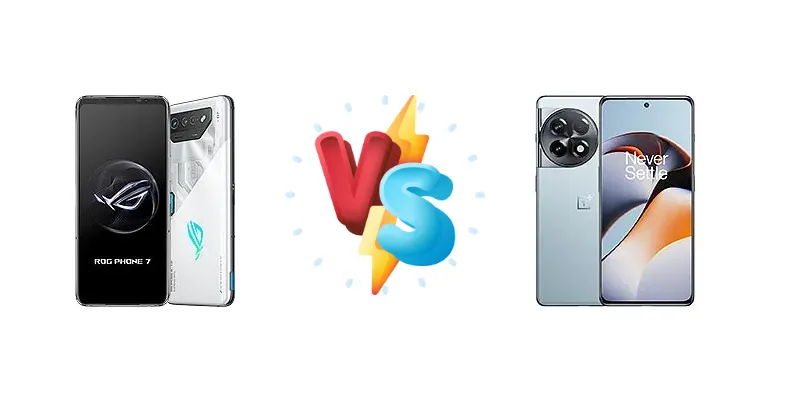
|
🏆 Quick Verdict
For dedicated mobile gamers prioritizing raw power and extended battery life, the Asus ROG Phone 7 is the clear winner. However, the OnePlus 11R delivers exceptional value, offering near-flagship performance and blazing-fast 100W charging for a more budget-conscious user.
| PHONES | ||
|---|---|---|
| Phone Names | Asus ROG Phone 7 | OnePlus 11R |
| Network | ||
|---|---|---|
| 2G bands | GSM 850 / 900 / 1800 / 1900 | GSM 850 / 900 / 1800 / 1900 |
| 3G bands | HSDPA 800 / 850 / 900 / 1700(AWS) / 1900 / 2100 | HSDPA 850 / 900 / 1700(AWS) / 2100 |
| 4G bands | 1, 2, 3, 4, 5, 7, 8, 12, 17, 18, 19, 20, 25, 26, 28, 32, 34, 38, 39, 40, 41, 42, 43, 48, 66 - International | 1, 3, 4, 5, 8, 28, 34, 38, 39, 40, 41 |
| 5G bands | 1, 2, 3, 5, 7, 8, 12, 18, 20, 25, 26, 28, 38, 40, 41, 48, 66, 77, 78, 79 SA/NSA/Sub6 - International | 1, 3, 5, 8, 28, 40, 41, 77, 78 SA/NSA |
| Speed | HSPA, LTE (Up to 7CA), 5G | HSPA, LTE (3CA), 5G |
| Technology | GSM / CDMA / HSPA / LTE / 5G | GSM / CDMA / HSPA / LTE / 5G |
| 1, 3, 5, 8, 28, 41, 77, 78, 79 SA/NSA/Sub6 - China | CDMA 800 | |
| Launch | ||
|---|---|---|
| Announced | 2023, April 13 | 2023, February 07 |
| Status | Available. Released 2023, May | Available. Released 2023, February 21 |
| Body | ||
|---|---|---|
| Build | Glass front (Gorilla Glass Victus), glass back (Gorilla Glass 3), aluminum frame | Glass front, glass back (Gorilla Glass 5), plastic frame |
| Dimensions | 173 x 77 x 10.3 mm (6.81 x 3.03 x 0.41 in) | 163.4 x 74.3 x 8.7 mm (6.43 x 2.93 x 0.34 in) |
| SIM | Nano-SIM + Nano-SIM | Nano-SIM + Nano-SIM |
| Weight | 239 g (8.43 oz) | 204 g (7.20 oz) |
| IP54 water resistant Illuminated RGB logo (on the back) Pressure sensitive zones (Gaming triggers) | - | |
| Display | ||
|---|---|---|
| Protection | Corning Gorilla Glass Victus | - |
| Resolution | 1080 x 2448 pixels (~395 ppi density) | 1240 x 2772 pixels, 20:9 ratio (~451 ppi density) |
| Size | 6.78 inches, 109.5 cm2 (~82.2% screen-to-body ratio) | 6.74 inches, 109.2 cm2 (~90.0% screen-to-body ratio) |
| Type | AMOLED, 1B colors, 165Hz, HDR10+, 1000 nits (HBM), 1500 nits (peak) | Fluid AMOLED, 1B colors, 120Hz, HDR10+, 1450 nits (peak) |
| Platform | ||
|---|---|---|
| CPU | Octa-core (1x3.2 GHz Cortex-X3 & 2x2.8 GHz Cortex-A715 & 2x2.8 GHz Cortex-A710 & 3x2.0 GHz Cortex-A510) | Octa-core (1x3.0 GHz Cortex-X2 & 3x2.5 GHz Cortex-A710 & 4x1.80 GHz Cortex-A510) |
| Chipset | Qualcomm SM8550-AB Snapdragon 8 Gen 2 (4 nm) | Qualcomm SM8475 Snapdragon 8+ Gen 1 (4 nm) |
| GPU | Adreno 740 | Adreno 730 |
| OS | Android 13, up to 2 major Android upgrades | Android 13, upgradable to Android 15, OxygenOS 15 |
| Memory | ||
|---|---|---|
| Card slot | No | No |
| Internal | 256GB 12GB RAM, 512GB 16GB RAM | 128GB 8GB RAM, 256GB 16GB RAM, 512GB 18GB RAM |
| UFS 4.0 NTFS support for external storage | UFS 3.1 | |
| Main Camera | ||
|---|---|---|
| Features | LED flash, HDR, panorama | Color spectrum sensor, LED flash, HDR, panorama |
| Single | - | 16 MP, f/2.4, 24mm (wide), 1/3.09", 1.0µm |
| Triple | 50 MP, f/1.9, 24mm (wide), 1/1.56", 1.0µm, PDAF 13 MP, f/2.2, 13mm, 120˚ (ultrawide) 5 MP (macro) | 50 MP, f/1.8, 24mm (wide), 1/1.56", 1.0µm, multi-directional PDAF, OIS 8 MP, f/2.2, 120˚ (ultrawide), 1/4.0", 1.12µm 2 MP (macro) |
| Video | 8K@24fps, 4K@30/60fps, 1080p@30/60/120/240fps, 720p@480fps; gyro-EIS, HDR10+ | 4K@30/60fps, 1080p@30/60/240fps, gyro-EIS |
| Selfie camera | ||
|---|---|---|
| Features | Panorama, HDR | HDR |
| Single | 32 MP, f/2.5, 29mm (wide), 1/3.2", 0.7µm | 16 MP, f/2.4, 24mm (wide), 1/3.09", 1.0µm |
| Video | 1080p@30fps | 1080p@30fps |
| Sound | ||
|---|---|---|
| 3.5mm jack | Yes | No |
| 35mm jack | Yes | No |
| Loudspeaker | Yes, with stereo speakers (2 amplifiers) | Yes, with stereo speakers |
| 32-bit/384kHz audio | 24-bit/192kHz audio | |
| Comms | ||
|---|---|---|
| Bluetooth | 5.3, A2DP, LE, aptX HD, aptX Adaptive, aptX Lossless | 5.3, A2DP, LE, aptX HD |
| Infrared port | - | Yes |
| NFC | Yes | Yes |
| Positioning | GPS (L1+L5), GLONASS (L1), BDS (B1I+B2a+B2c), GALILEO (E1+E5a), QZSS (L1+L5), NavIC (L5) | GPS (L1+L5), GLONASS (G1), BDS (B1I+B1c+B2a), GALILEO (E1+E5a), QZSS (L1+L5) |
| Radio | No | No |
| USB | USB Type-C 3.1 (side), DisplayPort 1.4; USB Type-C 2.0 (bottom), OTG, accessory connector | USB Type-C 2.0 |
| WLAN | Wi-Fi 802.11 a/b/g/n/ac/6e/7, tri-band, Wi-Fi Direct | Wi-Fi 802.11 a/b/g/n/ac/6, dual-band |
| Features | ||
|---|---|---|
| Sensors | Fingerprint (under display, optical), accelerometer, gyro, proximity, compass | Fingerprint (under display, optical), accelerometer, gyro, proximity, compass |
| Battery | ||
|---|---|---|
| Charging | 65W wired, PD3.0, QC5, 100% in 42 min 10W reverse wired | 100W wired |
| Type | Li-Po 6000 mAh | Li-Po 5000 mAh |
| Misc | ||
|---|---|---|
| Colors | Phantom Black, Storm White | Galactic Silver, Sonic Black, Solar Red |
| Models | AI2205_C | CPH2487 |
| Price | € 744.85 | About 600 EUR |
| SAR | - | 1.16 W/kg (head) 0.61 W/kg (body) |
| Tests | ||
|---|---|---|
| Battery life | Endurance rating 131h | - |
| Camera | Photo / Video | - |
| Display | Contrast ratio: Infinite (nominal) | - |
| Loudspeaker | -26.0 LUFS (Very good) | - |
| Performance | AnTuTu: 1333597 (v9) GeekBench: 5098 (v5.5), 5617 (v6) GFXBench: 108fps (ES 3.1 onscreen) | - |
Asus ROG Phone 7
- Superior performance with Snapdragon 8 Gen 2
- Exceptional battery life and endurance
- Likely better camera system
- Gaming-focused features like AirTriggers
- Higher price point
- Bulky design
OnePlus 11R
- Significantly faster 100W charging
- Excellent value for money
- Smooth user experience
- More manageable size
- Less powerful chipset
- Potentially inferior camera performance
Display Comparison
The Asus ROG Phone 7 boasts a display capable of reaching 1051 nits of peak brightness, ensuring excellent visibility even in direct sunlight. While the OnePlus 11R’s display specs aren’t provided, OnePlus typically utilizes AMOLED panels with good color accuracy. The ROG Phone 7’s gaming-focused design likely incorporates a higher refresh rate and potentially a more sophisticated PWM dimming scheme, crucial for reducing eye strain during extended use. The infinite contrast ratio on the ROG Phone 7, typical of AMOLED displays, provides deep blacks and vibrant colors.
Camera Comparison
Both devices feature photo and video capabilities, but detailed camera specifications are limited. Given the ROG Phone 7’s positioning as a premium device, it likely incorporates a more advanced camera system with larger sensors and improved image processing. The OnePlus 11R, while capable, likely prioritizes overall value over cutting-edge camera technology. Without specific sensor details, it’s difficult to make a definitive judgment, but the ROG Phone 7 likely offers superior image quality, particularly in low-light conditions.
Performance
The Asus ROG Phone 7’s Qualcomm SM8550-AB Snapdragon 8 Gen 2 (4nm) chipset represents a significant leap in performance and efficiency over the OnePlus 11R’s Snapdragon 8+ Gen 1 (4nm). The ROG Phone 7’s CPU configuration – a 1x3.2 GHz Cortex-X3 prime core, paired with 2x2.8 GHz Cortex-A715 and 2x2.8 GHz Cortex-A710 cores, and 3x2.0 GHz Cortex-A510 cores – offers superior single-core and multi-core performance compared to the 1x3.0 GHz Cortex-X2, 3x2.5 GHz Cortex-A710, and 4x1.80 GHz Cortex-A510 configuration of the 11R. The 4nm process node of the Snapdragon 8 Gen 2 also contributes to better thermal management, minimizing performance throttling during demanding gaming sessions. While the 11R is no slouch, the ROG Phone 7 is demonstrably more powerful.
Battery Life
The Asus ROG Phone 7 achieves an impressive 14:51h of active use and an endurance rating of 131 hours, indicating excellent battery life. It supports 65W wired charging with PD3.0 and QC5, reaching 100% in 42 minutes, and also offers 10W reverse wired charging. The OnePlus 11R counters with a significantly faster 100W wired charging solution, allowing for a quicker top-up. While the ROG Phone 7’s endurance rating suggests a larger battery capacity, the 11R’s faster charging could be more convenient for users who frequently need to quickly replenish their battery. The ROG Phone 7’s longer active use time suggests better overall efficiency.
Buying Guide
Buy the Asus ROG Phone 7 if you demand the absolute best gaming experience, require sustained performance during long sessions, and value features like AirTriggers. Buy the OnePlus 11R if you prioritize value, fast charging, and a smooth user experience without the premium gaming-centric features and price tag. The 11R is ideal for users who game casually alongside everyday tasks.