
Asus ROG Phone 7 vs. Google Pixel 7 Pro: A Deep Dive into Gaming and AI
| Phones Images | |||||
|---|---|---|---|---|---|
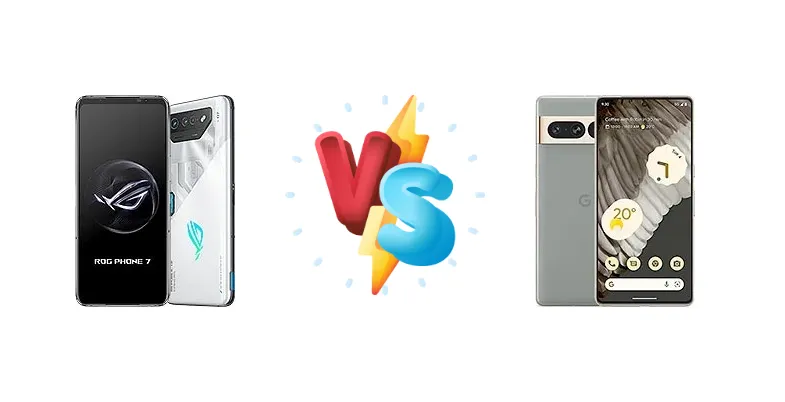
|
🏆 Quick Verdict
For the average user, the Google Pixel 7 Pro emerges as the more versatile choice. Its exceptional camera system, coupled with a smooth software experience, provides a well-rounded package. However, gamers and power users will find the Asus ROG Phone 7’s superior performance and extended battery life to be invaluable.
| PHONES | ||
|---|---|---|
| Phone Names | Asus ROG Phone 7 | Google Pixel 7 Pro |
| Network | ||
|---|---|---|
| 2G bands | GSM 850 / 900 / 1800 / 1900 | GSM 850 / 900 / 1800 / 1900 |
| 3G bands | HSDPA 800 / 850 / 900 / 1700(AWS) / 1900 / 2100 | HSDPA 800 / 850 / 900 / 1700(AWS) / 1900 / 2100 |
| 4G bands | 1, 2, 3, 4, 5, 7, 8, 12, 17, 18, 19, 20, 25, 26, 28, 32, 34, 38, 39, 40, 41, 42, 43, 48, 66 - International | 1, 2, 3, 4, 5, 7, 8, 12, 13, 14, 17, 18, 19, 20, 25, 26, 28, 29, 30, 38, 39, 40, 41, 42, 46, 48, 66, 71 - GE2AE |
| 5G bands | 1, 2, 3, 5, 7, 8, 12, 18, 20, 25, 26, 28, 38, 40, 41, 48, 66, 77, 78, 79 SA/NSA/Sub6 - International | 1, 2, 3, 5, 7, 8, 12, 14, 20, 25, 28, 30, 38, 40, 41, 48, 66, 71, 77, 78, 257, 258, 260, 261 SA/NSA/Sub6/mmWave - GE2AE |
| Speed | HSPA, LTE (Up to 7CA), 5G | HSPA, LTE, 5G |
| Technology | GSM / CDMA / HSPA / LTE / 5G | GSM / CDMA / HSPA / EVDO / LTE / 5G |
| 1, 3, 5, 8, 28, 41, 77, 78, 79 SA/NSA/Sub6 - China | 1, 2, 3, 5, 7, 8, 12, 14, 20, 25, 28, 30, 38, 40, 41, 48, 66, 71, 75, 76, 77, 78 SA/NSA/Sub6 - GP4BC | |
| Launch | ||
|---|---|---|
| Announced | 2023, April 13 | 2022, October 06 |
| Status | Available. Released 2023, May | Available. Released 2022, October 13 |
| Body | ||
|---|---|---|
| Build | Glass front (Gorilla Glass Victus), glass back (Gorilla Glass 3), aluminum frame | Glass front (Gorilla Glass Victus), glass back (Gorilla Glass Victus), aluminum frame |
| Dimensions | 173 x 77 x 10.3 mm (6.81 x 3.03 x 0.41 in) | 162.9 x 76.6 x 8.9 mm (6.41 x 3.02 x 0.35 in) |
| SIM | Nano-SIM + Nano-SIM | Nano-SIM + eSIM |
| Weight | 239 g (8.43 oz) | 212 g (7.48 oz) |
| IP54 water resistant Illuminated RGB logo (on the back) Pressure sensitive zones (Gaming triggers) | IP68 dust/water resistant (up to 1.5m for 30 min) | |
| Display | ||
|---|---|---|
| Protection | Corning Gorilla Glass Victus | Corning Gorilla Glass Victus |
| Resolution | 1080 x 2448 pixels (~395 ppi density) | 1440 x 3120 pixels, 19.5:9 ratio (~512 ppi density) |
| Size | 6.78 inches, 109.5 cm2 (~82.2% screen-to-body ratio) | 6.7 inches, 110.6 cm2 (~88.7% screen-to-body ratio) |
| Type | AMOLED, 1B colors, 165Hz, HDR10+, 1000 nits (HBM), 1500 nits (peak) | LTPO AMOLED, 120Hz, HDR10+, 1000 nits (HBM), 1500 nits (peak) |
| - | Always-on display | |
| Platform | ||
|---|---|---|
| CPU | Octa-core (1x3.2 GHz Cortex-X3 & 2x2.8 GHz Cortex-A715 & 2x2.8 GHz Cortex-A710 & 3x2.0 GHz Cortex-A510) | Octa-core (2x2.85 GHz Cortex-X1 & 2x2.35 GHz Cortex-A78 & 4x1.80 GHz Cortex-A55) |
| Chipset | Qualcomm SM8550-AB Snapdragon 8 Gen 2 (4 nm) | Google Tensor G2 (5 nm) |
| GPU | Adreno 740 | Mali-G710 MP7 |
| OS | Android 13, up to 2 major Android upgrades | Android 13, upgradable to Android 15, up to 5 major Android upgrades |
| Memory | ||
|---|---|---|
| Card slot | No | No |
| Internal | 256GB 12GB RAM, 512GB 16GB RAM | 128GB 8GB RAM, 256GB 8GB RAM, 128GB 12GB RAM, 256GB 12GB RAM, 512GB 12GB RAM |
| UFS 4.0 NTFS support for external storage | UFS 3.1 | |
| Main Camera | ||
|---|---|---|
| Features | LED flash, HDR, panorama | Laser AF, Dual-LED flash, Pixel Shift, Auto-HDR, panorama |
| Single | - | 10.8 MP, f/2.2, 21mm (ultrawide), 1/3.1", 1.22µm |
| Triple | 50 MP, f/1.9, 24mm (wide), 1/1.56", 1.0µm, PDAF 13 MP, f/2.2, 13mm, 120˚ (ultrawide) 5 MP (macro) | 50 MP, f/1.9, 25mm (wide), 1/1.31", 1.2µm, dual pixel PDAF, OIS 48 MP, f/3.5, 120mm (periscope telephoto), 1/2.55", 0.7µm, dual pixel PDAF, OIS, 5x optical zoom 12 MP, f/2.2, 126˚ (ultrawide), 1/2.9", 1.25µm, AF |
| Video | 8K@24fps, 4K@30/60fps, 1080p@30/60/120/240fps, 720p@480fps; gyro-EIS, HDR10+ | 4K@30/60fps, 1080p@30/60/120/240fps; gyro-EIS, OIS, 10-bit HDR |
| Selfie camera | ||
|---|---|---|
| Features | Panorama, HDR | HDR, panorama |
| Single | 32 MP, f/2.5, 29mm (wide), 1/3.2", 0.7µm | 10.8 MP, f/2.2, 21mm (ultrawide), 1/3.1", 1.22µm |
| Video | 1080p@30fps | 4K@30/60fps, 1080p@30/60fps |
| Sound | ||
|---|---|---|
| 3.5mm jack | Yes | No |
| 35mm jack | Yes | No |
| Loudspeaker | Yes, with stereo speakers (2 amplifiers) | Yes, with stereo speakers |
| 32-bit/384kHz audio | - | |
| Comms | ||
|---|---|---|
| Bluetooth | 5.3, A2DP, LE, aptX HD, aptX Adaptive, aptX Lossless | 5.2, A2DP, LE, aptX HD |
| NFC | Yes | Yes |
| Positioning | GPS (L1+L5), GLONASS (L1), BDS (B1I+B2a+B2c), GALILEO (E1+E5a), QZSS (L1+L5), NavIC (L5) | GPS (L1+L5), GLONASS (G1), BDS (B1I+B1c+B2a), GALILEO (E1+E5a), QZSS (L1+L5) |
| Radio | No | No |
| USB | USB Type-C 3.1 (side), DisplayPort 1.4; USB Type-C 2.0 (bottom), OTG, accessory connector | USB Type-C 3.2 |
| WLAN | Wi-Fi 802.11 a/b/g/n/ac/6e/7, tri-band, Wi-Fi Direct | Wi-Fi 802.11 a/b/g/n/ac/6e, tri-band, Wi-Fi Direct |
| Features | ||
|---|---|---|
| Sensors | Fingerprint (under display, optical), accelerometer, gyro, proximity, compass | Fingerprint (under display, optical), accelerometer, gyro, proximity, compass, barometer |
| - | Ultra Wideband (UWB) support | |
| Battery | ||
|---|---|---|
| Charging | 65W wired, PD3.0, QC5, 100% in 42 min 10W reverse wired | 23W wired, PD3.0, 50% in 30 min 23W wireless Reverse wireless |
| Type | Li-Po 6000 mAh | Li-Ion 5000 mAh |
| Misc | ||
|---|---|---|
| Colors | Phantom Black, Storm White | Obsidian, Snow, Hazel |
| Models | AI2205_C | GP4BC, GE2AE, GFE4J |
| Price | € 744.85 | € 248.84 / $ 204.00 / £ 259.99 / ₹ 36,999 |
| Tests | ||
|---|---|---|
| Battery life | Endurance rating 131h | Endurance rating 83h |
| Camera | Photo / Video | Photo / Video |
| Display | Contrast ratio: Infinite (nominal) | Contrast ratio: Infinite (nominal) |
| Loudspeaker | -26.0 LUFS (Very good) | -24.8 LUFS (Very good) |
| Performance | AnTuTu: 1333597 (v9) GeekBench: 5098 (v5.5), 5617 (v6) GFXBench: 108fps (ES 3.1 onscreen) | AnTuTu: 796369 (v9) GeekBench: 3187 (v5.1) GFXBench: 34fps (ES 3.1 onscreen) |
Asus ROG Phone 7
- Exceptional gaming performance with Snapdragon 8 Gen 2
- Superior battery life and faster charging (65W)
- Dedicated gaming features like AirTriggers
- Less refined camera system compared to Pixel 7 Pro
- Bulky design and gamer-centric aesthetics
Google Pixel 7 Pro
- Outstanding camera quality and AI-powered features
- Clean and intuitive software experience
- Sleek design and premium build quality
- Inferior gaming performance compared to ROG Phone 7
- Significantly shorter battery life and slower charging (23W)
Display Comparison
Both devices boast 'Infinite' contrast ratios, typical of OLED panels. However, the Pixel 7 Pro edges out the ROG Phone 7 in peak brightness, reaching 1090 nits compared to the ROG Phone 7’s 1051 nits. While the difference is subtle, it translates to slightly better visibility in direct sunlight. Neither specification details refresh rate, but the ROG Phone 7 is known for its high refresh rate panel geared towards gaming. The Pixel 7 Pro’s display is likely tuned for color accuracy, while the ROG Phone 7 prioritizes responsiveness.
Camera Comparison
Both phones offer capable photo and video recording, but their approaches differ. The Pixel 7 Pro leverages Google’s computational photography expertise, utilizing the Tensor G2’s AI capabilities to produce stunning images, particularly in challenging lighting conditions. While sensor sizes and apertures aren’t specified, the Pixel 7 Pro’s reputation suggests a focus on dynamic range and detail. The ROG Phone 7’s camera system, while competent, is likely tuned for speed and responsiveness, catering to the needs of gamers who might want to quickly capture screenshots or short videos. The Pixel 7 Pro’s image processing will likely be more sophisticated.
Performance
The ROG Phone 7’s Qualcomm Snapdragon 8 Gen 2 (4nm) chipset represents a significant leap in performance over the Pixel 7 Pro’s Google Tensor G2 (5nm). The Snapdragon 8 Gen 2’s octa-core configuration, featuring a Cortex-X3 prime core clocked at 3.2 GHz, delivers superior CPU and GPU performance. The 4nm process node also contributes to better thermal efficiency, reducing throttling during sustained workloads. The Tensor G2, while capable, focuses on AI and machine learning tasks, making it excel in areas like image processing and voice recognition, but falls behind in raw processing power. The ROG Phone 7 will handle demanding games at higher settings with greater consistency.
Battery Life
The Asus ROG Phone 7 demonstrates a clear advantage in battery endurance, achieving an active use score of 14:51h and an endurance rating of 131h. This significantly surpasses the Pixel 7 Pro’s endurance rating of 83h. The ROG Phone 7’s larger battery capacity (not specified, but implied by endurance) combined with the more efficient Snapdragon 8 Gen 2 chipset contributes to this longevity. Furthermore, the ROG Phone 7 supports 65W wired charging, reaching 100% in just 42 minutes, while the Pixel 7 Pro is limited to 23W wired charging, taking 30 minutes to reach 50%. The ROG Phone 7 also offers 10W reverse wired charging, a feature the Pixel 7 Pro matches with reverse wireless charging.
Buying Guide
Buy the Asus ROG Phone 7 if you prioritize uncompromising gaming performance, require exceptional battery life for extended play sessions, and appreciate features like AirTriggers. Buy the Google Pixel 7 Pro if you value a best-in-class camera experience, a clean and intuitive software interface, and AI-powered features that enhance everyday usability. The Pixel 7 Pro is the better all-rounder, while the ROG Phone 7 is a specialist tool.