
Asus ROG Phone 7 vs iPhone 14 Pro Max: The Ultimate Flagship Face-Off
| Phones Images | |||||
|---|---|---|---|---|---|
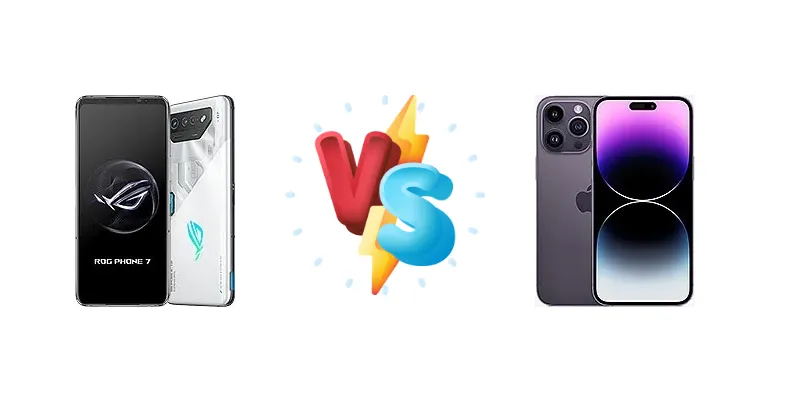
|
🏆 Quick Verdict
The ROG Phone 7 dominates in raw gaming performance and charging speed, boasting a brighter display and longer active use battery life. However, the iPhone 14 Pro Max offers a more refined user experience, superior camera processing, and tighter ecosystem integration. It depends on your priorities: gaming or overall excellence.
| PHONES | ||
|---|---|---|
| Phone Names | Asus ROG Phone 7 | Apple iPhone 14 Pro Max |
| Network | ||
|---|---|---|
| 2G bands | GSM 850 / 900 / 1800 / 1900 | GSM 850 / 900 / 1800 / 1900 |
| 3G bands | HSDPA 800 / 850 / 900 / 1700(AWS) / 1900 / 2100 | HSDPA 850 / 900 / 1700(AWS) / 1900 / 2100 |
| 4G bands | 1, 2, 3, 4, 5, 7, 8, 12, 17, 18, 19, 20, 25, 26, 28, 32, 34, 38, 39, 40, 41, 42, 43, 48, 66 - International | 1, 2, 3, 4, 5, 7, 8, 12, 13, 17, 18, 19, 20, 25, 26, 28, 30, 32, 34, 38, 39, 40, 41, 42, 46, 48, 66 - A2894, A2896 |
| 5G bands | 1, 2, 3, 5, 7, 8, 12, 18, 20, 25, 26, 28, 38, 40, 41, 48, 66, 77, 78, 79 SA/NSA/Sub6 - International | 1, 2, 3, 5, 7, 8, 12, 20, 25, 26, 28, 30, 38, 40, 41, 48, 66, 70, 77, 78, 79 SA/NSA/Sub6 - A2894, A2896 |
| Speed | HSPA, LTE (Up to 7CA), 5G | HSPA, LTE, 5G, EV-DO Rev.A 3.1 Mbps |
| Technology | GSM / CDMA / HSPA / LTE / 5G | GSM / CDMA / HSPA / EVDO / LTE / 5G |
| 1, 3, 5, 8, 28, 41, 77, 78, 79 SA/NSA/Sub6 - China | 1, 2, 3, 5, 7, 8, 12, 20, 25, 26, 28, 30, 38, 40, 41, 48, 66, 70, 77, 78, 79 SA/NSA/Sub6 - A2895 | |
| Launch | ||
|---|---|---|
| Announced | 2023, April 13 | 2022, September 07 |
| Status | Available. Released 2023, May | Available. Released 2022, September 16 |
| Body | ||
|---|---|---|
| Build | Glass front (Gorilla Glass Victus), glass back (Gorilla Glass 3), aluminum frame | Glass front, glass back, stainless steel frame |
| Dimensions | 173 x 77 x 10.3 mm (6.81 x 3.03 x 0.41 in) | 160.7 x 77.6 x 7.9 mm (6.33 x 3.06 x 0.31 in) |
| SIM | Nano-SIM + Nano-SIM | · Nano-SIM + eSIM + eSIM (max 2 at a time; International)· eSIM + eSIM (8 or more, max 2 at a time; USA)· Nano-SIM + Nano-SIM (China) |
| Weight | 239 g (8.43 oz) | 240 g (8.47 oz) |
| IP54 water resistant Illuminated RGB logo (on the back) Pressure sensitive zones (Gaming triggers) | IP68 dust/water resistant (up to 6m for 30 min) Apple Pay (Visa, MasterCard, AMEX certified) | |
| Display | ||
|---|---|---|
| Protection | Corning Gorilla Glass Victus | Ceramic Shield glass |
| Resolution | 1080 x 2448 pixels (~395 ppi density) | 1290 x 2796 pixels, 19.5:9 ratio (~460 ppi density) |
| Size | 6.78 inches, 109.5 cm2 (~82.2% screen-to-body ratio) | 6.7 inches, 110.2 cm2 (~88.3% screen-to-body ratio) |
| Type | AMOLED, 1B colors, 165Hz, HDR10+, 1000 nits (HBM), 1500 nits (peak) | LTPO Super Retina XDR OLED, 120Hz, HDR10, Dolby Vision, 1000 nits (typ), 2000 nits (HBM) |
| - | Always-On display | |
| Platform | ||
|---|---|---|
| CPU | Octa-core (1x3.2 GHz Cortex-X3 & 2x2.8 GHz Cortex-A715 & 2x2.8 GHz Cortex-A710 & 3x2.0 GHz Cortex-A510) | Hexa-core (2x3.46 GHz Everest + 4x2.02 GHz Sawtooth) |
| Chipset | Qualcomm SM8550-AB Snapdragon 8 Gen 2 (4 nm) | Apple A16 Bionic (4 nm) |
| GPU | Adreno 740 | Apple GPU (5-core graphics) |
| OS | Android 13, up to 2 major Android upgrades | iOS 16, upgradable to iOS 26.1 |
| Memory | ||
|---|---|---|
| Card slot | No | No |
| Internal | 256GB 12GB RAM, 512GB 16GB RAM | 128GB 6GB RAM, 256GB 6GB RAM, 512GB 6GB RAM, 1TB 6GB RAM |
| UFS 4.0 NTFS support for external storage | NVMe | |
| Main Camera | ||
|---|---|---|
| Features | LED flash, HDR, panorama | Dual-LED dual-tone flash, HDR (photo/panorama) |
| Single | - | 12 MP, f/1.9, 23mm (wide), 1/3.6", PDAF, OIS (unconfirmed) SL 3D, (depth/biometrics sensor) |
| Triple | 50 MP, f/1.9, 24mm (wide), 1/1.56", 1.0µm, PDAF 13 MP, f/2.2, 13mm, 120˚ (ultrawide) 5 MP (macro) | 48 MP, f/1.8, 24mm (wide), 1/1.28", 1.22µm, dual pixel PDAF, sensor-shift OIS 12 MP, f/2.8, 77mm (telephoto), 1/3.5", 1.0µm, PDAF, OIS, 3x optical zoom 12 MP, f/2.2, 13mm, 120˚ (ultrawide), 1/2.55", 1.4µm, dual pixel PDAF TOF 3D LiDAR scanner (depth) |
| Video | 8K@24fps, 4K@30/60fps, 1080p@30/60/120/240fps, 720p@480fps; gyro-EIS, HDR10+ | 4K@24/25/30/60fps, 1080p@25/30/60/120/240fps, 10-bit HDR, Dolby Vision HDR (up to 60fps), ProRes, stereo sound rec. |
| Selfie camera | ||
|---|---|---|
| Features | Panorama, HDR | HDR |
| Single | 32 MP, f/2.5, 29mm (wide), 1/3.2", 0.7µm | 12 MP, f/1.9, 23mm (wide), 1/3.6", 1.0µm, PDAF, OIS SL 3D, (depth/biometrics sensor) |
| Video | 1080p@30fps | 4K@24/25/30/60fps, 1080p@25/30/60/120fps, gyro-EIS |
| Sound | ||
|---|---|---|
| 3.5mm jack | Yes | No |
| 35mm jack | Yes | No |
| Loudspeaker | Yes, with stereo speakers (2 amplifiers) | Yes, with stereo speakers |
| 32-bit/384kHz audio | - | |
| Comms | ||
|---|---|---|
| Bluetooth | 5.3, A2DP, LE, aptX HD, aptX Adaptive, aptX Lossless | 5.3, A2DP, LE |
| NFC | Yes | Yes |
| Positioning | GPS (L1+L5), GLONASS (L1), BDS (B1I+B2a+B2c), GALILEO (E1+E5a), QZSS (L1+L5), NavIC (L5) | GPS (L1+L5), GLONASS, GALILEO, BDS, QZSS |
| Radio | No | No |
| USB | USB Type-C 3.1 (side), DisplayPort 1.4; USB Type-C 2.0 (bottom), OTG, accessory connector | Lightning, USB 2.0 |
| WLAN | Wi-Fi 802.11 a/b/g/n/ac/6e/7, tri-band, Wi-Fi Direct | Wi-Fi 802.11 a/b/g/n/ac/6, dual-band, hotspot |
| Features | ||
|---|---|---|
| Sensors | Fingerprint (under display, optical), accelerometer, gyro, proximity, compass | Face ID, accelerometer, gyro, proximity, compass, barometer |
| - | Ultra Wideband (UWB) support Emergency SOS via satellite (SMS sending/receiving) | |
| Battery | ||
|---|---|---|
| Charging | 65W wired, PD3.0, QC5, 100% in 42 min 10W reverse wired | Wired, PD2.0, 50% in 30 min 15W wireless (MagSafe) 15W wireless (Qi2) - requires iOS 17.2 update |
| Type | Li-Po 6000 mAh | Li-Ion 4323 mAh (16.68 Wh) |
| Misc | ||
|---|---|---|
| Colors | Phantom Black, Storm White | Space Black, Silver, Gold, Deep Purple |
| Models | AI2205_C | A2894, A2651, A2893, A2895, A2896, iphone15,3 |
| Price | € 744.85 | € 530.79 / $ 489.81 / £ 446.75 |
| SAR | - | 1.15 W/kg (head) 1.07 W/kg (body) |
| SAR EU | - | 0.99 W/kg (head) 0.98 W/kg (body) |
| Tests | ||
|---|---|---|
| Battery life | Endurance rating 131h | Endurance rating 121h |
| Camera | Photo / Video | Photo / Video |
| Display | Contrast ratio: Infinite (nominal) | Contrast ratio: Infinite (nominal) |
| Loudspeaker | -26.0 LUFS (Very good) | -24.3 LUFS (Very good) |
| Performance | AnTuTu: 1333597 (v9) GeekBench: 5098 (v5.5), 5617 (v6) GFXBench: 108fps (ES 3.1 onscreen) | AnTuTu: 955884 (v9) GeekBench: 5423 (v5.1) GFXBench: 54fps (ES 3.1 onscreen) |
Asus ROG Phone 7
- Exceptional gaming performance
- Brighter display
- Longer battery life
- Fast charging (65W)
- Customizable gaming features
- Camera not as good as iPhone
- Less polished software experience
- Bulky design
Apple iPhone 14 Pro Max
- Superior camera quality
- Refined user experience (iOS)
- Seamless ecosystem integration
- Premium design
- Excellent video recording
- Slower charging (20W wired)
- Less customizable
- Higher price
Display Comparison
The ROG Phone 7 boasts a staggering 1051 nits peak brightness, making it incredibly visible outdoors. The iPhone 14 Pro Max pushes even further with 1760 nits, offering even better sunlight readability. Both have excellent contrast ratios (infinite nominal), and smooth refresh rates (165Hz on ROG Phone 7 vs 120Hz on iPhone 14 Pro Max). The ROG Phone 7's higher refresh rate provides a slightly smoother visual experience for gaming.
Camera Comparison
The iPhone 14 Pro Max consistently delivers exceptional image quality with natural colors and excellent dynamic range. Its video recording capabilities are also industry-leading. The ROG Phone 7's camera is competent, but doesn't match the iPhone's overall quality and processing. The iPhone's computational photography is a significant advantage.
Performance
The ROG Phone 7's Snapdragon 8 Gen 2 is a beast for gaming, offering exceptional raw power and optimized thermal management. The iPhone 14 Pro Max's A16 Bionic is incredibly fast and efficient, excelling in everyday tasks and demanding applications. While the iPhone might feel snappier in some areas due to iOS optimization, the ROG Phone 7 has the edge in sustained gaming performance.
Battery Life
The ROG Phone 7 shines with its impressive 14:51h active use battery life and a massive 131h endurance rating. The iPhone 14 Pro Max offers a respectable 121h endurance rating. While both offer all-day battery life, the ROG Phone 7 provides significantly longer usage between charges, especially during intensive gaming.
Buying Guide
The Asus ROG Phone 7 is ideal for hardcore mobile gamers who prioritize performance, customization, and a long-lasting battery for extended play sessions. The iPhone 14 Pro Max is perfect for users seeking a premium, user-friendly experience with a top-tier camera, seamless integration with Apple's ecosystem, and a polished design.