
Asus ROG Phone 6D vs OnePlus 11R: A Deep Dive into Gaming and Charging Performance
| Phones Images | |||||
|---|---|---|---|---|---|
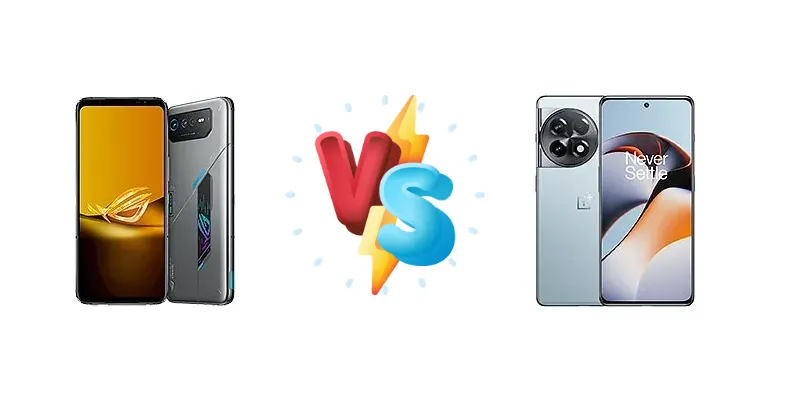
|
🏆 Quick Verdict
For the average user prioritizing all-around performance and incredibly fast charging, the OnePlus 11R emerges as the winner. Its Snapdragon 8+ Gen 1 delivers excellent speed, and the 100W charging is a game-changer. However, gamers who value sustained performance and a dedicated gaming ecosystem will find the ROG Phone 6D a more compelling choice.
| PHONES | ||
|---|---|---|
| Phone Names | Asus ROG Phone 6D | OnePlus 11R |
| Network | ||
|---|---|---|
| 2G bands | GSM 850 / 900 / 1800 / 1900 | GSM 850 / 900 / 1800 / 1900 |
| 3G bands | HSDPA 800 / 850 / 900 / 1700(AWS) / 1900 / 2100 | HSDPA 850 / 900 / 1700(AWS) / 2100 |
| 4G bands | 1, 2, 3, 4, 5, 7, 8, 12, 17, 18, 19, 20, 26, 28, 32, 34, 38, 39, 40, 41, 42, 43, 48 - A version | 1, 3, 4, 5, 8, 28, 34, 38, 39, 40, 41 |
| 5G bands | 1, 2, 3, 5, 7, 8, 12, 18, 20, 26, 28, 38, 40, 41, 48, 77, 78, 79 SA/NSA/Sub6 - A version | 1, 3, 5, 8, 28, 40, 41, 77, 78 SA/NSA |
| Speed | HSPA 42.2/11.5 Mbps, LTE (5CA) Cat19 1600/210 Mbps, 5G | HSPA, LTE (3CA), 5G |
| Technology | GSM / CDMA / HSPA / LTE / 5G | GSM / CDMA / HSPA / LTE / 5G |
| 1, 3, 5, 8, 28, 41, 77, 78, 79 SA/NSA/Sub6 - B version | CDMA 800 | |
| Launch | ||
|---|---|---|
| Announced | 2022, September 19 | 2023, February 07 |
| Status | Available. Released 2022, October 11 | Available. Released 2023, February 21 |
| Body | ||
|---|---|---|
| Build | Glass front (Gorilla Glass Victus), glass back (Gorilla Glass 3), aluminum frame | Glass front, glass back (Gorilla Glass 5), plastic frame |
| Dimensions | 173 x 77 x 10.4 mm (6.81 x 3.03 x 0.41 in) | 163.4 x 74.3 x 8.7 mm (6.43 x 2.93 x 0.34 in) |
| SIM | Nano-SIM + Nano-SIM | Nano-SIM + Nano-SIM |
| Weight | 239 g (8.43 oz) | 204 g (7.20 oz) |
| IPX4 water resistant Illuminated RGB logo (on the back) Pressure sensitive zones (Gaming triggers) | - | |
| Display | ||
|---|---|---|
| Protection | Corning Gorilla Glass Victus | - |
| Resolution | 1080 x 2448 pixels (~395 ppi density) | 1240 x 2772 pixels, 20:9 ratio (~451 ppi density) |
| Size | 6.78 inches, 109.5 cm2 (~82.2% screen-to-body ratio) | 6.74 inches, 109.2 cm2 (~90.0% screen-to-body ratio) |
| Type | AMOLED, 1B colors, 165Hz, HDR10+, 800 nits (typ), 1200 nits (peak) | Fluid AMOLED, 1B colors, 120Hz, HDR10+, 1450 nits (peak) |
| Platform | ||
|---|---|---|
| CPU | Octa-core (1x3.35 GHz Cortex-X2 & 3x2.85 GHz Cortex-A710 & 4x1.80 GHz Cortex-A510) | Octa-core (1x3.0 GHz Cortex-X2 & 3x2.5 GHz Cortex-A710 & 4x1.80 GHz Cortex-A510) |
| Chipset | Mediatek Dimensity 9000+ (4 nm) | Qualcomm SM8475 Snapdragon 8+ Gen 1 (4 nm) |
| GPU | Mali-G710 MC10 | Adreno 730 |
| OS | Android 12 | Android 13, upgradable to Android 15, OxygenOS 15 |
| Memory | ||
|---|---|---|
| Card slot | No | No |
| Internal | 256GB 12GB RAM, 256GB 16GB RAM | 128GB 8GB RAM, 256GB 16GB RAM, 512GB 18GB RAM |
| UFS 3.1 NTFS support for external storage | UFS 3.1 | |
| Main Camera | ||
|---|---|---|
| Features | LED flash, HDR, panorama | Color spectrum sensor, LED flash, HDR, panorama |
| Single | - | 16 MP, f/2.4, 24mm (wide), 1/3.09", 1.0µm |
| Triple | 50 MP, f/1.9, 24mm (wide), 1/1.56", 1.0µm, PDAF 13 MP, f/2.2, 13mm (ultrawide) 5 MP (macro) | 50 MP, f/1.8, 24mm (wide), 1/1.56", 1.0µm, multi-directional PDAF, OIS 8 MP, f/2.2, 120˚ (ultrawide), 1/4.0", 1.12µm 2 MP (macro) |
| Video | 8K@24fps, 4K@30/60fps, 1080p@30/60/120/240fps, 720p@480fps; gyro-EIS, HDR10+ | 4K@30/60fps, 1080p@30/60/240fps, gyro-EIS |
| Selfie camera | ||
|---|---|---|
| Features | Panorama, HDR | HDR |
| Single | 12 MP, 28mm (wide) | 16 MP, f/2.4, 24mm (wide), 1/3.09", 1.0µm |
| Video | 1080p@30fps | 1080p@30fps |
| Sound | ||
|---|---|---|
| 3.5mm jack | Yes | No |
| 35mm jack | Yes | No |
| Loudspeaker | Yes, with stereo speakers (2 amplifiers) | Yes, with stereo speakers |
| 24-bit/192kHz audio | 24-bit/192kHz audio | |
| Comms | ||
|---|---|---|
| Bluetooth | 5.3, A2DP, LE, aptX HD, aptX Adaptive | 5.3, A2DP, LE, aptX HD |
| Infrared port | - | Yes |
| NFC | Yes | Yes |
| Positioning | GPS (L1+L5), GLONASS (L1), BDS (B1I+B1c+B2a), GALILEO (E1+E5a), QZSS (L1), NavIC (L5) | GPS (L1+L5), GLONASS (G1), BDS (B1I+B1c+B2a), GALILEO (E1+E5a), QZSS (L1+L5) |
| Radio | No | No |
| USB | USB Type-C 3.1 (side), USB Type-C 2.0 (bottom), OTG, accessory connector | USB Type-C 2.0 |
| WLAN | Wi-Fi 802.11 a/b/g/n/ac/6e, tri-band, Wi-Fi Direct | Wi-Fi 802.11 a/b/g/n/ac/6, dual-band |
| Features | ||
|---|---|---|
| Sensors | Fingerprint (under display, optical), accelerometer, gyro, proximity, compass | Fingerprint (under display, optical), accelerometer, gyro, proximity, compass |
| Battery | ||
|---|---|---|
| Charging | 65W wired, PD3.0 10W reverse wired | 100W wired |
| Type | Li-Po 6000 mAh | Li-Po 5000 mAh |
| Misc | ||
|---|---|---|
| Colors | Space Gray | Galactic Silver, Sonic Black, Solar Red |
| Models | AI2203, AI2203_D | CPH2487 |
| Price | About 690 EUR | About 600 EUR |
| SAR | - | 1.16 W/kg (head) 0.61 W/kg (body) |
Asus ROG Phone 6D
- Potentially better sustained gaming performance due to Dimensity 9000+ architecture.
- Gaming-centric software features and ecosystem.
- Reverse wireless charging capability.
- Slower charging speed (65W vs 100W).
- May prioritize gaming features over all-around camera performance.
OnePlus 11R
- Significantly faster 100W charging.
- Strong all-around performance with Snapdragon 8+ Gen 1.
- Likely more versatile camera system.
- Potentially more prone to thermal throttling under sustained load.
- Lacks gaming-specific features of the ROG Phone 6D.
Display Comparison
While both phones likely feature high refresh rate AMOLED displays (data not provided), the core difference lies in their underlying philosophies. The ROG Phone 6D, typical of Asus’s gaming focus, likely prioritizes color accuracy and low latency for competitive gaming. The OnePlus 11R, aiming for broader appeal, may lean towards a more vibrant, consumer-friendly color profile. The absence of LTPO information means we can't assess dynamic refresh rate efficiency, but the ROG Phone's gaming optimizations might include features to minimize display-induced lag.
Camera Comparison
Without detailed camera specifications, a direct comparison is limited. However, given the market positioning, the OnePlus 11R likely prioritizes a versatile camera system with a focus on everyday photography. The ROG Phone 6D, while capable, likely treats the camera as a secondary feature. The Snapdragon 8+ Gen 1’s ISP (Image Signal Processor) is generally regarded as excellent, offering strong image processing capabilities. The Dimensity 9000+ also has a capable ISP, but Asus may prioritize different image processing algorithms geared towards gaming content creation. We can assume both phones will have a main camera, but sensor size and optical image stabilization (OIS) details are needed for a more definitive assessment.
Performance
The chipset battle is central here. The OnePlus 11R’s Snapdragon 8+ Gen 1 (4nm) is known for its raw processing power, with a peak CPU clock speed of 3.0 GHz. However, the Asus ROG Phone 6D’s Mediatek Dimensity 9000+ (4nm) counters with a slightly higher peak CPU clock of 3.35 GHz. Crucially, the Dimensity 9000+’s architecture, with its Cortex-X2 prime core, is designed for sustained performance, potentially mitigating thermal throttling during prolonged gaming. Both utilize the same Cortex-A710 and A510 efficiency cores, but the ROG Phone’s cooling system (not detailed in the provided data) will be a key factor in realizing the Dimensity’s potential. The OnePlus 11R benefits from Qualcomm’s optimizations, but may be more prone to throttling under heavy, sustained load.
Battery Life
The OnePlus 11R’s 100W wired charging is a significant advantage. This allows for a full charge in a fraction of the time compared to the Asus ROG Phone 6D’s 65W charging. While the ROG Phone 6D may have a larger battery capacity (data not provided), the OnePlus 11R’s faster charging mitigates the impact of a potentially smaller battery. The difference between 65W and 100W is substantial in real-world usage, especially for users who frequently top up their phones throughout the day. The ROG Phone 6D does offer 10W reverse wired charging, a niche feature for charging accessories, which the OnePlus 11R lacks.
Buying Guide
Buy the Asus ROG Phone 6D if you need a phone specifically optimized for extended gaming sessions, appreciate the gaming-centric software features, and prioritize sustained performance over peak speed. Buy the OnePlus 11R if you prefer a more versatile smartphone experience with blazing-fast charging, a cleaner software experience, and a focus on everyday performance and responsiveness.