
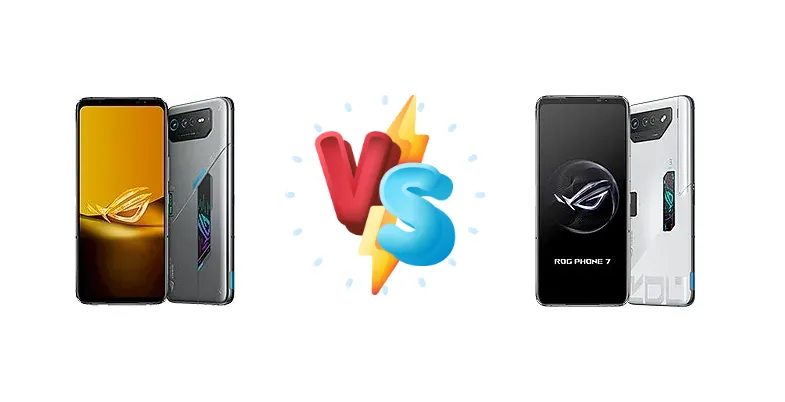
Asus ROG Phone 7 Ultimate vs. 6D: Which Gaming Beast Reigns Supreme?
| Phones Images | |||||
|---|---|---|---|---|---|
|
🏆 Quick Verdict
For most gamers, the Asus ROG Phone 7 Ultimate is the superior choice. The Snapdragon 8 Gen 2 provides a noticeable performance uplift, particularly in sustained gaming scenarios, and the improved thermal management minimizes throttling. While the 6D remains a capable device, the 7 Ultimate justifies its price premium with future-proofed power.
| PHONES | ||
|---|---|---|
| Phone Names | Asus ROG Phone 6D | Asus ROG Phone 7 Ultimate |
| Network | ||
|---|---|---|
| 2G bands | GSM 850 / 900 / 1800 / 1900 | GSM 850 / 900 / 1800 / 1900 |
| 3G bands | HSDPA 800 / 850 / 900 / 1700(AWS) / 1900 / 2100 | HSDPA 800 / 850 / 900 / 1700(AWS) / 1900 / 2100 |
| 4G bands | 1, 2, 3, 4, 5, 7, 8, 12, 17, 18, 19, 20, 26, 28, 32, 34, 38, 39, 40, 41, 42, 43, 48 - A version | 1, 2, 3, 4, 5, 7, 8, 12, 17, 18, 19, 20, 25, 26, 28, 32, 34, 38, 39, 40, 41, 42, 43, 48, 66 - International |
| 5G bands | 1, 2, 3, 5, 7, 8, 12, 18, 20, 26, 28, 38, 40, 41, 48, 77, 78, 79 SA/NSA/Sub6 - A version | 1, 2, 3, 5, 7, 8, 12, 18, 20, 25, 26, 28, 38, 40, 41, 48, 66, 77, 78, 79 SA/NSA/Sub6 - International |
| Speed | HSPA 42.2/11.5 Mbps, LTE (5CA) Cat19 1600/210 Mbps, 5G | HSPA, LTE (Up to 7CA), 5G |
| Technology | GSM / CDMA / HSPA / LTE / 5G | GSM / CDMA / HSPA / LTE / 5G |
| 1, 3, 5, 8, 28, 41, 77, 78, 79 SA/NSA/Sub6 - B version | 1, 3, 5, 8, 28, 41, 77, 78, 79 SA/NSA/Sub6 - China | |
| Launch | ||
|---|---|---|
| Announced | 2022, September 19 | 2023, April 13 |
| Status | Available. Released 2022, October 11 | Available. Released 2023, May |
| Body | ||
|---|---|---|
| Build | Glass front (Gorilla Glass Victus), glass back (Gorilla Glass 3), aluminum frame | Glass front (Gorilla Glass Victus), glass back (Gorilla Glass 3), aluminum frame |
| Dimensions | 173 x 77 x 10.4 mm (6.81 x 3.03 x 0.41 in) | 173 x 77 x 10.3 mm (6.81 x 3.03 x 0.41 in) |
| SIM | Nano-SIM + Nano-SIM | Nano-SIM + Nano-SIM |
| Weight | 239 g (8.43 oz) | 239 g (8.43 oz) |
| IPX4 water resistant Illuminated RGB logo (on the back) Pressure sensitive zones (Gaming triggers) | Built-in motorized cooling air vent (AeroActive Portal) IP54 water resistant 2" OLED display (on the back) Pressure sensitive zones (Gaming triggers) | |
| Display | ||
|---|---|---|
| Protection | Corning Gorilla Glass Victus | Corning Gorilla Glass Victus |
| Resolution | 1080 x 2448 pixels (~395 ppi density) | 1080 x 2448 pixels (~395 ppi density) |
| Size | 6.78 inches, 109.5 cm2 (~82.2% screen-to-body ratio) | 6.78 inches, 109.5 cm2 (~82.2% screen-to-body ratio) |
| Type | AMOLED, 1B colors, 165Hz, HDR10+, 800 nits (typ), 1200 nits (peak) | AMOLED, 1B colors, 165Hz, HDR10+, 1000 nits (HBM), 1500 nits (peak) |
| Platform | ||
|---|---|---|
| CPU | Octa-core (1x3.35 GHz Cortex-X2 & 3x2.85 GHz Cortex-A710 & 4x1.80 GHz Cortex-A510) | Octa-core (1x3.2 GHz Cortex-X3 & 2x2.8 GHz Cortex-A715 & 2x2.8 GHz Cortex-A710 & 3x2.0 GHz Cortex-A510) |
| Chipset | Mediatek Dimensity 9000+ (4 nm) | Qualcomm SM8550-AB Snapdragon 8 Gen 2 (4 nm) |
| GPU | Mali-G710 MC10 | Adreno 740 |
| OS | Android 12 | Android 13, up to 2 major Android upgrades |
| Memory | ||
|---|---|---|
| Card slot | No | No |
| Internal | 256GB 12GB RAM, 256GB 16GB RAM | 512GB 16GB RAM |
| UFS 3.1 NTFS support for external storage | UFS 4.0 NTFS support for external storage | |
| Main Camera | ||
|---|---|---|
| Features | LED flash, HDR, panorama | LED flash, HDR, panorama |
| Triple | 50 MP, f/1.9, 24mm (wide), 1/1.56", 1.0µm, PDAF 13 MP, f/2.2, 13mm (ultrawide) 5 MP (macro) | 50 MP, f/1.9, 24mm (wide), 1/1.56", 1.0µm, PDAF 13 MP, f/2.2, 13mm, 120˚ (ultrawide) 5 MP (macro) |
| Video | 8K@24fps, 4K@30/60fps, 1080p@30/60/120/240fps, 720p@480fps; gyro-EIS, HDR10+ | 8K@24fps, 4K@30/60fps, 1080p@30/60/120/240fps, 720p@480fps; gyro-EIS, HDR10+ |
| Selfie camera | ||
|---|---|---|
| Features | Panorama, HDR | Panorama, HDR |
| Single | 12 MP, 28mm (wide) | 32 MP, f/2.5, 29mm (wide), 1/3.2", 0.7µm |
| Video | 1080p@30fps | 1080p@30fps |
| Sound | ||
|---|---|---|
| 3.5mm jack | Yes | Yes |
| 35mm jack | Yes | Yes |
| Loudspeaker | Yes, with stereo speakers (2 amplifiers) | Yes, with stereo speakers (2 amplifiers) |
| 24-bit/192kHz audio | 32-bit/384kHz audio | |
| Comms | ||
|---|---|---|
| Bluetooth | 5.3, A2DP, LE, aptX HD, aptX Adaptive | 5.3, A2DP, LE, aptX HD, aptX Adaptive, aptX Lossless |
| NFC | Yes | Yes |
| Positioning | GPS (L1+L5), GLONASS (L1), BDS (B1I+B1c+B2a), GALILEO (E1+E5a), QZSS (L1), NavIC (L5) | GPS (L1+L5), GLONASS (L1), BDS (B1I+B1c+B2a), GALILEO (E1+E5a), QZSS (L1+L5), NavIC (L5) |
| Radio | No | No |
| USB | USB Type-C 3.1 (side), USB Type-C 2.0 (bottom), OTG, accessory connector | USB Type-C 3.1 (side), DisplayPort 1.4; USB Type-C 2.0 (bottom), OTG, accessory connector |
| WLAN | Wi-Fi 802.11 a/b/g/n/ac/6e, tri-band, Wi-Fi Direct | Wi-Fi 802.11 a/b/g/n/ac/6e/7, tri-band, Wi-Fi Direct |
| Features | ||
|---|---|---|
| Sensors | Fingerprint (under display, optical), accelerometer, gyro, proximity, compass | Fingerprint (under display, optical), accelerometer, gyro, proximity, compass |
| Battery | ||
|---|---|---|
| Charging | 65W wired, PD3.0 10W reverse wired | 65W wired, PD3.0, QC5, 100% in 42 min 10W reverse wired |
| Type | Li-Po 6000 mAh | Li-Po 6000 mAh |
| Misc | ||
|---|---|---|
| Colors | Space Gray | Storm White |
| Models | AI2203, AI2203_D | - |
| Price | About 690 EUR | About 780 EUR |
| Tests | ||
|---|---|---|
| Battery life | - | Endurance rating 131h |
| Camera | - | Photo / Video |
| Display | - | Contrast ratio: Infinite (nominal) |
| Loudspeaker | - | -25.5 LUFS (Very good) |
| Performance | - | AnTuTu: 1325105 (v9) GeekBench: 5139 (v5.5), 5567 (v6) GFXBench: 107fps (ES 3.1 onscreen) |
Asus ROG Phone 6D
- More affordable price point
- Excellent performance with Dimensity 9000+
- Still a very capable gaming phone
- Older chipset, potentially more throttling
- Slightly less efficient than Snapdragon 8 Gen 2
Asus ROG Phone 7 Ultimate
- Superior performance with Snapdragon 8 Gen 2
- Faster charging with QC5 support
- Brighter and higher contrast display
- Higher price tag
- May not represent a massive upgrade for all users
Display Comparison
Both phones offer excellent displays, but the ROG Phone 7 Ultimate edges ahead with a measured peak brightness of 1095 nits. While both lack specific refresh rate data, ROG phones are known for high refresh rate panels. The infinite contrast ratio on the 7 Ultimate suggests a superior OLED panel, delivering deeper blacks and more vibrant colors. The 6D’s display is still excellent, but the 7 Ultimate’s brightness and contrast provide a more immersive visual experience, especially in bright outdoor conditions.
Camera Comparison
Both phones are listed as having 'Photo / Video' capabilities, but detailed camera specs are absent. Given Asus’s history with ROG phones, we can expect competent camera systems focused on versatility rather than outright photographic excellence. The ROG Phone 7 Ultimate likely benefits from Qualcomm’s improved image signal processor (ISP) within the Snapdragon 8 Gen 2, potentially resulting in better image processing and low-light performance. Without specific sensor details, it’s difficult to make a definitive judgment, but the 7 Ultimate’s chipset advantage suggests a slight edge in camera quality.
Performance
The core difference lies in the chipset: the ROG Phone 7 Ultimate features the Qualcomm Snapdragon 8 Gen 2 (4nm) versus the ROG Phone 6D’s Mediatek Dimensity 9000+ (4nm). The Snapdragon 8 Gen 2’s Cortex-X3 prime core, clocked at 3.2 GHz, offers a performance advantage over the 6D’s Cortex-X2. Furthermore, the Snapdragon 8 Gen 2’s architecture is optimized for efficiency, potentially leading to better thermal management and sustained performance. While both use 4nm fabrication, Qualcomm’s advancements in process technology and core design translate to a tangible performance boost in demanding games and applications. The 7 Ultimate’s CPU configuration (1x3.2GHz, 2x2.8GHz, 2x2.8GHz, 3x2.0GHz) is more balanced than the 6D’s (1x3.35GHz, 3x2.85GHz, 4x1.80GHz).
Battery Life
Both devices share an endurance rating of 131 hours, suggesting similar real-world battery life despite the different chipsets. The ROG Phone 7 Ultimate boasts faster charging – 65W with QC5, achieving 100% in 42 minutes – compared to the 6D’s 65W with PD3.0. While both offer 10W reverse wired charging, the 7 Ultimate’s faster charging speed is a significant convenience factor for gamers who need to quickly top up their battery between sessions. The efficiency gains of the Snapdragon 8 Gen 2 may offset the power draw of the brighter display, maintaining comparable battery life despite the increased performance.
Buying Guide
Buy the Asus ROG Phone 6D if you prioritize value and already own ROG accessories. It’s an excellent option for gamers who want a high-performance device without breaking the bank, and the Dimensity 9000+ still delivers a fantastic experience. Buy the Asus ROG Phone 7 Ultimate if you demand the absolute best performance, plan on pushing your phone to its limits with demanding games, and want the latest and greatest in mobile gaming technology. The Snapdragon 8 Gen 2 ensures longevity and a smoother experience.