
Asus ROG Phone 6D Ultimate vs ZTE nubia Z50 Ultra: A Deep Dive Comparison
| Phones Images | |||||
|---|---|---|---|---|---|
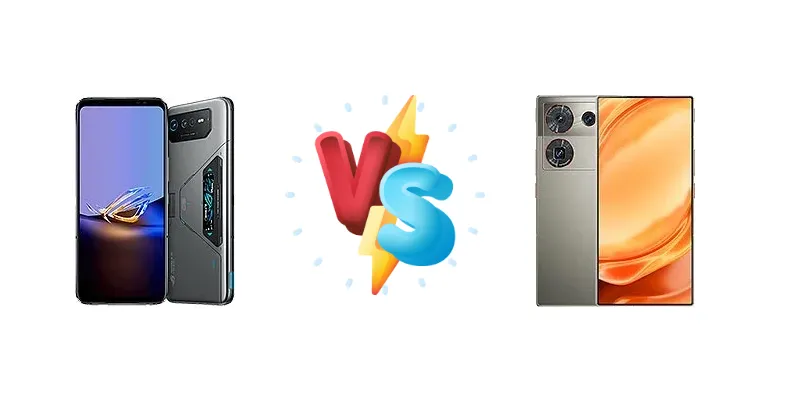
|
🏆 Quick Verdict
For the average user prioritizing raw performance and camera versatility, the ZTE nubia Z50 Ultra emerges as the winner. Its Snapdragon 8 Gen 2 chipset delivers a noticeable performance edge, and its 80W charging is faster than the ROG Phone's 65W. However, gamers heavily invested in the ROG ecosystem will still find the 6D Ultimate compelling.
| PHONES | ||
|---|---|---|
| Phone Names | Asus ROG Phone 6D Ultimate | ZTE nubia Z50 Ultra |
| Network | ||
|---|---|---|
| 2G bands | GSM 850 / 900 / 1800 / 1900 | GSM 850 / 900 / 1800 / 1900 |
| 3G bands | HSDPA 800 / 850 / 900 / 1700(AWS) / 1900 / 2100 | HSDPA 850 / 900 / 1700(AWS) / 1900 / 2100 |
| 4G bands | 1, 2, 3, 4, 5, 7, 8, 12, 17, 18, 19, 20, 26, 28, 32, 34, 38, 39, 40, 41, 42, 43, 48 - A version | LTE |
| 5G bands | 1, 2, 3, 5, 7, 8, 12, 18, 20, 26, 28, 38, 40, 41, 48, 77, 78, 79 SA/NSA/Sub6 - A version | SA/NSA |
| Speed | HSPA 42.2/11.5 Mbps, LTE (5CA) Cat19 1600/210 Mbps, 5G | HSPA, LTE, 5G |
| Technology | GSM / CDMA / HSPA / LTE / 5G | GSM / CDMA / HSPA / CDMA2000 / LTE / 5G |
| 1, 3, 5, 8, 28, 41, 77, 78, 79 SA/NSA/Sub6 - B version | CDMA2000 1x | |
| Launch | ||
|---|---|---|
| Announced | 2022, September 19 | 2023, March 07 |
| Status | Available. Released 2022, October 07 | Available. Released 2023, March 14 |
| Body | ||
|---|---|---|
| Build | Glass front (Gorilla Glass Victus), glass back (Gorilla Glass 3), aluminum frame | - |
| Dimensions | 173 x 77 x 10.4 mm (6.81 x 3.03 x 0.41 in) | 163.9 x 76.3 x 8.3 mm (6.45 x 3.00 x 0.33 in) |
| SIM | Nano-SIM + Nano-SIM | Nano-SIM + Nano-SIM |
| Weight | 247 g (8.71 oz) | 228 g (8.04 oz) |
| Built-in motorized cooling air vent (AeroActive Portal) IPX4 water resistant 2" OLED display (on the back) Pressure sensitive zones (Gaming triggers) | - | |
| Display | ||
|---|---|---|
| Protection | Corning Gorilla Glass Victus | - |
| Resolution | 1080 x 2448 pixels (~395 ppi density) | 1116 x 2480 pixels, 20:9 ratio (~400 ppi density) |
| Size | 6.78 inches, 109.5 cm2 (~82.2% screen-to-body ratio) | 6.8 inches, 111.6 cm2 (~89.3% screen-to-body ratio) |
| Type | AMOLED, 1B colors, 165Hz, HDR10+, 800 nits (typ), 1200 nits (peak) | AMOLED, 1B colors, 120Hz, HDR10+, 1500 nits (peak) |
| Platform | ||
|---|---|---|
| CPU | Octa-core (1x3.35 GHz Cortex-X2 & 3x2.85 GHz Cortex-A710 & 4x1.80 GHz Cortex-A510) | Octa-core (1x3.2 GHz Cortex-X3 & 2x2.8 GHz Cortex-A715 & 2x2.8 GHz Cortex-A710 & 3x2.0 GHz Cortex-A510) |
| Chipset | Mediatek Dimensity 9000+ (4 nm) | Qualcomm SM8550-AB Snapdragon 8 Gen 2 (4 nm) |
| GPU | Mali-G710 MC10 | Adreno 740 |
| OS | Android 12 | Android 13, MyOS 13 |
| Memory | ||
|---|---|---|
| Card slot | No | No |
| Internal | 512GB 16GB RAM | 256GB 8GB RAM, 256GB 12GB RAM, 512GB 12GB RAM, 1TB 16GB RAM |
| UFS 3.1 NTFS support for external storage | UFS 4.0 | |
| Main Camera | ||
|---|---|---|
| Features | LED flash, HDR, panorama | Laser AF, Ring-LED, dual-tone flash, panorama, HDR |
| Single | - | 16 MP, f/2.0, 26mm (wide), 1/2.8", 1.22µm, under display |
| Triple | 50 MP, f/1.9, 24mm (wide), 1/1.56", 1.0µm, PDAF 13 MP, f/2.2, 13mm (ultrawide) 5 MP (macro) | 64 MP, f/1.6, 35mm (standard), 1/1.73", 0.8µm, PDAF, OIS 64 MP, f/3.3, 85mm (periscope telephoto), 1/2.0", PDAF, OIS, 3.3x optical zoom (vs. 26mm cam) 50 MP, f/2.X, 14mm, 116˚ (ultrawide), PDAF |
| Video | 8K@24fps, 4K@30/60fps, 1080p@30/60/120/240fps, 720p@480fps; gyro-EIS, HDR10+ | 8K@30fps, 4K@30/60/120fps, 1080p@30/60fps, gyro-EIS, HDR10, 10‑bit video |
| Selfie camera | ||
|---|---|---|
| Features | Panorama, HDR | HDR |
| Single | 12 MP, 28mm (wide) | 16 MP, f/2.0, 26mm (wide), 1/2.8", 1.22µm, under display |
| Video | 1080p@30fps | 1080p@30fps |
| Sound | ||
|---|---|---|
| 3.5mm jack | Yes | No |
| 35mm jack | Yes | No |
| Loudspeaker | Yes, with stereo speakers (2 amplifiers) | Yes, with stereo speakers |
| 24-bit/192kHz audio | 24-bit/192kHz audio | |
| Comms | ||
|---|---|---|
| Bluetooth | 5.3, A2DP, LE, aptX HD, aptX Adaptive | 5.3, A2DP, LE Audio, aptX HD, aptX Adaptive, aptX Lossless |
| Infrared port | - | Yes |
| NFC | Yes | Yes |
| Positioning | GPS (L1+L5), GLONASS (L1), BDS (B1I+B1c+B2a), GALILEO (E1+E5a), QZSS (L1), NavIC (L5) | GPS (L1+L5), GLONASS (L1+L2+L5), GALILEO, BDS |
| Radio | No | No |
| USB | USB Type-C 3.1 (side), USB Type-C 2.0 (bottom), OTG, accessory connector | USB Type-C 3.1, OTG |
| WLAN | Wi-Fi 802.11 a/b/g/n/ac/6e, tri-band, Wi-Fi Direct | Wi-Fi 802.11 a/b/g/n/ac/6e, dual-band, Wi-Fi Direct |
| Features | ||
|---|---|---|
| Sensors | Fingerprint (under display, optical), accelerometer, gyro, proximity, compass | Fingerprint (under display, optical), accelerometer, gyro, proximity, compass |
| Battery | ||
|---|---|---|
| Charging | 65W wired, PD3.0 10W reverse wired | 80W wired, PD3.0, QC4 |
| Type | Li-Po 6000 mAh | Li-Po 5000 mAh |
| Misc | ||
|---|---|---|
| Colors | Space Gray | Black, Silver, Starry Sky |
| Models | AI2203, AI2203-3E010EU | NX712J |
| Price | About 1100 EUR | About 540 EUR |
| Tests | ||
|---|---|---|
| Battery life | Endurance rating 103h | - |
| Camera | Photo / Video | - |
| Display | Contrast ratio: Infinite (nominal) | - |
| Loudspeaker | -24.1 LUFS (Very good) | - |
| Performance | AnTuTu: 1107464 (v9) GeekBench: 4575 (v5.1) GFXBench: 68fps (ES 3.1 onscreen) | - |
Asus ROG Phone 6D Ultimate
- Dedicated gaming features (AirTriggers)
- Robust ROG ecosystem and accessories
- Good battery endurance (103h)
- Older chipset (Dimensity 9000+)
- Slower charging (65W)
- Limited camera information
ZTE nubia Z50 Ultra
- Latest Snapdragon 8 Gen 2 chipset
- Faster 80W charging with QC4/PD3.0
- Potentially superior camera system
- Lacks dedicated gaming features
- May not have the same level of software optimization for gaming
- ROG ecosystem integration absent
Display Comparison
Both devices feature displays with an 'Infinite' (nominal) contrast ratio, suggesting excellent black levels. However, detailed specifications like peak brightness and panel type (AMOLED is assumed for both) are missing. The nubia Z50 Ultra's potential advantage lies in its likely higher refresh rate, a common feature in Snapdragon 8 Gen 2 flagships, which would translate to smoother scrolling and gaming. Without specific data, it's difficult to assess color accuracy or HDR support, but both are expected to be competitive within their price brackets.
Camera Comparison
Context data only indicates 'Photo / Video' capabilities for the Asus ROG Phone 6D Ultimate, making a detailed comparison challenging. The ZTE nubia Z50 Ultra is expected to have a more sophisticated camera system, potentially including a high-resolution main sensor (market speculation suggests a 200MP sensor, though unconfirmed). The Snapdragon 8 Gen 2’s ISP (Image Signal Processor) is also more advanced, offering improved image processing capabilities, noise reduction, and dynamic range. Without specific aperture and sensor size details for the ROG Phone, it’s safe to assume the nubia Z50 Ultra will deliver superior image quality, especially in low-light conditions.
Performance
The core difference lies in the chipsets. The ZTE nubia Z50 Ultra’s Snapdragon 8 Gen 2 (4nm) boasts a Cortex-X3 prime core clocked at 3.2 GHz, offering a significant architectural advantage over the Asus ROG Phone 6D Ultimate’s Dimensity 9000+ (4nm) and its Cortex-X2 core at 3.35 GHz. While the Dimensity 9000+ has a slightly higher clock speed on its prime core, the Snapdragon 8 Gen 2’s newer architecture and improved efficiency translate to better sustained performance and thermal management. The Snapdragon 8 Gen 2’s CPU configuration (1x3.2GHz Cortex-X3, 2x2.8GHz Cortex-A715, 2x2.8GHz Cortex-A710, 3x2.0GHz Cortex-A510) is more balanced than the Dimensity 9000+'s (1x3.35 GHz Cortex-X2, 3x2.85 GHz Cortex-A710, 4x1.80 GHz Cortex-A510), potentially benefiting multi-threaded workloads. Both utilize 4nm fabrication, but Qualcomm’s process optimization typically yields better results.
Battery Life
The Asus ROG Phone 6D Ultimate has an endurance rating of 103 hours, indicating solid battery life. However, the ZTE nubia Z50 Ultra’s 80W wired charging (with PD3.0 and QC4 support) significantly outperforms the ROG Phone’s 65W (with PD3.0) and 10W reverse wired charging. This faster charging speed translates to quicker top-ups, minimizing downtime. While the ROG Phone’s endurance rating suggests comparable battery capacity, the nubia Z50 Ultra’s charging advantage is a key differentiator for users who prioritize convenience.
Buying Guide
Buy the Asus ROG Phone 6D Ultimate if you need a dedicated gaming phone with specialized features like AirTriggers and a focus on sustained performance within the ROG ecosystem. Buy the ZTE nubia Z50 Ultra if you prefer a more versatile flagship experience with a superior processor, faster charging, and a potentially more refined camera system, even if it lacks dedicated gaming accessories.