
Asus ROG Phone 6D Ultimate vs. ZTE RedMagic 8 Pro+: The Ultimate Gaming Phone Showdown
| Phones Images | |||||
|---|---|---|---|---|---|
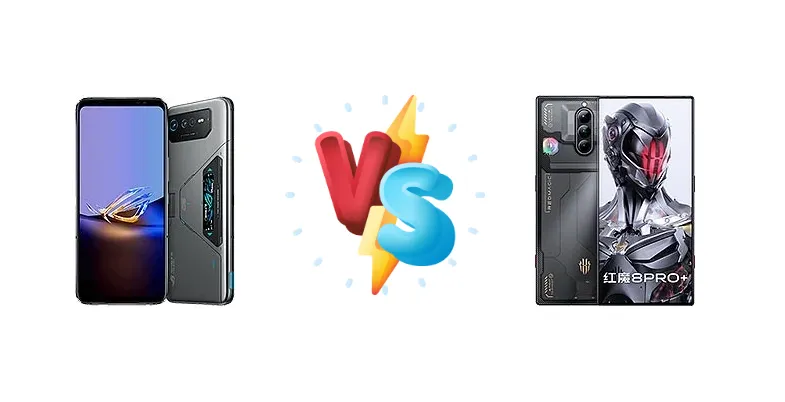
|
🏆 Quick Verdict
For the average gamer prioritizing sustained performance and a more refined software experience, the ZTE nubia RedMagic 8 Pro+ emerges as the winner. Its Snapdragon 8 Gen 2 chipset offers a clear performance advantage, and the 165W charging is a game-changer for minimizing downtime. However, the ROG Phone 6D Ultimate remains a strong contender for users valuing a more established ecosystem.
| PHONES | ||
|---|---|---|
| Phone Names | Asus ROG Phone 6D Ultimate | ZTE nubia RedMagic 8 Pro+ |
| Network | ||
|---|---|---|
| 2G bands | GSM 850 / 900 / 1800 / 1900 | GSM 850 / 900 / 1800 / 1900 |
| 3G bands | HSDPA 800 / 850 / 900 / 1700(AWS) / 1900 / 2100 | HSDPA 850 / 900 / 1700(AWS) / 1900 / 2100 |
| 4G bands | 1, 2, 3, 4, 5, 7, 8, 12, 17, 18, 19, 20, 26, 28, 32, 34, 38, 39, 40, 41, 42, 43, 48 - A version | LTE |
| 5G bands | 1, 2, 3, 5, 7, 8, 12, 18, 20, 26, 28, 38, 40, 41, 48, 77, 78, 79 SA/NSA/Sub6 - A version | SA/NSA |
| Speed | HSPA 42.2/11.5 Mbps, LTE (5CA) Cat19 1600/210 Mbps, 5G | HSPA, LTE, 5G |
| Technology | GSM / CDMA / HSPA / LTE / 5G | GSM / CDMA / HSPA / EVDO / LTE / 5G |
| 1, 3, 5, 8, 28, 41, 77, 78, 79 SA/NSA/Sub6 - B version | - | |
| Launch | ||
|---|---|---|
| Announced | 2022, September 19 | 2022, December 26 |
| Status | Available. Released 2022, October 07 | Available. Released 2022, December 28 |
| Body | ||
|---|---|---|
| Build | Glass front (Gorilla Glass Victus), glass back (Gorilla Glass 3), aluminum frame | Glass front, glass back, aluminum frame |
| Dimensions | 173 x 77 x 10.4 mm (6.81 x 3.03 x 0.41 in) | 164 x 76.4 x 8.9 mm (6.46 x 3.01 x 0.35 in) |
| SIM | Nano-SIM + Nano-SIM | Nano-SIM + Nano-SIM |
| Weight | 247 g (8.71 oz) | 230 g (8.11 oz) |
| Built-in motorized cooling air vent (AeroActive Portal) IPX4 water resistant 2" OLED display (on the back) Pressure sensitive zones (Gaming triggers) | - | |
| Display | ||
|---|---|---|
| Protection | Corning Gorilla Glass Victus | Unspecified |
| Resolution | 1080 x 2448 pixels (~395 ppi density) | 1116 x 2480 pixels, 20:9 ratio (~400 ppi density) |
| Size | 6.78 inches, 109.5 cm2 (~82.2% screen-to-body ratio) | 6.8 inches, 111.6 cm2 (~89.1% screen-to-body ratio) |
| Type | AMOLED, 1B colors, 165Hz, HDR10+, 800 nits (typ), 1200 nits (peak) | AMOLED, 1B colors, 120Hz, 1300 nits (peak) |
| Platform | ||
|---|---|---|
| CPU | Octa-core (1x3.35 GHz Cortex-X2 & 3x2.85 GHz Cortex-A710 & 4x1.80 GHz Cortex-A510) | Octa-core (1x3.2 GHz Cortex-X3 & 2x2.8 GHz Cortex-A715 & 2x2.8 GHz Cortex-A710 & 3x2.0 GHz Cortex-A510) |
| Chipset | Mediatek Dimensity 9000+ (4 nm) | Qualcomm SM8550-AB Snapdragon 8 Gen 2 (4 nm) |
| GPU | Mali-G710 MC10 | Adreno 740 |
| OS | Android 12 | Android 13, Redmagic OS 6 |
| Memory | ||
|---|---|---|
| Card slot | No | No |
| Internal | 512GB 16GB RAM | 256GB 12GB RAM, 512GB 16GB RAM, 1TB 16GB RAM |
| UFS 3.1 NTFS support for external storage | - | |
| Main Camera | ||
|---|---|---|
| Features | LED flash, HDR, panorama | LED flash, HDR, panorama |
| Triple | 50 MP, f/1.9, 24mm (wide), 1/1.56", 1.0µm, PDAF 13 MP, f/2.2, 13mm (ultrawide) 5 MP (macro) | 50 MP, f/1.9, 25mm (wide), 1/1.57", 1.0µm, PDAF 8 MP, f/2.2, 120˚, 13mm (ultrawide), 1/4.0", 1.12µm 2 MP (macro) |
| Video | 8K@24fps, 4K@30/60fps, 1080p@30/60/120/240fps, 720p@480fps; gyro-EIS, HDR10+ | 8K@30fps, 4K@30/60fps, 1080p@30/60/120/240fps |
| Selfie camera | ||
|---|---|---|
| Features | Panorama, HDR | HDR |
| Single | 12 MP, 28mm (wide) | 16 MP, f/2.0, (wide), 1.12µm, under display |
| Video | 1080p@30fps | 1080p@30/60fps |
| Sound | ||
|---|---|---|
| 3.5mm jack | Yes | - |
| 35mm jack | Yes | Yes |
| Loudspeaker | Yes, with stereo speakers (2 amplifiers) | Yes, with stereo speakers |
| 24-bit/192kHz audio | - | |
| Comms | ||
|---|---|---|
| Bluetooth | 5.3, A2DP, LE, aptX HD, aptX Adaptive | 5.3, A2DP, LE |
| NFC | Yes | Yes (market/region dependent) |
| Positioning | GPS (L1+L5), GLONASS (L1), BDS (B1I+B1c+B2a), GALILEO (E1+E5a), QZSS (L1), NavIC (L5) | GPS (L1+L5), GLONASS, BDS, GALILEO |
| Radio | No | No |
| USB | USB Type-C 3.1 (side), USB Type-C 2.0 (bottom), OTG, accessory connector | USB Type-C 3.2, OTG, accessory connector, DisplayPort |
| WLAN | Wi-Fi 802.11 a/b/g/n/ac/6e, tri-band, Wi-Fi Direct | Wi-Fi 802.11 a/b/g/n/ac/6e, tri-band, Wi-Fi Direct |
| Features | ||
|---|---|---|
| Sensors | Fingerprint (under display, optical), accelerometer, gyro, proximity, compass | Fingerprint (under display, optical), accelerometer, gyro, proximity, compass |
| Battery | ||
|---|---|---|
| Charging | 65W wired, PD3.0 10W reverse wired | 165W wired, PD3.0, 100% in 14 min |
| Type | Li-Po 6000 mAh | Li-Po 5000 mAh |
| Misc | ||
|---|---|---|
| Colors | Space Gray | Black, Transparent |
| Models | AI2203, AI2203-3E010EU | - |
| Price | About 1100 EUR | About 700 EUR |
| Tests | ||
|---|---|---|
| Battery life | Endurance rating 103h | - |
| Camera | Photo / Video | - |
| Display | Contrast ratio: Infinite (nominal) | - |
| Loudspeaker | -24.1 LUFS (Very good) | - |
| Performance | AnTuTu: 1107464 (v9) GeekBench: 4575 (v5.1) GFXBench: 68fps (ES 3.1 onscreen) | - |
Asus ROG Phone 6D Ultimate
- Established gaming ecosystem and software support.
- Solid battery endurance (103h rating).
- Potentially more refined software experience.
- Older chipset (Dimensity 9000+) compared to the competition.
- Slower charging speed (65W) than the RedMagic 8 Pro+.
ZTE nubia RedMagic 8 Pro+
- Superior performance with the Snapdragon 8 Gen 2.
- Blazing-fast 165W charging (0-100% in 14 minutes).
- Likely better thermal management due to chipset efficiency.
- Software experience may be less polished than Asus.
- Aggressive thermal throttling possible under sustained load (needs further testing).
Display Comparison
Both phones feature displays designed for immersive gaming, but details are limited. The Asus ROG Phone 6D Ultimate boasts an 'Infinite' contrast ratio, suggesting a high-quality AMOLED panel. The RedMagic 8 Pro+’s display specifications are not provided, but RedMagic phones typically prioritize high refresh rates and low touch latency. Without specific brightness or color accuracy data, it’s difficult to declare a clear winner, but the ROG Phone’s brand reputation suggests excellent display quality. The lack of LTPO information on either device means adaptive refresh rate capabilities are unknown.
Camera Comparison
Both phones list 'Photo / Video' capabilities, but lack specific details. Given the gaming focus, camera performance is likely secondary. Without sensor size, aperture, or OIS information, a meaningful comparison is impossible. It’s safe to assume both phones offer adequate cameras for casual use, but neither is likely to compete with dedicated camera flagships. The absence of details suggests neither prioritizes camera innovation.
Performance
The core difference lies in the chipsets. The ZTE nubia RedMagic 8 Pro+ utilizes the Qualcomm Snapdragon 8 Gen 2 (4nm), featuring an octa-core CPU with a Cortex-X3 prime core clocked at 3.2 GHz. This architecture represents a significant leap over the Mediatek Dimensity 9000+ (4nm) in the Asus ROG Phone 6D Ultimate, which uses a Cortex-X2 core at 3.35 GHz. The Snapdragon 8 Gen 2’s newer CPU cores and improved GPU architecture translate to demonstrably higher frame rates and better sustained performance in demanding games. While both are built on a 4nm process, Qualcomm’s advancements in thermal efficiency mean the RedMagic 8 Pro+ is likely to experience less throttling during extended gaming sessions. The RedMagic 8 Pro+ also benefits from the latest Cortex-A715 cores, offering efficiency gains over the A710 cores in the ROG Phone.
Battery Life
The Asus ROG Phone 6D Ultimate has an endurance rating of 103 hours, indicating solid battery life. However, the ZTE nubia RedMagic 8 Pro+ compensates for any potential capacity difference with its groundbreaking 165W wired charging, capable of a full charge in just 14 minutes. This drastically reduces downtime and allows for quick top-ups between gaming sessions. While the ROG Phone 6D Ultimate offers 65W charging and 10W reverse wired charging, it pales in comparison to the RedMagic’s speed. The RedMagic’s charging speed effectively mitigates any concerns about battery capacity, making it the clear winner in this category.
Buying Guide
Buy the Asus ROG Phone 6D Ultimate if you need a phone with a well-established gaming ecosystem, a potentially more stable software experience, and prefer a slightly more balanced approach to performance and battery life. Buy the ZTE nubia RedMagic 8 Pro+ if you prioritize absolute performance, the fastest charging speeds available, and are willing to accept a potentially more aggressive thermal profile in exchange for maximum gaming power.