
Asus ROG Phone 6 vs. ZTE nubia RedMagic 8S Pro: The Ultimate Gaming Phone Battle
| Phones Images | |||||
|---|---|---|---|---|---|
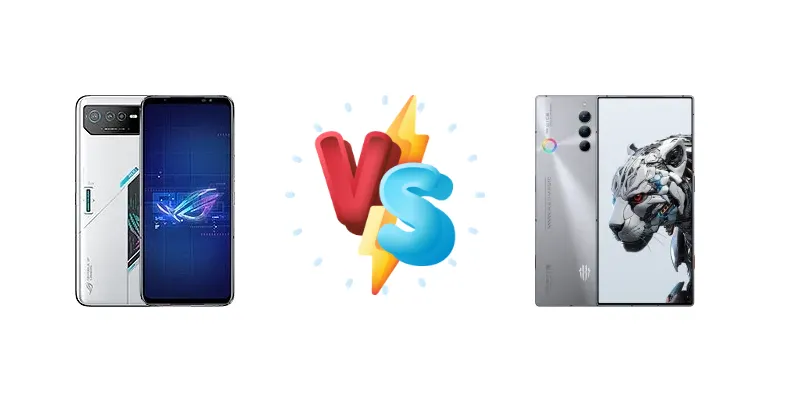
|
🏆 Quick Verdict
For most gamers, the ZTE nubia RedMagic 8S Pro emerges as the superior choice. Its Snapdragon 8 Gen 2 chipset delivers a noticeable performance uplift, and the faster 80W charging (in China) and potentially better thermal management provide a more sustained gaming experience. However, the ROG Phone 6 remains a strong contender for those prioritizing a more polished software experience.
| PHONES | ||
|---|---|---|
| Phone Names | Asus ROG Phone 6 | ZTE nubia RedMagic 8S Pro |
| Network | ||
|---|---|---|
| 2G bands | GSM 850 / 900 / 1800 / 1900 | GSM 850 / 900 / 1800 / 1900 |
| 3G bands | HSDPA 800 / 850 / 900 / 1700(AWS) / 1900 / 2100 - Version A, Version C | HSDPA 850 / 900 / 1700(AWS) / 1900 / 2100 |
| 4G bands | 1, 2, 3, 4, 5, 7, 8, 12, 13, 17, 18, 19, 20, 25, 26, 28, 29, 30, 32, 38, 39, 40, 41, 42, 43, 48, 66, 71, - Version A | 1, 2, 3, 4, 5, 7, 8, 12, 17, 18, 19, 20, 26, 28, 34, 38, 39, 40, 41, 66 |
| 5G bands | 1, 2, 3, 5, 7, 8, 12, 13, 18, 20, 25, 26, 28, 38, 40, 41, 48, 66, 71, 77, 78, 79 SA/NSA/Sub6 - Version A | 1, 3, 5, 7, 8, 20, 28, 38, 41, 66, 77, 78 SA/NSA - International |
| Speed | HSPA 42.2/5.76 Mbps, LTE (6CA) Cat20 2024/210 Mbps, 5G | HSPA, LTE, 5G |
| Technology | GSM / CDMA / HSPA / LTE / 5G | GSM / CDMA / HSPA / EVDO / LTE / 5G |
| 1, 3, 5, 8, 28, 41, 77, 78, 79 SA/NSA/Sub6 - Version C | - | |
| Launch | ||
|---|---|---|
| Announced | 2022, July 05 | 2023, June 05 |
| Status | Available. Released 2022, July 13 | Available. Released 2023, July 11 |
| Body | ||
|---|---|---|
| Build | Glass front (Gorilla Glass Victus), glass back (Gorilla Glass 3), aluminum frame | Glass front (Gorilla Glass 5), glass back, aluminum frame |
| Dimensions | 173 x 77 x 10.3 mm (6.81 x 3.03 x 0.41 in) | 164 x 76.4 x 9.5 mm (6.46 x 3.01 x 0.37 in) |
| SIM | Nano-SIM + Nano-SIM | Nano-SIM + Nano-SIM |
| Weight | 239 g (8.43 oz) | 228 g (8.04 oz) |
| IPX4 water resistant Illuminated RGB logo (on the back) Pressure sensitive zones (Gaming triggers) | - | |
| Display | ||
|---|---|---|
| Protection | Corning Gorilla Glass Victus | Corning Gorilla Glass 5 |
| Resolution | 1080 x 2448 pixels (~395 ppi density) | 1116 x 2480 pixels, 20:9 ratio (~400 ppi density) |
| Size | 6.78 inches, 109.5 cm2 (~82.2% screen-to-body ratio) | 6.8 inches, 111.6 cm2 (~89.1% screen-to-body ratio) |
| Type | AMOLED, 1B colors, 165Hz, HDR10+, 800 nits (typ), 1200 nits (peak) | AMOLED, 1B colors (China only), 120Hz, 1300 nits (peak) |
| Platform | ||
|---|---|---|
| CPU | Octa-core (1x3.19 GHz Cortex-X2 & 3x2.75 GHz Cortex-A710 & 4x1.80 GHz Cortex-A510) | Octa-core (1x3.36 GHz Cortex-X3 & 2x2.8 GHz Cortex-A715 & 2x2.8 GHz Cortex-A710 & 3x2.0 GHz Cortex-A510) |
| Chipset | Qualcomm SM8475 Snapdragon 8+ Gen 1 (4 nm) | Qualcomm SM8550-AC Snapdragon 8 Gen 2 (4 nm) |
| GPU | Adreno 730 | Adreno 740 (719 MHz) |
| OS | Android 12, upgradable to Android 13 | Android 13, Redmagic OS 8 |
| Memory | ||
|---|---|---|
| Card slot | No | No |
| Internal | 128GB 8GB RAM, 128GB 12GB RAM, 256GB 12GB RAM, 512GB 16GB RAM | 128GB 8GB RAM, 256GB 8GB RAM, 256GB 12GB RAM, 512GB 12GB RAM, 512GB 16GB RAM |
| UFS 3.1 NTFS support for external storage | - | |
| Main Camera | ||
|---|---|---|
| Features | LED flash, HDR, panorama | LED flash, HDR, panorama |
| Triple | 50 MP, f/1.9, (wide), 1/1.56", 1.0µm, PDAF 13 MP, f/2.2, (ultrawide) 5 MP (macro) | 50 MP, f/1.9, 25mm (wide), 1/1.57", 1.0µm, PDAF 8 MP, f/2.2, 120˚, 13mm (ultrawide), 1/4.0", 1.12µm 2 MP (macro) |
| Video | 8K@24fps, 4K@30/60/120fps, 1080p@30/60/120/240fps, 720p@480fps; gyro-EIS | 8K@30fps, 4K@30/60fps, 1080p@30/60/120/240fps |
| Selfie camera | ||
|---|---|---|
| Features | Panorama, HDR | HDR |
| Single | 12 MP, 28mm (wide) | 16 MP, f/2.0, (wide), 1.12µm, under display |
| Video | 1080p@30fps | 1080p@30/60fps |
| Sound | ||
|---|---|---|
| 3.5mm jack | Yes | - |
| 35mm jack | Yes | Yes |
| Loudspeaker | Yes, with stereo speakers (2 amplifiers) | Yes, with stereo speakers |
| 32-bit/384kHz audio | - | |
| Comms | ||
|---|---|---|
| Bluetooth | 5.2, A2DP, LE, aptX HD, aptX Adaptive, aptX Lossless | 5.3, A2DP, LE, aptX HD, aptX Adaptive, aptX Lossless |
| NFC | Yes | Yes (market/region dependent) |
| Positioning | GPS (L1+L5), GLONASS (L1), BDS (B1I+B1c+B2a), GALILEO (E1+E5a), QZSS (L1+L5), NavIC (L5) | GPS (L1+L5), GLONASS, BDS, GALILEO |
| Radio | No | No |
| USB | USB Type-C 3.1 (side), USB Type-C 2.0 (bottom), OTG, accessory connector | USB Type-C 3.2 (China), 3.1 (Global), OTG, accessory connector, DisplayPort |
| WLAN | Wi-Fi 802.11 a/b/g/n/ac/6e, tri-band, Wi-Fi Direct | Wi-Fi 802.11 a/b/g/n/ac/6e/7, tri-band, Wi-Fi Direct |
| Features | ||
|---|---|---|
| Sensors | Fingerprint (under display, optical), accelerometer, gyro, proximity, compass | Fingerprint (under display, optical), accelerometer, gyro, proximity, compass |
| Battery | ||
|---|---|---|
| Charging | 65W wired, PD3.0, QC5, 100% in 42 min 10W reverse wired | 80W wired, PD3.0, 100% in 35 min (China) 65W wired, PD3.0, 100% in 40 min (International) |
| Type | Li-Po 6000 mAh | Li-Po 6000 mAh |
| Misc | ||
|---|---|---|
| Colors | Phantom Black, Storm White | Midnight, Platinum, Aurora |
| Models | AI2201_C, AI2201_F, AI2201-1A030EU, AI2201_A, AI2201-1A029EU | - |
| Price | C$ 1,599.00 / € 805.42 | About 650 EUR |
Asus ROG Phone 6
- Established software ecosystem
- Wider accessory support
- Potentially more refined image processing
- Older Snapdragon 8+ Gen 1 chipset
- Slower charging speed (42 minutes)
ZTE nubia RedMagic 8S Pro
- Latest Snapdragon 8 Gen 2 chipset
- Faster charging speed (35/40 minutes)
- Potentially better thermal management
- Less polished software experience
- Camera details are limited
Display Comparison
The RedMagic 8S Pro boasts a measured peak brightness of 784 nits, a respectable figure, but the ROG Phone 6’s display specifications are not provided for direct comparison. Both devices likely utilize high refresh rate AMOLED panels, crucial for smooth gaming visuals. The absence of LTPO information for either phone makes it difficult to assess power efficiency gains from variable refresh rates. Bezels are likely minimal on both, reflecting the premium positioning, but the RedMagic 8S Pro’s under-display camera could offer a slightly more immersive experience.
Camera Comparison
Camera details are sparse for both devices. The context data only mentions 'Photo / Video' for the RedMagic 8S Pro, making a detailed comparison impossible. Given the gaming focus, neither phone is likely to prioritize camera capabilities to the same extent as flagship smartphones from Apple or Samsung. Expect competent performance in good lighting conditions, but potentially struggles in low-light scenarios. The ROG Phone 6, given Asus’s broader smartphone portfolio, might offer slightly more refined image processing.
Performance
The core difference lies in the chipsets. The RedMagic 8S Pro’s Snapdragon 8 Gen 2 (4nm) represents a significant architectural leap over the ROG Phone 6’s Snapdragon 8+ Gen 1 (4nm). The Gen 2 features a new Cortex-X3 prime core clocked at 3.36 GHz, compared to the X2 in the 8+ Gen 1 at 3.19 GHz, promising faster single-core performance. The Gen 2 also benefits from improved Cortex-A715 and A710 cores, enhancing multi-core capabilities. While both use a 4nm process, the Gen 2’s architecture is more efficient, potentially leading to less thermal throttling during extended gaming sessions. The RedMagic 8S Pro’s CPU configuration (1x3.36GHz, 2x2.8GHz, 2x2.8GHz, 3x2.0GHz) is optimized for sustained performance, while the ROG Phone 6’s (1x3.19GHz, 3x2.75GHz, 4x1.80GHz) prioritizes a balance between performance and efficiency.
Battery Life
The RedMagic 8S Pro offers 80W wired charging (China) or 65W (International), achieving a 100% charge in 35 or 40 minutes respectively. The ROG Phone 6’s 65W charging takes 42 minutes. While the ROG Phone 6’s battery capacity isn’t specified, the RedMagic 8S Pro’s endurance rating of 132 hours suggests a substantial battery size. The faster charging on the RedMagic 8S Pro is a significant advantage for gamers who need to quickly top up their battery between sessions. The 10W reverse wired charging on the ROG Phone 6 is a useful, though niche, feature.
Buying Guide
Buy the Asus ROG Phone 6 if you need a more mature software ecosystem with broader accessory support and a slightly more balanced feature set. It’s ideal for users who value a refined experience over raw power. Buy the ZTE nubia RedMagic 8S Pro if you prioritize absolute performance, fastest charging speeds (China variant), and a design unapologetically focused on gaming, even if it means sacrificing some software polish.