
Asus ROG Phone 6 vs. Xiaomi 13 Ultra: A Deep Dive into Gaming and Photography
| Phones Images | |||||
|---|---|---|---|---|---|
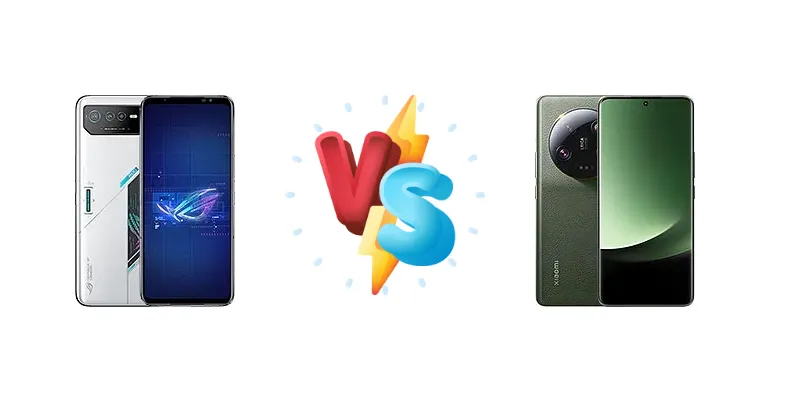
|
🏆 Quick Verdict
For the average user prioritizing camera quality and a refined all-around experience, the Xiaomi 13 Ultra emerges as the winner. However, dedicated mobile gamers will find the ROG Phone 6’s specialized features and sustained performance under load to be invaluable.
| PHONES | ||
|---|---|---|
| Phone Names | Asus ROG Phone 6 | Xiaomi 13 Ultra |
| Network | ||
|---|---|---|
| 2G bands | GSM 850 / 900 / 1800 / 1900 | GSM 850 / 900 / 1800 / 1900 |
| 3G bands | HSDPA 800 / 850 / 900 / 1700(AWS) / 1900 / 2100 - Version A, Version C | HSDPA 800 / 850 / 900 / 1700(AWS) / 1900 / 2100 |
| 4G bands | 1, 2, 3, 4, 5, 7, 8, 12, 13, 17, 18, 19, 20, 25, 26, 28, 29, 30, 32, 38, 39, 40, 41, 42, 43, 48, 66, 71, - Version A | 1, 2, 3, 4, 5, 7, 8, 18, 19, 20, 26, 28, 38, 40, 41, 66 - International |
| 5G bands | 1, 2, 3, 5, 7, 8, 12, 13, 18, 20, 25, 26, 28, 38, 40, 41, 48, 66, 71, 77, 78, 79 SA/NSA/Sub6 - Version A | 1, 3, 5, 7, 8, 20, 28, 38, 40, 41, 77, 78, 79 SA/NSA - International |
| Speed | HSPA 42.2/5.76 Mbps, LTE (6CA) Cat20 2024/210 Mbps, 5G | HSPA, LTE, 5G |
| Technology | GSM / CDMA / HSPA / LTE / 5G | GSM / CDMA / HSPA / EVDO / LTE / 5G |
| 1, 3, 5, 8, 28, 41, 77, 78, 79 SA/NSA/Sub6 - Version C | CDMA2000 1xEV-DO | |
| Launch | ||
|---|---|---|
| Announced | 2022, July 05 | 2023, April 18 |
| Status | Available. Released 2022, July 13 | Available. Released 2023, April 21 |
| Body | ||
|---|---|---|
| Build | Glass front (Gorilla Glass Victus), glass back (Gorilla Glass 3), aluminum frame | Glass front (Gorilla Glass Victus), eco leather back, aluminum frame |
| Dimensions | 173 x 77 x 10.3 mm (6.81 x 3.03 x 0.41 in) | 163.2 x 74.6 x 9.1 mm (6.43 x 2.94 x 0.36 in) |
| SIM | Nano-SIM + Nano-SIM | Nano-SIM + Nano-SIM |
| Weight | 239 g (8.43 oz) | 227 g (8.01 oz) |
| IPX4 water resistant Illuminated RGB logo (on the back) Pressure sensitive zones (Gaming triggers) | IP68 dust/water resistant (up to 1.5m for 30 min) | |
| Display | ||
|---|---|---|
| Protection | Corning Gorilla Glass Victus | Corning Gorilla Glass Victus |
| Resolution | 1080 x 2448 pixels (~395 ppi density) | 1440 x 3200 pixels, 20:9 ratio (~522 ppi density) |
| Size | 6.78 inches, 109.5 cm2 (~82.2% screen-to-body ratio) | 6.73 inches, 108.9 cm2 (~89.5% screen-to-body ratio) |
| Type | AMOLED, 1B colors, 165Hz, HDR10+, 800 nits (typ), 1200 nits (peak) | LTPO AMOLED, 68B colors, 120Hz, Dolby Vision, HDR10+, 1300 nits (HBM), 2600 nits (peak) |
| Platform | ||
|---|---|---|
| CPU | Octa-core (1x3.19 GHz Cortex-X2 & 3x2.75 GHz Cortex-A710 & 4x1.80 GHz Cortex-A510) | Octa-core (1x3.2 GHz Cortex-X3 & 2x2.8 GHz Cortex-A715 & 2x2.8 GHz Cortex-A710 & 3x2.0 GHz Cortex-A510) |
| Chipset | Qualcomm SM8475 Snapdragon 8+ Gen 1 (4 nm) | Qualcomm SM8550-AB Snapdragon 8 Gen 2 (4 nm) |
| GPU | Adreno 730 | Adreno 740 |
| OS | Android 12, upgradable to Android 13 | Android 13, upgradable to Android 14, HyperOS |
| Memory | ||
|---|---|---|
| Card slot | No | No |
| Internal | 128GB 8GB RAM, 128GB 12GB RAM, 256GB 12GB RAM, 512GB 16GB RAM | 256GB 12GB RAM, 512GB 12GB RAM, 512GB 16GB RAM, 1TB 16GB RAM |
| UFS 3.1 NTFS support for external storage | UFS 4.0 | |
| Main Camera | ||
|---|---|---|
| Features | LED flash, HDR, panorama | Laser AF, color spectrum sensor, Leica lenses, Dual-LED flash, HDR, panorama, 67mm filter ring holder (optional) |
| Quad | - | 50 MP, f/1.9 or f/4.0, 23mm (wide), 1.0"-type, 1.6µm, dual pixel PDAF, OIS 50 MP, f/1.8, 75mm (telephoto), 1/2.51", 0.7µm, dual pixel PDAF, OIS, 3.2x optical zoom 50 MP, f/3.0, 120mm (periscope telephoto), 1/2.51", 0.7µm, dual pixel PDAF, OIS, 5x optical zoom 50 MP, f/1.8, 12mm, 122˚ (ultrawide), 1/2.51", 0.7µm, dual pixel PDAF TOF 3D, (depth) |
| Triple | 50 MP, f/1.9, (wide), 1/1.56", 1.0µm, PDAF 13 MP, f/2.2, (ultrawide) 5 MP (macro) | - |
| Video | 8K@24fps, 4K@30/60/120fps, 1080p@30/60/120/240fps, 720p@480fps; gyro-EIS | 8K@24fps, 4K@24/30/60fps, 1080p@30/60/120/240/480/960/1920fps, gyro-EIS, Dolby Vision HDR 10-bit rec. (4K@60fps, 1080p) |
| Selfie camera | ||
|---|---|---|
| Features | Panorama, HDR | HDR, panorama |
| Single | 12 MP, 28mm (wide) | 32 MP, f/2.0, 22mm (wide), 1/3.14", 0.7µm |
| Video | 1080p@30fps | 1080p@30/60fps, gyro-EIS |
| Sound | ||
|---|---|---|
| 3.5mm jack | Yes | No |
| 35mm jack | Yes | No |
| Loudspeaker | Yes, with stereo speakers (2 amplifiers) | Yes, with stereo speakers |
| 32-bit/384kHz audio | 24-bit/192kHz audio | |
| Comms | ||
|---|---|---|
| Bluetooth | 5.2, A2DP, LE, aptX HD, aptX Adaptive, aptX Lossless | 5.3, A2DP, LE, aptX HD, aptX Adaptive |
| Infrared port | - | Yes |
| NFC | Yes | Yes |
| Positioning | GPS (L1+L5), GLONASS (L1), BDS (B1I+B1c+B2a), GALILEO (E1+E5a), QZSS (L1+L5), NavIC (L5) | GPS (L1+L5), GLONASS (L1), BDS (B1I+B1c+B2a), GALILEO (E1+E5a), QZSS (L1+L5), NavIC (L5) |
| Radio | No | No |
| USB | USB Type-C 3.1 (side), USB Type-C 2.0 (bottom), OTG, accessory connector | USB Type-C 3.2, DisplayPort, OTG |
| WLAN | Wi-Fi 802.11 a/b/g/n/ac/6e, tri-band, Wi-Fi Direct | Wi-Fi 802.11 a/b/g/n/ac/6e/7, tri-band, Wi-Fi Direct |
| Features | ||
|---|---|---|
| Sensors | Fingerprint (under display, optical), accelerometer, gyro, proximity, compass | Fingerprint (under display, optical), accelerometer, proximity, gyro, compass, barometer |
| - | Virtual proximity sensing | |
| Battery | ||
|---|---|---|
| Charging | 65W wired, PD3.0, QC5, 100% in 42 min 10W reverse wired | 90W wired, PD3.0, QC4, 100% in 35 min 50W wireless, 100% in 49 min 10W reverse wireless |
| Type | Li-Po 6000 mAh | Li-Po 5000 mAh |
| Misc | ||
|---|---|---|
| Colors | Phantom Black, Storm White | Black, Olive Green, White, Orange, Yellow, Blue |
| Models | AI2201_C, AI2201_F, AI2201-1A030EU, AI2201_A, AI2201-1A029EU | 2304FPN6DC, 2304FPN6DG |
| Price | C$ 1,599.00 / € 805.42 | € 797.98 / $ 389.69 |
| SAR EU | - | 0.99 W/kg (head) 1.00 W/kg (body) |
Asus ROG Phone 6
- Dedicated gaming features (triggers, cooling)
- High refresh rate display for smooth gaming
- Fast 65W wired charging
- Customizable performance profiles
- Older Snapdragon 8+ Gen 1 chipset
- Likely inferior camera system
- Potentially less efficient battery life
Xiaomi 13 Ultra
- Latest Snapdragon 8 Gen 2 chipset
- Exceptional camera system
- Faster 90W wired and 50W wireless charging
- Brighter and more color-accurate display
- Less focused on gaming-specific features
- Higher price point (likely)
- May not offer the same level of customization for gaming
Display Comparison
The Xiaomi 13 Ultra boasts a significantly brighter display, reaching a measured 1207 nits, compared to an unspecified peak brightness for the ROG Phone 6. While the ROG Phone 6 likely features a high refresh rate, the Ultra’s brightness advantage is crucial for outdoor visibility. Both devices likely employ AMOLED panels, but the Ultra’s superior brightness and potentially wider color gamut make it the better choice for media consumption and content creation. The ROG Phone 6’s display is geared towards fast response times for gaming, but the Ultra’s overall quality is higher.
Camera Comparison
The Xiaomi 13 Ultra is unequivocally the camera champion. While specific sensor details are missing for both, Xiaomi’s focus on camera technology is well-established. The Ultra’s camera system is designed for both photo and video, likely featuring a large main sensor and advanced image processing algorithms. The ROG Phone 6, while capable, prioritizes other features and will likely offer a less sophisticated camera experience. The absence of details on the ROG Phone 6’s camera suggests it’s not a primary selling point, and any 2MP macro or depth sensors are likely to be of limited utility.
Performance
The Xiaomi 13 Ultra’s Snapdragon 8 Gen 2 (4nm) represents a generational leap over the ROG Phone 6’s Snapdragon 8+ Gen 1 (4nm). The Gen 2 features a newer Cortex-X3 prime core clocked at 3.2 GHz, alongside improved Cortex-A715 and A710 performance cores, resulting in faster CPU and GPU performance. While the ROG Phone 6’s cooling system is robust, the more efficient 4nm process of the Gen 2 in the Ultra, combined with potentially more advanced thermal management, should lead to less throttling during sustained workloads. The Ultra’s LPDDR5x RAM further contributes to faster data access and overall system responsiveness.
Battery Life
The Xiaomi 13 Ultra demonstrates superior charging capabilities with 90W wired charging (35 minutes to 100%) and 50W wireless charging (49 minutes to 100%), compared to the ROG Phone 6’s 65W wired (42 minutes) and 10W reverse wired. The Ultra’s active use battery score of 10:09h and endurance rating of 108h indicate excellent battery life, likely due to the efficiency of the Snapdragon 8 Gen 2. While the ROG Phone 6’s battery capacity is unspecified, the Ultra’s faster charging and longer endurance provide a significant advantage for users who demand all-day battery life.
Buying Guide
Buy the Asus ROG Phone 6 if you need a device specifically engineered for extended gaming sessions, prioritize cooling and customizable performance profiles, and value gaming-centric accessories. Buy the Xiaomi 13 Ultra if you prefer a top-tier camera system, a brighter and more color-accurate display, and a more polished, everyday smartphone experience with faster charging and wireless capabilities.