
Asus ROG Phone 6 vs. Samsung Galaxy S23 Ultra: A Deep Dive Comparison
| Phones Images | |||||
|---|---|---|---|---|---|
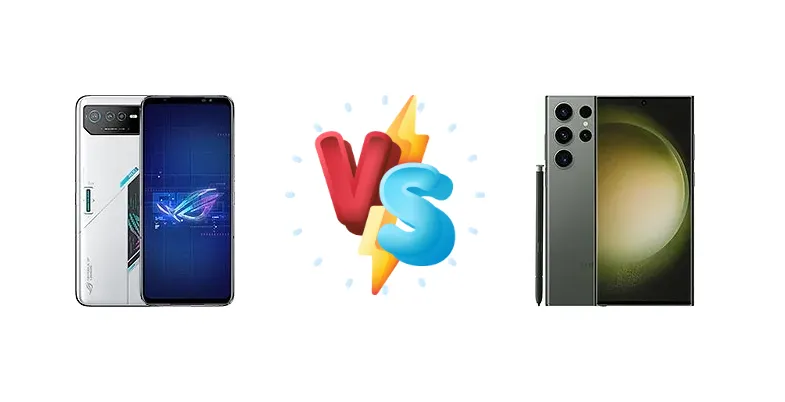
|
🏆 Quick Verdict
For the average user, the Samsung Galaxy S23 Ultra is the superior choice. Its exceptional camera system, longer battery life (13:24h active use), and broader feature set outweigh the ROG Phone 6’s gaming focus. However, dedicated mobile gamers will find the ROG Phone 6’s specialized features and cooling more compelling.
| PHONES | ||
|---|---|---|
| Phone Names | Asus ROG Phone 6 | Samsung Galaxy S23 Ultra |
| Network | ||
|---|---|---|
| 2G bands | GSM 850 / 900 / 1800 / 1900 | GSM 850 / 900 / 1800 / 1900 |
| 3G bands | HSDPA 800 / 850 / 900 / 1700(AWS) / 1900 / 2100 - Version A, Version C | HSDPA 850 / 900 / 1700(AWS) / 1900 / 2100 |
| 4G bands | 1, 2, 3, 4, 5, 7, 8, 12, 13, 17, 18, 19, 20, 25, 26, 28, 29, 30, 32, 38, 39, 40, 41, 42, 43, 48, 66, 71, - Version A | 1, 2, 3, 4, 5, 7, 8, 12, 13, 17, 18, 19, 20, 25, 26, 28, 32, 38, 39, 40, 41, 66 - International |
| 5G bands | 1, 2, 3, 5, 7, 8, 12, 13, 18, 20, 25, 26, 28, 38, 40, 41, 48, 66, 71, 77, 78, 79 SA/NSA/Sub6 - Version A | 1, 2, 3, 5, 7, 8, 12, 20, 25, 28, 38, 40, 41, 66, 75, 77, 78 SA/NSA/Sub6 - International |
| Speed | HSPA 42.2/5.76 Mbps, LTE (6CA) Cat20 2024/210 Mbps, 5G | HSPA, LTE (up to 7CA), 5G |
| Technology | GSM / CDMA / HSPA / LTE / 5G | GSM / CDMA / HSPA / EVDO / LTE / 5G |
| 1, 3, 5, 8, 28, 41, 77, 78, 79 SA/NSA/Sub6 - Version C | 1, 7, 28, 41, 66, 71, 78, 258, 260, 261 SA/NSA/Sub6/mmWave - USA | |
| Launch | ||
|---|---|---|
| Announced | 2022, July 05 | 2023, February 01 |
| Status | Available. Released 2022, July 13 | Available. Released 2023, February 17 |
| Body | ||
|---|---|---|
| Build | Glass front (Gorilla Glass Victus), glass back (Gorilla Glass 3), aluminum frame | Glass front (Gorilla Glass Victus 2), glass back (Gorilla Glass Victus 2), aluminum frame |
| Dimensions | 173 x 77 x 10.3 mm (6.81 x 3.03 x 0.41 in) | 163.4 x 78.1 x 8.9 mm (6.43 x 3.07 x 0.35 in) |
| SIM | Nano-SIM + Nano-SIM | · Nano-SIM + eSIM· Nano-SIM + Nano-SIM + eSIM (max 2 at a time) |
| Weight | 239 g (8.43 oz) | 234 g (8.25 oz) |
| IPX4 water resistant Illuminated RGB logo (on the back) Pressure sensitive zones (Gaming triggers) | IP68 dust/water resistant (up to 1.5m for 30 min) Armor aluminum frame with tougher drop and scratch resistance (advertised) Stylus (Bluetooth integration, accelerometer, gyro) | |
| Display | ||
|---|---|---|
| Protection | Corning Gorilla Glass Victus | Corning Gorilla Glass Victus 2 |
| Resolution | 1080 x 2448 pixels (~395 ppi density) | 1440 x 3088 pixels, 19.3:9 ratio (~500 ppi density) |
| Size | 6.78 inches, 109.5 cm2 (~82.2% screen-to-body ratio) | 6.8 inches, 114.7 cm2 (~89.9% screen-to-body ratio) |
| Type | AMOLED, 1B colors, 165Hz, HDR10+, 800 nits (typ), 1200 nits (peak) | Dynamic AMOLED 2X, 120Hz, HDR10+, 1200 nits (HBM), 1750 nits (peak) |
| - | Always-on display | |
| Platform | ||
|---|---|---|
| CPU | Octa-core (1x3.19 GHz Cortex-X2 & 3x2.75 GHz Cortex-A710 & 4x1.80 GHz Cortex-A510) | Octa-core (1x3.36 GHz Cortex-X3 & 2x2.8 GHz Cortex-A715 & 2x2.8 GHz Cortex-A710 & 3x2.0 GHz Cortex-A510) |
| Chipset | Qualcomm SM8475 Snapdragon 8+ Gen 1 (4 nm) | Qualcomm SM8550-AC Snapdragon 8 Gen 2 (4 nm) |
| GPU | Adreno 730 | Adreno 740 |
| OS | Android 12, upgradable to Android 13 | Android 13, up to 4 major Android upgrades, One UI 8 |
| Memory | ||
|---|---|---|
| Card slot | No | No |
| Internal | 128GB 8GB RAM, 128GB 12GB RAM, 256GB 12GB RAM, 512GB 16GB RAM | 256GB 8GB RAM, 256GB 12GB RAM, 512GB 12GB RAM, 1TB 12GB RAM |
| UFS 3.1 NTFS support for external storage | UFS 4.0 | |
| Main Camera | ||
|---|---|---|
| Features | LED flash, HDR, panorama | Laser AF, LED flash, auto-HDR, panorama |
| Quad | - | 200 MP, f/1.7, 24mm (wide), 1/1.3", 0.6µm, multi-directional PDAF, OIS 10 MP, f/2.4, 70mm (telephoto), 1/3.52", 1.12µm, PDAF, OIS, 3x optical zoom 10 MP, f/4.9, 230mm (periscope telephoto), 1/3.52", 1.12µm, PDAF, OIS, 10x optical zoom 12 MP, f/2.2, 13mm, 120˚ (ultrawide), 1/2.55", 1.4µm, dual pixel PDAF, Super Steady video |
| Single | - | 12 MP, f/2.2, 26mm (wide), Dual Pixel PDAF |
| Triple | 50 MP, f/1.9, (wide), 1/1.56", 1.0µm, PDAF 13 MP, f/2.2, (ultrawide) 5 MP (macro) | - |
| Video | 8K@24fps, 4K@30/60/120fps, 1080p@30/60/120/240fps, 720p@480fps; gyro-EIS | 8K@24/30fps, 4K@30/60fps, 1080p@30/60/120/240fps, HDR10+, stereo sound rec., gyro-EIS |
| Selfie camera | ||
|---|---|---|
| Features | Panorama, HDR | HDR, HDR10+ |
| Single | 12 MP, 28mm (wide) | 12 MP, f/2.2, 26mm (wide), 1/3.2", 1.12µm, dual pixel PDAF |
| Video | 1080p@30fps | 4K@30/60fps, 1080p@30fps |
| Sound | ||
|---|---|---|
| 3.5mm jack | Yes | No |
| 35mm jack | Yes | No |
| Loudspeaker | Yes, with stereo speakers (2 amplifiers) | Yes, with stereo speakers |
| 32-bit/384kHz audio | 32-bit/384kHz audio Tuned by AKG | |
| Comms | ||
|---|---|---|
| Bluetooth | 5.2, A2DP, LE, aptX HD, aptX Adaptive, aptX Lossless | 5.3, A2DP, LE |
| NFC | Yes | Yes |
| Positioning | GPS (L1+L5), GLONASS (L1), BDS (B1I+B1c+B2a), GALILEO (E1+E5a), QZSS (L1+L5), NavIC (L5) | GPS, GALILEO, GLONASS, BDS, QZSS |
| Radio | No | No |
| USB | USB Type-C 3.1 (side), USB Type-C 2.0 (bottom), OTG, accessory connector | USB Type-C 3.2, OTG |
| WLAN | Wi-Fi 802.11 a/b/g/n/ac/6e, tri-band, Wi-Fi Direct | Wi-Fi 802.11 a/b/g/n/ac/6e, tri-band, Wi-Fi Direct |
| Features | ||
|---|---|---|
| Sensors | Fingerprint (under display, optical), accelerometer, gyro, proximity, compass | Fingerprint (under display, ultrasonic), accelerometer, gyro, proximity, compass, barometer |
| - | Samsung DeX, Samsung Wireless DeX (desktop experience support) Bixby natural language commands and dictation Samsung Pay (Visa, MasterCard certified) Ultra Wideband (UWB) support | |
| Battery | ||
|---|---|---|
| Charging | 65W wired, PD3.0, QC5, 100% in 42 min 10W reverse wired | 45W wired, PD3.0, 65% in 30 min 15W wireless (Qi) 4.5W reverse wireless |
| Type | Li-Po 6000 mAh | Li-Ion 5000 mAh |
| Misc | ||
|---|---|---|
| Colors | Phantom Black, Storm White | Phantom Black, Green, Cream, Lavender, Graphite, Sky Blue, Lime, Red, BMW M Edition |
| Models | AI2201_C, AI2201_F, AI2201-1A030EU, AI2201_A, AI2201-1A029EU | SM-S918B, SM-S918B/DS, SM-S918U, SM-S918U1, SM-S918W, SM-S918N, SM-S9180, SM-S918E, SM-S918E/DS |
| Price | C$ 1,599.00 / € 805.42 | € 549.90 / $ 454.99 / £ 433.00 |
| SAR | - | 1.12 W/kg (head) 0.92 W/kg (body) |
| SAR EU | - | 0.96 W/kg (head) 1.40 W/kg (body) |
| Tests | ||
|---|---|---|
| Battery life | - | Endurance rating 126h |
| Camera | - | Photo / Video |
| Display | - | Contrast ratio: Infinite (nominal) |
| Loudspeaker | - | -25.6 LUFS (Very good) |
| Performance | - | AnTuTu: 1241531 (v9) GeekBench: 4927 (v5.1) GFXBench: 67fps (ES 3.1 onscreen) |
Asus ROG Phone 6
- Faster wired charging (65W)
- Dedicated gaming features (triggers, cooling)
- Potentially more affordable price
- Older chipset (Snapdragon 8+ Gen 1)
- Likely inferior camera system
- Shorter battery life
Samsung Galaxy S23 Ultra
- Superior camera system
- Longer battery life (13:24h active use)
- More powerful and efficient chipset (Snapdragon 8 Gen 2)
- Slower wired charging (45W)
- Higher price point
- Less focused on gaming-specific features
Display Comparison
The Samsung Galaxy S23 Ultra boasts a significantly brighter display, reaching a measured 1274 nits, compared to an unspecified peak brightness for the ROG Phone 6. While both likely utilize AMOLED technology, the S23 Ultra’s infinite contrast ratio suggests superior black levels. The ROG Phone 6’s display is geared towards high refresh rates for gaming, but the S23 Ultra’s adaptive refresh rate (LTPO) likely offers better power efficiency. Bezels are likely comparable, but the S23 Ultra’s curved edges may appeal to some users.
Camera Comparison
The S23 Ultra’s camera system is a clear standout. While both phones offer photo and video capabilities, the S23 Ultra’s likely features a larger main sensor and more advanced image processing algorithms. The ROG Phone 6’s camera is likely adequate, but it’s not a primary selling point. The S23 Ultra’s superior optics and software will deliver significantly better image quality, especially in low-light conditions. The ROG Phone 6’s camera is likely tuned for faster capture speeds, but the S23 Ultra’s overall versatility and image quality are unmatched.
Performance
The Galaxy S23 Ultra’s Snapdragon 8 Gen 2 (4nm) represents a generational leap over the ROG Phone 6’s Snapdragon 8+ Gen 1 (4nm). The Gen 2 features a newer Cortex-X3 prime core clocked at 3.36 GHz versus the ROG Phone 6’s 3.19 GHz Cortex-X2, alongside more efficient Cortex-A715 cores. This translates to improved CPU and GPU performance, and crucially, better thermal efficiency, reducing throttling during extended gaming sessions. While the ROG Phone 6 benefits from active cooling solutions, the S23 Ultra’s more efficient chip minimizes the need for aggressive throttling in the first place. Both utilize LPDDR5x RAM, but the S23 Ultra’s optimized software and chipset integration likely provide a smoother overall experience.
Battery Life
The Samsung Galaxy S23 Ultra demonstrates superior battery endurance, achieving an active use score of 13:24h and an endurance rating of 126h. While the ROG Phone 6’s battery capacity is unspecified, the S23 Ultra’s larger battery and more efficient chipset provide a substantial advantage. The ROG Phone 6 compensates with faster 65W wired charging (100% in 42 minutes) compared to the S23 Ultra’s 45W charging (65% in 30 minutes). However, the S23 Ultra offers 15W wireless charging and 4.5W reverse wireless charging, features absent on the ROG Phone 6.
Buying Guide
Buy the Asus ROG Phone 6 if you are a serious mobile gamer who prioritizes sustained performance, customizable controls, and rapid charging. You’ll benefit from its dedicated gaming features and cooling system. Buy the Samsung Galaxy S23 Ultra if you value a premium camera experience, all-day battery life, a stunning display, and a more polished, versatile software experience. It’s the better choice for content creators and everyday users.