
Asus ROG Phone 6 vs OnePlus 11R: A Detailed Comparison for Gamers and Power Users
| Phones Images | |||||
|---|---|---|---|---|---|
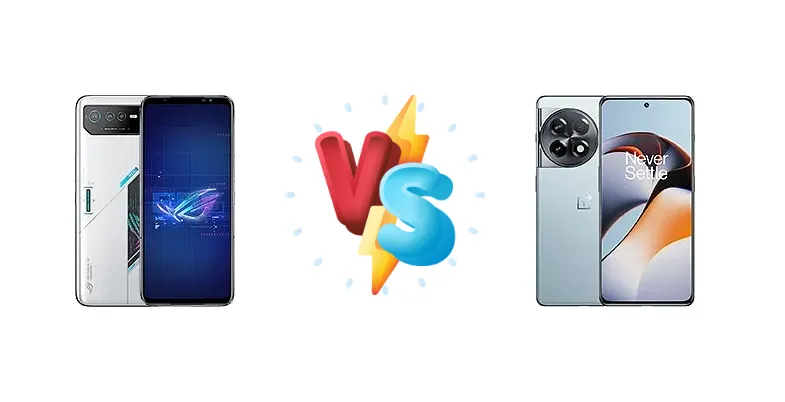
|
🏆 Quick Verdict
For dedicated mobile gamers, the Asus ROG Phone 6 is the clear winner, offering a superior gaming experience through its specialized features. However, the OnePlus 11R provides excellent performance at a more accessible price point, making it ideal for users who prioritize fast charging and overall value.
| PHONES | ||
|---|---|---|
| Phone Names | Asus ROG Phone 6 | OnePlus 11R |
| Network | ||
|---|---|---|
| 2G bands | GSM 850 / 900 / 1800 / 1900 | GSM 850 / 900 / 1800 / 1900 |
| 3G bands | HSDPA 800 / 850 / 900 / 1700(AWS) / 1900 / 2100 - Version A, Version C | HSDPA 850 / 900 / 1700(AWS) / 2100 |
| 4G bands | 1, 2, 3, 4, 5, 7, 8, 12, 13, 17, 18, 19, 20, 25, 26, 28, 29, 30, 32, 38, 39, 40, 41, 42, 43, 48, 66, 71, - Version A | 1, 3, 4, 5, 8, 28, 34, 38, 39, 40, 41 |
| 5G bands | 1, 2, 3, 5, 7, 8, 12, 13, 18, 20, 25, 26, 28, 38, 40, 41, 48, 66, 71, 77, 78, 79 SA/NSA/Sub6 - Version A | 1, 3, 5, 8, 28, 40, 41, 77, 78 SA/NSA |
| Speed | HSPA 42.2/5.76 Mbps, LTE (6CA) Cat20 2024/210 Mbps, 5G | HSPA, LTE (3CA), 5G |
| Technology | GSM / CDMA / HSPA / LTE / 5G | GSM / CDMA / HSPA / LTE / 5G |
| 1, 3, 5, 8, 28, 41, 77, 78, 79 SA/NSA/Sub6 - Version C | CDMA 800 | |
| Launch | ||
|---|---|---|
| Announced | 2022, July 05 | 2023, February 07 |
| Status | Available. Released 2022, July 13 | Available. Released 2023, February 21 |
| Body | ||
|---|---|---|
| Build | Glass front (Gorilla Glass Victus), glass back (Gorilla Glass 3), aluminum frame | Glass front, glass back (Gorilla Glass 5), plastic frame |
| Dimensions | 173 x 77 x 10.3 mm (6.81 x 3.03 x 0.41 in) | 163.4 x 74.3 x 8.7 mm (6.43 x 2.93 x 0.34 in) |
| SIM | Nano-SIM + Nano-SIM | Nano-SIM + Nano-SIM |
| Weight | 239 g (8.43 oz) | 204 g (7.20 oz) |
| IPX4 water resistant Illuminated RGB logo (on the back) Pressure sensitive zones (Gaming triggers) | - | |
| Display | ||
|---|---|---|
| Protection | Corning Gorilla Glass Victus | - |
| Resolution | 1080 x 2448 pixels (~395 ppi density) | 1240 x 2772 pixels, 20:9 ratio (~451 ppi density) |
| Size | 6.78 inches, 109.5 cm2 (~82.2% screen-to-body ratio) | 6.74 inches, 109.2 cm2 (~90.0% screen-to-body ratio) |
| Type | AMOLED, 1B colors, 165Hz, HDR10+, 800 nits (typ), 1200 nits (peak) | Fluid AMOLED, 1B colors, 120Hz, HDR10+, 1450 nits (peak) |
| Platform | ||
|---|---|---|
| CPU | Octa-core (1x3.19 GHz Cortex-X2 & 3x2.75 GHz Cortex-A710 & 4x1.80 GHz Cortex-A510) | Octa-core (1x3.0 GHz Cortex-X2 & 3x2.5 GHz Cortex-A710 & 4x1.80 GHz Cortex-A510) |
| Chipset | Qualcomm SM8475 Snapdragon 8+ Gen 1 (4 nm) | Qualcomm SM8475 Snapdragon 8+ Gen 1 (4 nm) |
| GPU | Adreno 730 | Adreno 730 |
| OS | Android 12, upgradable to Android 13 | Android 13, upgradable to Android 15, OxygenOS 15 |
| Memory | ||
|---|---|---|
| Card slot | No | No |
| Internal | 128GB 8GB RAM, 128GB 12GB RAM, 256GB 12GB RAM, 512GB 16GB RAM | 128GB 8GB RAM, 256GB 16GB RAM, 512GB 18GB RAM |
| UFS 3.1 NTFS support for external storage | UFS 3.1 | |
| Main Camera | ||
|---|---|---|
| Features | LED flash, HDR, panorama | Color spectrum sensor, LED flash, HDR, panorama |
| Single | - | 16 MP, f/2.4, 24mm (wide), 1/3.09", 1.0µm |
| Triple | 50 MP, f/1.9, (wide), 1/1.56", 1.0µm, PDAF 13 MP, f/2.2, (ultrawide) 5 MP (macro) | 50 MP, f/1.8, 24mm (wide), 1/1.56", 1.0µm, multi-directional PDAF, OIS 8 MP, f/2.2, 120˚ (ultrawide), 1/4.0", 1.12µm 2 MP (macro) |
| Video | 8K@24fps, 4K@30/60/120fps, 1080p@30/60/120/240fps, 720p@480fps; gyro-EIS | 4K@30/60fps, 1080p@30/60/240fps, gyro-EIS |
| Selfie camera | ||
|---|---|---|
| Features | Panorama, HDR | HDR |
| Single | 12 MP, 28mm (wide) | 16 MP, f/2.4, 24mm (wide), 1/3.09", 1.0µm |
| Video | 1080p@30fps | 1080p@30fps |
| Sound | ||
|---|---|---|
| 3.5mm jack | Yes | No |
| 35mm jack | Yes | No |
| Loudspeaker | Yes, with stereo speakers (2 amplifiers) | Yes, with stereo speakers |
| 32-bit/384kHz audio | 24-bit/192kHz audio | |
| Comms | ||
|---|---|---|
| Bluetooth | 5.2, A2DP, LE, aptX HD, aptX Adaptive, aptX Lossless | 5.3, A2DP, LE, aptX HD |
| Infrared port | - | Yes |
| NFC | Yes | Yes |
| Positioning | GPS (L1+L5), GLONASS (L1), BDS (B1I+B1c+B2a), GALILEO (E1+E5a), QZSS (L1+L5), NavIC (L5) | GPS (L1+L5), GLONASS (G1), BDS (B1I+B1c+B2a), GALILEO (E1+E5a), QZSS (L1+L5) |
| Radio | No | No |
| USB | USB Type-C 3.1 (side), USB Type-C 2.0 (bottom), OTG, accessory connector | USB Type-C 2.0 |
| WLAN | Wi-Fi 802.11 a/b/g/n/ac/6e, tri-band, Wi-Fi Direct | Wi-Fi 802.11 a/b/g/n/ac/6, dual-band |
| Features | ||
|---|---|---|
| Sensors | Fingerprint (under display, optical), accelerometer, gyro, proximity, compass | Fingerprint (under display, optical), accelerometer, gyro, proximity, compass |
| Battery | ||
|---|---|---|
| Charging | 65W wired, PD3.0, QC5, 100% in 42 min 10W reverse wired | 100W wired |
| Type | Li-Po 6000 mAh | Li-Po 5000 mAh |
| Misc | ||
|---|---|---|
| Colors | Phantom Black, Storm White | Galactic Silver, Sonic Black, Solar Red |
| Models | AI2201_C, AI2201_F, AI2201-1A030EU, AI2201_A, AI2201-1A029EU | CPH2487 |
| Price | C$ 1,599.00 / € 805.42 | About 600 EUR |
| SAR | - | 1.16 W/kg (head) 0.61 W/kg (body) |
Asus ROG Phone 6
- Potentially superior cooling for sustained gaming performance
- Likely higher refresh rate display for smoother visuals
- Gaming-centric features like AirTriggers
- Slower 65W charging compared to the OnePlus 11R
- Potentially higher price point
OnePlus 11R
- Blazing-fast 100W wired charging
- Competitive performance with Snapdragon 8+ Gen 1
- Potentially more affordable price
- Less focused on gaming-specific features
- Potentially less robust cooling system
Display Comparison
Both phones utilize the Snapdragon 8+ Gen 1, but display differences are notable. While specific display specs (resolution, refresh rate) aren't provided, the ROG Phone 6, being a gaming phone, likely features a higher refresh rate panel optimized for smooth visuals. The OnePlus 11R, while likely offering a high refresh rate as well, may prioritize color accuracy and power efficiency. The ROG Phone 6’s display is geared towards responsiveness, while the 11R’s is likely tuned for broader content consumption.
Camera Comparison
Camera details are limited, but the focus should be on image processing and sensor quality. Without specific sensor size information, it’s difficult to definitively declare a winner. However, given the ROG Phone 6’s gaming focus, its camera system may be tuned for quick snapshots and social media sharing, while the OnePlus 11R might prioritize more balanced image quality. The absence of details suggests neither phone is a primary camera contender against dedicated camera flagships.
Performance
Both devices are powered by the Qualcomm SM8475 Snapdragon 8+ Gen 1 (4 nm) chipset, but subtle CPU clock speed differences exist. The ROG Phone 6 boasts a slightly higher peak CPU clock speed of 3.19 GHz on its Cortex-X2 core compared to the OnePlus 11R’s 3.0 GHz. This difference, while potentially measurable in benchmarks, may not be perceptible in everyday use. However, the ROG Phone 6’s cooling system is likely more advanced, allowing it to sustain peak performance for longer periods, mitigating thermal throttling during extended gaming sessions. Both utilize the same CPU core configuration (1x Cortex-X2, 3x Cortex-A710, 4x Cortex-A510).
Battery Life
The OnePlus 11R’s 100W wired charging is a significant advantage over the ROG Phone 6’s 65W charging. This translates to a substantially faster 0-100% charge time for the 11R. While the ROG Phone 6 supports PD3.0 and QC5 for broader compatibility, the sheer speed of 100W charging is a compelling benefit for users who frequently need to top up their battery. The difference in charging speed is more impactful than any potential mAh difference (not provided in the data).
Buying Guide
Buy the Asus ROG Phone 6 if you demand the ultimate mobile gaming experience, prioritizing features like AirTriggers, a high refresh rate display, and robust cooling. Buy the OnePlus 11R if you want flagship-level performance without the gaming-centric extras, and if incredibly fast 100W charging is a top priority, offering a quicker turnaround between gaming sessions or daily use.