
Asus ROG Phone 6 Pro vs Xiaomi Black Shark 5 Pro: The Ultimate Gaming Phone Battle
| Phones Images | |||||
|---|---|---|---|---|---|
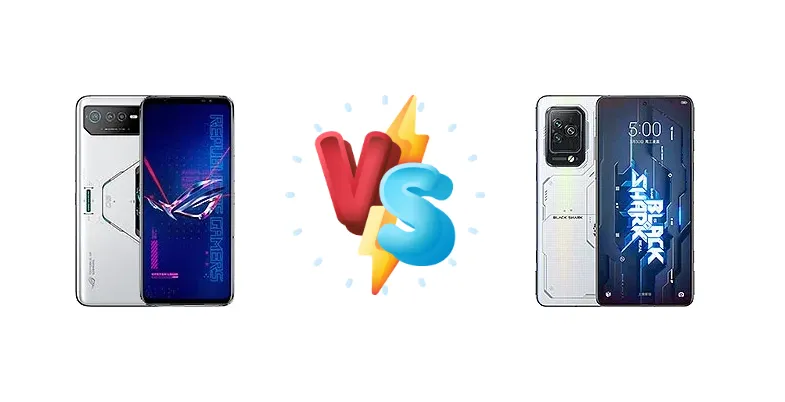
|
🏆 Quick Verdict
The ROG Phone 6 Pro takes the crown thanks to its superior Snapdragon 8+ Gen 1 chipset, brighter display, and significantly longer battery life. While the Black Shark 5 Pro boasts incredibly fast 120W charging, the ROG Phone 6 Pro's overall performance and endurance make it the better choice for serious gamers.
| PHONES | ||
|---|---|---|
| Phone Names | Asus ROG Phone 6 Pro | Xiaomi Black Shark 5 Pro |
| Network | ||
|---|---|---|
| 2G bands | GSM 850 / 900 / 1800 / 1900 | GSM 850 / 900 / 1800 / 1900 |
| 3G bands | HSDPA 800 / 850 / 900 / 1700(AWS) / 1900 / 2100 | HSDPA 800 / 850 / 900 / 1700(AWS) / 1900 / 2100 |
| 4G bands | 1, 2, 3, 4, 5, 7, 8, 12, 13, 17, 18, 19, 20, 25, 26, 28, 29, 30, 32, 34, 38, 39, 40, 41, 42, 43, 48, 66, 71 - Version A | 1, 2, 3, 4, 5, 7, 8, 12, 17, 18, 19, 26, 28, 34, 38, 39, 40, 41 |
| 5G bands | 1, 2, 3, 5, 7, 8, 12, 13, 18, 20, 25, 26, 28, 38, 40, 41, 48, 66, 71, 77, 78, 79 SA/NSA/Sub6 - Version A | 1, 3, 8, 28, 41, 77, 78, 79 SA/NSA |
| Speed | HSPA 42.2/5.76 Mbps, LTE (6CA) Cat20 2024/210 Mbps, 5G | HSPA, LTE, 5G |
| Technology | GSM / CDMA / HSPA / LTE / 5G | GSM / CDMA / HSPA / EVDO / LTE / 5G |
| 1, 3, 5, 8, 28, 41, 77, 78, 79 - Version B | - | |
| Launch | ||
|---|---|---|
| Announced | 2022, July 05 | 2022, March 30 |
| Status | Available. Released 2022, July 13 | Available. Released 2022, April 04 |
| Body | ||
|---|---|---|
| Build | Glass front (Gorilla Glass Victus), glass back (Gorilla Glass 3), aluminum frame | - |
| Dimensions | 173 x 77 x 10.3 mm (6.81 x 3.03 x 0.41 in) | 163.9 x 76.5 x 9.5 mm (6.45 x 3.01 x 0.37 in) |
| SIM | Nano-SIM + Nano-SIM | Nano-SIM + Nano-SIM |
| Weight | 239 g (8.43 oz) | 220 g (7.76 oz) |
| IPX4 water resistant 2" OLED display (on the back) Pressure sensitive zones (Gaming triggers) | - | |
| Display | ||
|---|---|---|
| Protection | Corning Gorilla Glass Victus | - |
| Resolution | 1080 x 2448 pixels (~395 ppi density) | 1080 x 2400 pixels, 20:9 ratio (~395 ppi density) |
| Size | 6.78 inches, 109.5 cm2 (~82.2% screen-to-body ratio) | 6.67 inches, 107.4 cm2 (~85.7% screen-to-body ratio) |
| Type | AMOLED, 1B colors, 165Hz, HDR10+, 800 nits (typ), 1200 nits (peak) | OLED, 1B colors, 144Hz, HDR10+ |
| Platform | ||
|---|---|---|
| CPU | Octa-core (1x3.19 GHz Cortex-X2 & 3x2.75 GHz Cortex-A710 & 4x1.80 GHz Cortex-A510) | Octa-core (1x3.00 GHz Cortex-X2 & 3x2.50 GHz Cortex-A710 & 4x1.80 GHz Cortex-A510) |
| Chipset | Qualcomm SM8475 Snapdragon 8+ Gen 1 (4 nm) | Qualcomm SM8450 Snapdragon 8 Gen 1 (4 nm) |
| GPU | Adreno 730 | Adreno 730 |
| OS | Android 12, upgradable to Android 13 | Android 12, Joy UI 13 |
| Memory | ||
|---|---|---|
| Card slot | No | No |
| Internal | 512GB 18GB RAM | 128GB 8GB RAM, 256GB 8GB RAM, 256GB 12GB RAM, 512GB 16GB RAM |
| UFS 3.1 NTFS support for external storage | - | |
| Main Camera | ||
|---|---|---|
| Features | LED flash, HDR, panorama | LED flash, HDR, panorama |
| Single | - | 16 MP, (wide), 1/3.06", 1.0µm |
| Triple | 50 MP, f/1.9, (wide), 1/1.56", 1.0µm, PDAF 13 MP, f/2.2, (ultrawide) 5 MP (macro) | 108 MP, f/1.8, (wide), 1/1.52", 0.7µm, PDAF 13 MP, f/2.4, 120˚ (ultrawide), 1/3.06", 1.12µm 5 MP, f/2.4, (telephoto macro), AF |
| Video | 8K@24fps, 4K@30/60/120fps, 1080p@30/60/120/240fps, 720p@480fps; gyro-EIS | 4K@30/60fps, 1080p@30/60/240fps, 1080p@960fps; HDR10+ |
| Selfie camera | ||
|---|---|---|
| Features | Panorama, HDR | HDR |
| Single | 12 MP, 28mm (wide) | 16 MP, (wide), 1/3.06", 1.0µm |
| Video | 1080p@30fps | 1080p@30fps |
| Sound | ||
|---|---|---|
| 3.5mm jack | Yes | No |
| 35mm jack | Yes | No |
| Loudspeaker | Yes, with stereo speakers (2 amplifiers) | Yes, with stereo speakers |
| 32-bit/384kHz audio | - | |
| Comms | ||
|---|---|---|
| Bluetooth | 5.2, A2DP, LE, aptX HD, aptX Adaptive, aptX Lossless | 5.2, A2DP, LE, aptX HD, aptX Adaptive |
| NFC | Yes | Yes |
| Positioning | GPS (L1+L5), GLONASS (L1), BDS (B1I+B1c+B2a), GALILEO (E1+E5a), QZSS (L1+L5), NavIC (L5) | GPS, GLONASS, GALILEO, QZSS, BDS |
| Radio | No | No |
| USB | USB Type-C 3.1 (side), USB Type-C 2.0 (bottom), OTG, accessory connector | USB Type-C 2.0, video output |
| WLAN | Wi-Fi 802.11 a/b/g/n/ac/6e, tri-band, Wi-Fi Direct | Wi-Fi 802.11 a/b/g/n/ac/6, dual-band, Wi-Fi Direct |
| Features | ||
|---|---|---|
| Sensors | Fingerprint (under display, optical), accelerometer, gyro, proximity, compass | Fingerprint (side-mounted), accelerometer, gyro, proximity, compass, barometer (China only) |
| Battery | ||
|---|---|---|
| Charging | 65W wired, PD3.0, QC5, 100% in 42 min 10W reverse wired | 120W wired, 100% in 15 min |
| Type | Li-Po 6000 mAh | Li-Po 4650 mAh |
| Misc | ||
|---|---|---|
| Colors | Storm White | Black, White |
| Models | AI2201_D | SHARK KTUS-H0 |
| Price | About 800 EUR | About 720 EUR |
| Tests | ||
|---|---|---|
| Battery life | Endurance rating 119h | Endurance rating 83h |
| Camera | Photo / Video | Photo / Video |
| Display | Contrast ratio: Infinite (nominal) | Contrast ratio: Infinite (nominal) |
| Loudspeaker | -24.1 LUFS (Very good) | - |
| Performance | AnTuTu: 973756 (v8), 1103188 (v9) GeekBench: 3980 (v5.1) GFXBench: 79fps (ES 3.1 onscreen) | AnTuTu: 876704 (v8), 1007133 (v9) GeekBench: 3665 (v5.1) GFXBench: 82fps (ES 3.1 onscreen) |
Asus ROG Phone 6 Pro
- Superior Performance (Snapdragon 8+ Gen 1)
- Brighter Display (829 nits)
- Exceptional Battery Life (119h Endurance)
- Premium Build Quality
- Advanced Cooling System
- Higher Price
- Design may not appeal to everyone
Xiaomi Black Shark 5 Pro
- Blazing-Fast 120W Charging
- More Affordable
- Aggressive Gaming Design
- Shoulder Triggers (Physical Buttons)
- Lower Performance (Snapdragon 8 Gen 1)
- Dimmer Display (682 nits)
- Shorter Battery Life (83h Endurance)
- Potential for Throttling
Display Comparison
The ROG Phone 6 Pro's display shines with a measured peak brightness of 829 nits, significantly brighter than the Black Shark 5 Pro's 682 nits. Both offer excellent contrast ratios (infinite nominal), but the ROG Phone 6 Pro's higher brightness provides better visibility in outdoor conditions and a more vibrant gaming experience. Both utilize AMOLED panels with high refresh rates (likely 144Hz), ensuring smooth visuals.
Camera Comparison
Camera performance is generally secondary in gaming phones, but both offer decent capabilities. The ROG Phone 6 Pro likely has a more refined camera system, potentially with better image processing. Both phones likely feature a main sensor around 50MP, an ultrawide lens, and a macro lens. Video recording capabilities are likely similar, supporting 4K at 60fps.
Performance
Here's where the ROG Phone 6 Pro truly pulls ahead. Its Snapdragon 8+ Gen 1 chipset is a noticeable upgrade over the Black Shark 5 Pro's Snapdragon 8 Gen 1. The 8+ Gen 1 offers improved efficiency and sustained performance, meaning less throttling during extended gaming sessions. Both phones have ample RAM (likely 12GB or 16GB) and storage, ensuring smooth multitasking and fast loading times.
Battery Life
The ROG Phone 6 Pro dominates in battery life, boasting an impressive endurance rating of 119 hours, compared to the Black Shark 5 Pro's 83 hours. This translates to significantly longer gaming sessions and less frequent charging. However, the Black Shark 5 Pro compensates with its incredibly fast 120W wired charging, capable of fully charging the device in just 15 minutes.
Buying Guide
The Asus ROG Phone 6 Pro is ideal for hardcore gamers who prioritize performance, battery life, and a premium gaming experience. The Xiaomi Black Shark 5 Pro is a good option for those who value blazing-fast charging and a more budget-friendly price point, but are willing to compromise on battery longevity.