
Asus ROG Phone 6 Pro vs ROG Phone 6D Ultimate: The Ultimate Showdown
| Phones Images | |||||
|---|---|---|---|---|---|
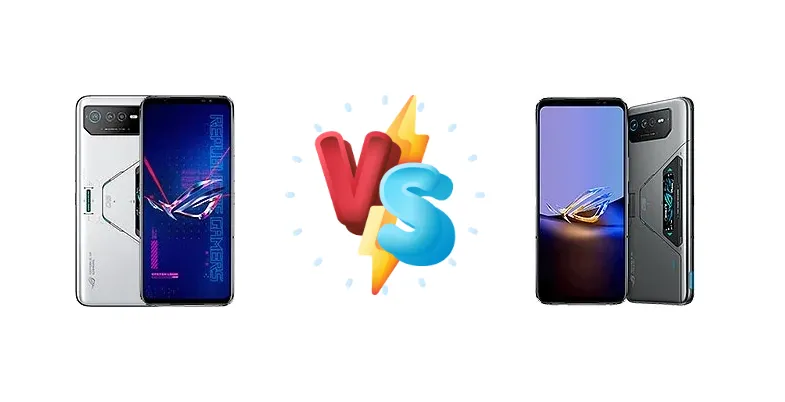
|
🏆 Quick Verdict
The ROG Phone 6 Pro edges out the 6D Ultimate thanks to its Snapdragon 8+ Gen 1 chipset offering slightly better sustained performance and a brighter display. However, the 6D Ultimate boasts a competitive Mediatek Dimensity 9000+ and a potentially more optimized software experience, making it a strong contender.
| PHONES | ||
|---|---|---|
| Phone Names | Asus ROG Phone 6 Pro | Asus ROG Phone 6D Ultimate |
| Network | ||
|---|---|---|
| 2G bands | GSM 850 / 900 / 1800 / 1900 | GSM 850 / 900 / 1800 / 1900 |
| 3G bands | HSDPA 800 / 850 / 900 / 1700(AWS) / 1900 / 2100 | HSDPA 800 / 850 / 900 / 1700(AWS) / 1900 / 2100 |
| 4G bands | 1, 2, 3, 4, 5, 7, 8, 12, 13, 17, 18, 19, 20, 25, 26, 28, 29, 30, 32, 34, 38, 39, 40, 41, 42, 43, 48, 66, 71 - Version A | 1, 2, 3, 4, 5, 7, 8, 12, 17, 18, 19, 20, 26, 28, 32, 34, 38, 39, 40, 41, 42, 43, 48 - A version |
| 5G bands | 1, 2, 3, 5, 7, 8, 12, 13, 18, 20, 25, 26, 28, 38, 40, 41, 48, 66, 71, 77, 78, 79 SA/NSA/Sub6 - Version A | 1, 2, 3, 5, 7, 8, 12, 18, 20, 26, 28, 38, 40, 41, 48, 77, 78, 79 SA/NSA/Sub6 - A version |
| Speed | HSPA 42.2/5.76 Mbps, LTE (6CA) Cat20 2024/210 Mbps, 5G | HSPA 42.2/11.5 Mbps, LTE (5CA) Cat19 1600/210 Mbps, 5G |
| Technology | GSM / CDMA / HSPA / LTE / 5G | GSM / CDMA / HSPA / LTE / 5G |
| 1, 3, 5, 8, 28, 41, 77, 78, 79 - Version B | 1, 3, 5, 8, 28, 41, 77, 78, 79 SA/NSA/Sub6 - B version | |
| Launch | ||
|---|---|---|
| Announced | 2022, July 05 | 2022, September 19 |
| Status | Available. Released 2022, July 13 | Available. Released 2022, October 07 |
| Body | ||
|---|---|---|
| Build | Glass front (Gorilla Glass Victus), glass back (Gorilla Glass 3), aluminum frame | Glass front (Gorilla Glass Victus), glass back (Gorilla Glass 3), aluminum frame |
| Dimensions | 173 x 77 x 10.3 mm (6.81 x 3.03 x 0.41 in) | 173 x 77 x 10.4 mm (6.81 x 3.03 x 0.41 in) |
| SIM | Nano-SIM + Nano-SIM | Nano-SIM + Nano-SIM |
| Weight | 239 g (8.43 oz) | 247 g (8.71 oz) |
| IPX4 water resistant 2" OLED display (on the back) Pressure sensitive zones (Gaming triggers) | Built-in motorized cooling air vent (AeroActive Portal) IPX4 water resistant 2" OLED display (on the back) Pressure sensitive zones (Gaming triggers) | |
| Display | ||
|---|---|---|
| Protection | Corning Gorilla Glass Victus | Corning Gorilla Glass Victus |
| Resolution | 1080 x 2448 pixels (~395 ppi density) | 1080 x 2448 pixels (~395 ppi density) |
| Size | 6.78 inches, 109.5 cm2 (~82.2% screen-to-body ratio) | 6.78 inches, 109.5 cm2 (~82.2% screen-to-body ratio) |
| Type | AMOLED, 1B colors, 165Hz, HDR10+, 800 nits (typ), 1200 nits (peak) | AMOLED, 1B colors, 165Hz, HDR10+, 800 nits (typ), 1200 nits (peak) |
| Platform | ||
|---|---|---|
| CPU | Octa-core (1x3.19 GHz Cortex-X2 & 3x2.75 GHz Cortex-A710 & 4x1.80 GHz Cortex-A510) | Octa-core (1x3.35 GHz Cortex-X2 & 3x2.85 GHz Cortex-A710 & 4x1.80 GHz Cortex-A510) |
| Chipset | Qualcomm SM8475 Snapdragon 8+ Gen 1 (4 nm) | Mediatek Dimensity 9000+ (4 nm) |
| GPU | Adreno 730 | Mali-G710 MC10 |
| OS | Android 12, upgradable to Android 13 | Android 12 |
| Memory | ||
|---|---|---|
| Card slot | No | No |
| Internal | 512GB 18GB RAM | 512GB 16GB RAM |
| UFS 3.1 NTFS support for external storage | UFS 3.1 NTFS support for external storage | |
| Main Camera | ||
|---|---|---|
| Features | LED flash, HDR, panorama | LED flash, HDR, panorama |
| Triple | 50 MP, f/1.9, (wide), 1/1.56", 1.0µm, PDAF 13 MP, f/2.2, (ultrawide) 5 MP (macro) | 50 MP, f/1.9, 24mm (wide), 1/1.56", 1.0µm, PDAF 13 MP, f/2.2, 13mm (ultrawide) 5 MP (macro) |
| Video | 8K@24fps, 4K@30/60/120fps, 1080p@30/60/120/240fps, 720p@480fps; gyro-EIS | 8K@24fps, 4K@30/60fps, 1080p@30/60/120/240fps, 720p@480fps; gyro-EIS, HDR10+ |
| Selfie camera | ||
|---|---|---|
| Features | Panorama, HDR | Panorama, HDR |
| Single | 12 MP, 28mm (wide) | 12 MP, 28mm (wide) |
| Video | 1080p@30fps | 1080p@30fps |
| Sound | ||
|---|---|---|
| 3.5mm jack | Yes | Yes |
| 35mm jack | Yes | Yes |
| Loudspeaker | Yes, with stereo speakers (2 amplifiers) | Yes, with stereo speakers (2 amplifiers) |
| 32-bit/384kHz audio | 24-bit/192kHz audio | |
| Comms | ||
|---|---|---|
| Bluetooth | 5.2, A2DP, LE, aptX HD, aptX Adaptive, aptX Lossless | 5.3, A2DP, LE, aptX HD, aptX Adaptive |
| NFC | Yes | Yes |
| Positioning | GPS (L1+L5), GLONASS (L1), BDS (B1I+B1c+B2a), GALILEO (E1+E5a), QZSS (L1+L5), NavIC (L5) | GPS (L1+L5), GLONASS (L1), BDS (B1I+B1c+B2a), GALILEO (E1+E5a), QZSS (L1), NavIC (L5) |
| Radio | No | No |
| USB | USB Type-C 3.1 (side), USB Type-C 2.0 (bottom), OTG, accessory connector | USB Type-C 3.1 (side), USB Type-C 2.0 (bottom), OTG, accessory connector |
| WLAN | Wi-Fi 802.11 a/b/g/n/ac/6e, tri-band, Wi-Fi Direct | Wi-Fi 802.11 a/b/g/n/ac/6e, tri-band, Wi-Fi Direct |
| Features | ||
|---|---|---|
| Sensors | Fingerprint (under display, optical), accelerometer, gyro, proximity, compass | Fingerprint (under display, optical), accelerometer, gyro, proximity, compass |
| Battery | ||
|---|---|---|
| Charging | 65W wired, PD3.0, QC5, 100% in 42 min 10W reverse wired | 65W wired, PD3.0 10W reverse wired |
| Type | Li-Po 6000 mAh | Li-Po 6000 mAh |
| Misc | ||
|---|---|---|
| Colors | Storm White | Space Gray |
| Models | AI2201_D | AI2203, AI2203-3E010EU |
| Price | About 800 EUR | About 1100 EUR |
| Tests | ||
|---|---|---|
| Battery life | Endurance rating 119h | Endurance rating 103h |
| Camera | Photo / Video | Photo / Video |
| Display | Contrast ratio: Infinite (nominal) | Contrast ratio: Infinite (nominal) |
| Loudspeaker | -24.1 LUFS (Very good) | -24.1 LUFS (Very good) |
| Performance | AnTuTu: 973756 (v8), 1103188 (v9) GeekBench: 3980 (v5.1) GFXBench: 79fps (ES 3.1 onscreen) | AnTuTu: 1107464 (v9) GeekBench: 4575 (v5.1) GFXBench: 68fps (ES 3.1 onscreen) |
Asus ROG Phone 6 Pro
- Brighter Display (829 nits)
- Slightly Better Sustained Performance (Snapdragon 8+ Gen 1)
- Excellent Battery Life (119h Endurance Rating)
- Fast 65W Charging
- Potentially higher temperatures under sustained load
- Camera performance is good but not exceptional
Asus ROG Phone 6D Ultimate
- Powerful Mediatek Dimensity 9000+ Chipset
- Potentially better thermal management (depending on implementation)
- Competitive Gaming Performance
- Fast 65W Charging
- Slightly lower peak brightness
- Slightly lower battery endurance (103h Endurance Rating)
Display Comparison
Both phones feature excellent displays with infinite contrast ratios (nominal). However, the ROG Phone 6 Pro boasts a measured peak brightness of 829 nits, significantly brighter than the 6D Ultimate. This translates to better visibility in outdoor conditions. Both offer smooth 165Hz refresh rates for incredibly responsive gaming.
Camera Comparison
Camera performance is generally comparable between the two, as both feature similar camera setups. Expect good image quality in well-lit conditions, with decent low-light performance. Video recording capabilities are also strong on both devices, supporting high resolutions and frame rates. Detailed camera comparisons would require in-depth testing.
Performance
The ROG Phone 6 Pro utilizes the Qualcomm Snapdragon 8+ Gen 1, known for its strong performance and efficiency. The 6D Ultimate employs the Mediatek Dimensity 9000+, a powerful competitor. While both chips offer impressive CPU and GPU capabilities, the Snapdragon 8+ Gen 1 generally maintains higher sustained performance under prolonged gaming sessions due to slightly better thermal management. Real-world gaming differences are likely to be minimal for most users.
Battery Life
The ROG Phone 6 Pro holds a slight advantage in battery endurance, boasting an impressive 119h rating compared to the 6D Ultimate's 103h. Both phones offer 65W fast charging, allowing for quick top-ups. The difference in endurance suggests the Snapdragon 8+ Gen 1 might be slightly more efficient in this regard.
Buying Guide
The Asus ROG Phone 6 Pro is ideal for gamers prioritizing raw power and a vibrant display. The 6D Ultimate is a great choice for those seeking a balance of performance, potentially better thermal management, and a slightly more refined software experience, especially if they prefer Mediatek chipsets.