
Asus ROG Phone 6 Batman Edition vs. Sony Xperia 1 VII: A Deep Dive Comparison
| Phones Images | |||||
|---|---|---|---|---|---|
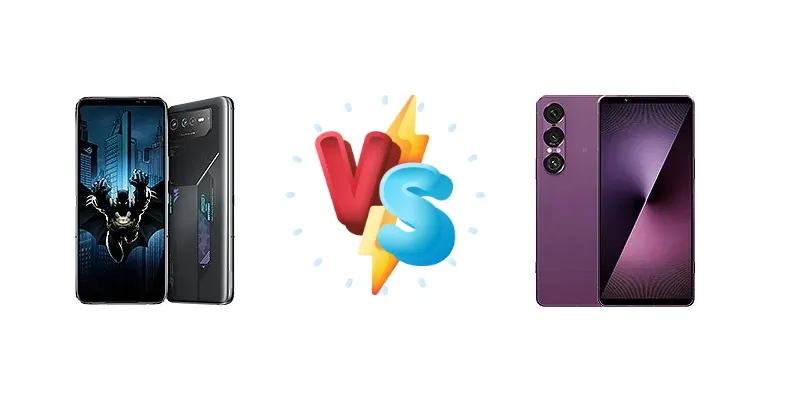
|
🏆 Quick Verdict
For the dedicated mobile gamer, the Asus ROG Phone 6 Batman Edition is the clear winner, offering superior processing power and gaming-centric features. However, the Sony Xperia 1 VII excels in display quality, battery endurance, and a more balanced user experience, making it ideal for content creators and multimedia enthusiasts.
| PHONES | ||
|---|---|---|
| Phone Names | Asus ROG Phone 6 Batman Edition | Sony Xperia 1 VII |
| Network | ||
|---|---|---|
| 2G bands | GSM 850 / 900 / 1800 / 1900 | GSM 850 / 900 / 1800 / 1900 |
| 3G bands | HSDPA 800 / 850 / 900 / 1700(AWS) / 1900 / 2100 | HSDPA 800 / 850 / 900 / 1700(AWS) / 1900 / 2100 |
| 4G bands | 1, 2, 3, 4, 5, 7, 8, 12, 17, 18, 19, 20, 26, 28, 32, 34, 38, 39, 40, 41, 42, 43, 48 - A version (MediaTek) | 1, 2, 3, 4, 5, 7, 8, 12, 13, 17, 19, 20, 25, 26, 28, 32, 34, 38, 39, 40, 41, 66 - Europe |
| 5G bands | 1, 2, 3, 5, 7, 8, 12, 18, 20, 26, 28, 38, 40, 41, 48, 77, 78, 79 SA/NSA/Sub6 - A version (MediaTek) | 1, 3, 5, 7, 8, 20, 28, 38, 40, 41, 75, 77, 78 SA/NSA/Sub6 - Europe |
| Speed | HSPA 42.2/5.76 Mbps, LTE (6CA) Cat20 2024/210 Mbps, 5G - Snapdragon modelHSPA 42.2/11.5 Mbps, LTE (5CA) Cat19 1600/210 Mbps, 5G - MediaTek mod | HSPA, LTE, 5G |
| Technology | GSM / CDMA / HSPA / LTE / 5G | GSM / HSPA / LTE / 5G |
| 1, 3, 7, 8, 20, 28, 38, 40, 41, 77, 78, 79 SA/NSA/Sub6 - B version (Snapdragon) | - | |
| Launch | ||
|---|---|---|
| Announced | 2022, September 19 | 2025, May 13 |
| Status | Available. Released 2022, October 10 | Available. Released 2025, June 04 |
| Body | ||
|---|---|---|
| Build | Glass front (Gorilla Glass Victus), glass back (Gorilla Glass 3), aluminum frame | Glass front (Gorilla Glass Victus 2), glass back (Gorilla Glass Victus), aluminum frame |
| Dimensions | 173 x 77 x 10.4 mm (6.81 x 3.03 x 0.41 in) | 162 x 74 x 8.2 mm (6.38 x 2.91 x 0.32 in) |
| SIM | Nano-SIM + Nano-SIM | · Nano-SIM + eSIM· Nano-SIM + Nano-SIM |
| Weight | 239 g (8.43 oz) | 197 g (6.95 oz) |
| IPX4 water resistant Illuminated RGB logo (on the back) Pressure sensitive zones (Gaming triggers) | - | |
| Display | ||
|---|---|---|
| Protection | Corning Gorilla Glass Victus | Corning Gorilla Glass Victus 2, Mohs level 5 |
| Resolution | 1080 x 2448 pixels (~395 ppi density) | 1080 x 2340 pixels, 19.5:9 ratio (~396 ppi density) |
| Size | 6.78 inches, 109.5 cm2 (~82.2% screen-to-body ratio) | 6.5 inches, 103.7 cm2 (~86.5% screen-to-body ratio) |
| Type | AMOLED, 1B colors, 165Hz, HDR10+, 800 nits (typ), 1200 nits (peak) | LTPO OLED, 1B colors, 120Hz, HDR BT.2020 |
| Platform | ||
|---|---|---|
| CPU | Octa-core (1x3.19 GHz Cortex-X2 & 3x2.75 GHz Cortex-A710 & 4x1.80 GHz Cortex-A510)Octa-core (1x3.35 GHz Cortex-X2 & 3x2.85 GHz Cortex-A710 & 4x1.80 GHz Cortex-A510) | Octa-core (2x4.32 GHz Oryon V2 Phoenix L + 6x3.53 GHz Oryon V2 Phoenix M) |
| Chipset | Qualcomm SM8475 Snapdragon 8+ Gen 1 (4 nm) - USAMediatek Dimensity 9000+ (4 nm) - International | Qualcomm SM8750-AB Snapdragon 8 Elite (3 nm) |
| GPU | Adreno 730Mali-G710 MC10 | Adreno 830 |
| OS | Android 12 | Android 15, up to 4 major Android upgrades |
| Memory | ||
|---|---|---|
| Card slot | No | microSDXC (uses shared SIM slot) |
| Internal | 256GB 12GB RAM | 256GB 12GB RAM, 512GB 12GB RAM |
| UFS 3.1 NTFS support for external storage | - | |
| Main Camera | ||
|---|---|---|
| Features | LED flash, HDR, panorama | Zeiss optics, Zeiss T* lens coating, color spectrum sensor, LED flash, panorama, HDR, eye tracking |
| Triple | 50 MP, f/1.9, 24mm (wide), 1/1.56", 1.0µm, PDAF 13 MP, f/2.2, 13mm (ultrawide) 5 MP (macro) | 48 MP, f/1.9, 24mm (wide), 1/1.35", 1.12µm, dual pixel PDAF, OIS 12 MP, f/2.3, 85mm (telephoto), f/3.5, 170mm (telephoto), 1/3.5", 1.0µm, dual pixel PDAF, 3.5x-7.1x continuous optical zoom, OIS, 4cm macro @ 120mm, no AF 48 MP, f/2.0, 16mm (ultrawide), 1/1.56", 1.0µm, PDAF |
| Video | 8K@24fps, 4K@30/60fps, 4K@120fps (Snapdragon model), 1080p@30/60/120/240fps, 720p@480fps; gyro-EIS, HDR10+ | 4K@24/30/60/120fps HDR, 1080p@30/60/120fps; 5-axis gyro-EIS, OIS |
| Selfie camera | ||
|---|---|---|
| Features | Panorama, HDR | HDR |
| Single | 12 MP, 28mm (wide) | 12 MP, f/2.0, 24mm (wide), 1/2.9", 1.22µm |
| Video | 1080p@30fps | 4K@30/60fps, 1080p@30/60fps, 5-axis gyro-EIS |
| Sound | ||
|---|---|---|
| 3.5mm jack | Yes | - |
| 35mm jack | Yes | Yes |
| Loudspeaker | Yes, with stereo speakers (2 amplifiers) | Yes, with stereo speakers |
| 24-bit/192kHz audio - MediaTek model 32-bit/384kHz audio - Snapdragon model | - | |
| Comms | ||
|---|---|---|
| Bluetooth | 5.2, A2DP, LE, aptX HD, aptX Adaptive - Snapdragon model5.3, A2DP, LE - MediaTek model | 6.0, A2DP, LE Audio, aptX HD, aptX Adaptive, aptX Lossless |
| NFC | Yes | Yes |
| Positioning | GPS (L1+L5), GLONASS (L1), BDS (B1I+B1c+B2a), GALILEO (E1+E5a), QZSS (L1+L5), NavIC (L5) | GPS, GLONASS, BDS, GALILEO, QZSS |
| Radio | No | No |
| USB | USB Type-C 3.1 (side), USB Type-C 2.0 (bottom), OTG, accessory connector | USB Type-C 3.2, OTG, video output |
| WLAN | Wi-Fi 802.11 a/b/g/n/ac/6e, tri-band, Wi-Fi Direct | Wi-Fi 802.11 a/b/g/n/ac/6e/7, tri-band, Wi-Fi Direct, DLNA |
| Features | ||
|---|---|---|
| Sensors | Fingerprint (under display, optical), accelerometer, gyro, proximity, compass | Fingerprint (side-mounted), accelerometer, gyro, proximity, barometer, compass |
| Battery | ||
|---|---|---|
| Charging | 65W wired, PD3.0, QC5 (Snapdragon model) 10W reverse wired | 30W wired, PD3.0, PPS, 50% in 30 min 15W wireless Reverse wireless |
| Type | Li-Po 6000 mAh | 5000 mAh |
| Misc | ||
|---|---|---|
| Colors | Night Black | Moss Green, Orchid Purple, Slate Black |
| Models | AI2203_C | XQ-FS54, XQFS54EUKCG.GC, XQFS54EUKCV.GC, XQFS54EUKCB.GC, PDX256 |
| Price | About 1500 EUR | € 1,338.99 / $ 1,394.99 / £ 1,149.94 |
| EU LABEL | ||
|---|---|---|
| Battery | - | 43:30h endurance, 1400 cycles |
| Energy | - | Class B |
| Free fall | - | Class B (181 falls) |
| Repairability | - | Class D |
Asus ROG Phone 6 Batman Edition
- Superior gaming performance with Snapdragon 8+ Gen 1/Dimensity 9000+
- Gaming-centric features like AirTriggers and high refresh rate display
- Faster wired charging (65W)
- Likely shorter battery life compared to Xperia 1 VII
- Less refined design and larger form factor
- Camera system not a primary strength
Sony Xperia 1 VII
- Exceptional battery life and endurance
- Brighter and more color-accurate display
- Powerful and efficient Snapdragon 8 Elite chipset
- Slower wired charging (30W)
- Less focused on gaming-specific features
- Potentially higher price point
Display Comparison
The Sony Xperia 1 VII boasts a significantly brighter display, reaching a measured 1475 nits, compared to the ROG Phone 6 Batman Edition (brightness data unavailable, but typically lower for gaming phones). While the ROG Phone likely features a higher refresh rate, the Xperia 1 VII’s color accuracy and peak brightness are crucial for content consumption. The Xperia 1 VII’s panel is likely to offer superior viewing angles and color reproduction, benefiting photographers and videographers reviewing their work. The ROG Phone’s display is tuned for fast response times, prioritizing gaming over color fidelity.
Camera Comparison
Detailed camera specs for the Xperia 1 VII are needed for a full comparison, but Sony’s history suggests a focus on image quality and manual controls. The ROG Phone 6 Batman Edition’s camera system is likely geared towards convenience and social media sharing. The Xperia 1 VII’s image processing will likely prioritize natural colors and detail, while the ROG Phone may employ more aggressive sharpening and contrast. The Xperia 1 VII’s camera system is expected to excel in low-light conditions and offer advanced video recording capabilities, catering to professional content creators. The ROG Phone’s camera is adequate but not a primary selling point.
Performance
The Xperia 1 VII’s Snapdragon 8 Elite, built on a 3nm process, represents a substantial leap in performance and efficiency over the ROG Phone 6 Batman Edition’s Snapdragon 8+ Gen 1 (or Dimensity 9000+). The Oryon V2 Phoenix CPU cores in the Xperia 1 VII (2x4.32 GHz + 6x3.53 GHz) offer a significant clock speed and architectural advantage over the ROG Phone’s (3.19 GHz Cortex-X2 + 2.75 GHz Cortex-A710). This translates to faster app loading, smoother multitasking, and improved performance in demanding applications. While the ROG Phone’s gaming optimizations are strong, the Xperia 1 VII’s raw processing power provides a more future-proof experience. The 3nm node also means the Xperia 1 VII will run cooler under sustained load, reducing thermal throttling.
Battery Life
The Sony Xperia 1 VII’s battery endurance is a standout feature, offering 43:30h of endurance and 15:32h of active use. This is likely due to the efficient Snapdragon 8 Elite chipset and optimized software. The ROG Phone 6 Batman Edition, while offering 65W wired charging, likely has a shorter battery life due to its power-hungry processor and high refresh rate display. The Xperia 1 VII’s 30W charging with PPS is respectable, reaching 50% in 30 minutes, and the addition of 15W wireless and reverse wireless charging adds convenience. The ROG Phone’s 10W reverse wired charging is less versatile.
Buying Guide
Buy the Asus ROG Phone 6 Batman Edition if you need uncompromising gaming performance, a high refresh rate display for competitive play, and features like AirTriggers for enhanced control. Buy the Sony Xperia 1 VII if you prefer a more compact flagship with exceptional display accuracy, long-lasting battery life, and a focus on photography and video recording with a professional-grade camera system.