
Asus ROG Phone 5 Pro vs Xiaomi Black Shark 4 Pro: A Deep Dive for Gamers
| Phones Images | |||||
|---|---|---|---|---|---|
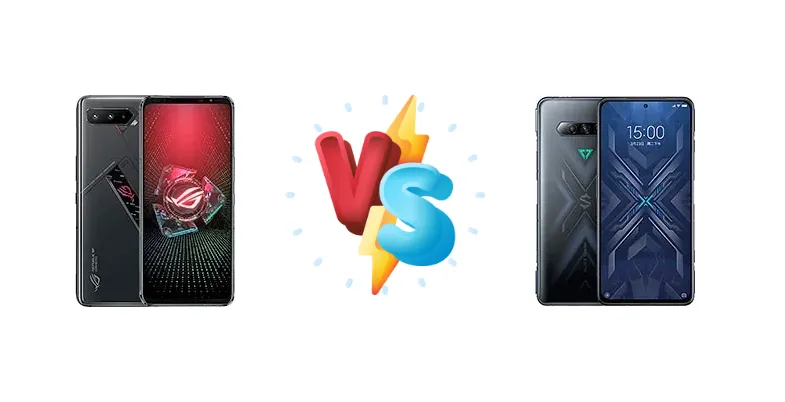
|
🏆 Quick Verdict
For the gamer prioritizing absolute speed and minimal downtime, the Xiaomi Black Shark 4 Pro is the clear winner. Its 120W charging, achieving a full charge in just 15 minutes, dramatically reduces interruptions. However, the Asus ROG Phone 5 Pro offers a more refined ecosystem and potentially better sustained performance due to its advanced cooling solutions.
| PHONES | ||
|---|---|---|
| Phone Names | Asus ROG Phone 5 Pro | Xiaomi Black Shark 4 Pro |
| Network | ||
|---|---|---|
| 2G bands | GSM 850 / 900 / 1800 / 1900 | GSM 850 / 900 / 1800 / 1900 |
| 3G bands | HSDPA 800 / 850 / 900 / 1700(AWS) / 1800 / 1900 / 2100 | HSDPA 800 / 850 / 900 / 1700(AWS) / 1900 / 2100 |
| 4G bands | 1, 2, 3, 4, 5, 7, 8, 12, 13, 17, 18, 19, 20, 25, 26, 28, 29, 30, 32, 34, 38, 39, 40, 41, 42, 48, 66, 71 | 1, 2, 3, 4, 5, 7, 8, 18, 19, 20, 26, 28, 34, 38, 39, 40, 41 |
| 5G bands | 1, 2, 3, 5, 7, 8, 12, 20, 25, 28, 38, 40, 41, 66, 71, 77, 78, 79 SA/NSA | 1, 3, 8, 28, 41, 77, 78, 79 SA/NSA |
| Speed | HSPA 42.2/5.76 Mbps, LTE (7CA) Cat20 1400/150 Mbps, 5G 4 Gbps DL | HSPA, LTE, 5G |
| Technology | GSM / HSPA / LTE / 5G | GSM / CDMA / HSPA / EVDO / LTE / 5G |
| - | CDMA2000 1xEV-DO | |
| Launch | ||
|---|---|---|
| Announced | 2021, March 10 | 2021, March 23 |
| Status | Available. Released 2021, July 02 | Available. Released 2021, March 30 |
| Body | ||
|---|---|---|
| Build | Glass front (Gorilla Glass Victus), glass back (Gorilla Glass 3), aluminum frame | - |
| Dimensions | 172.8 x 77.3 x 10.3 mm (6.80 x 3.04 x 0.41 in) | 163.8 x 76.4 x 9.9 mm (6.45 x 3.01 x 0.39 in) |
| SIM | Nano-SIM + Nano-SIM | Nano-SIM + Nano-SIM |
| Weight | 238 g (8.40 oz) | 220 g (7.76 oz) |
| Pressure sensitive zones (Gaming triggers) Touch sensor; ROG Vision color PMOLED display (on the back) | Physical pop-up gaming triggers | |
| Display | ||
|---|---|---|
| Protection | Corning Gorilla Glass Victus | - |
| Resolution | 1080 x 2448 pixels (~395 ppi density) | 1080 x 2400 pixels, 20:9 ratio (~395 ppi density) |
| Size | 6.78 inches, 109.5 cm2 (~82.0% screen-to-body ratio) | 6.67 inches, 107.4 cm2 (~85.8% screen-to-body ratio) |
| Type | AMOLED, 1B colors, 144Hz, HDR10+, 800 nits (typ), 1200 nits (peak) | Super AMOLED, 144Hz, HDR10+, 1300 nits (peak) |
| - | Always-on display | |
| Platform | ||
|---|---|---|
| CPU | Octa-core (1x2.84 GHz Cortex-X1 & 3x2.42 GHz Cortex-A78 & 4x1.80 GHz Cortex-A55) | Octa-core (1x2.84 GHz Cortex-X1 & 3x2.42 GHz Cortex-A78 & 4x1.80 GHz Cortex-A55) |
| Chipset | Qualcomm SM8350 Snapdragon 888 5G (5 nm) | Qualcomm SM8350 Snapdragon 888 5G (5 nm) |
| GPU | Adreno 660 | Adreno 660 |
| OS | Android 11, upgradable to Android 13, ROG UI | Android 11, Joy UI 12.5 |
| Memory | ||
|---|---|---|
| Card slot | No | No |
| Internal | 512GB 16GB RAM | 128GB 8GB RAM, 256GB 8GB RAM, 256GB 12GB RAM, 512GB 16GB RAM |
| UFS 3.1 | UFS 3.1 | |
| Main Camera | ||
|---|---|---|
| Features | LED flash, HDR, panorama | LED flash, HDR, panorama |
| Single | - | 20 MP, f/2.5, (wide), 0.8µm |
| Triple | 64 MP, f/1.8, 26mm (wide), 1/1.73", 0.8µm, PDAF 13 MP, f/2.4, 11mm, 125˚ (ultrawide) 5 MP (macro) | 64 MP, f/1.8, (wide), 1/1.97", 0.7µm, PDAF 8 MP, f/2.2, 120˚ (ultrawide), 1/4.0", 1.12µm 5 MP (macro), AF |
| Video | 8K@30fps, 4K@30/60/120fps, 1080p@30/60/120/240fps, 720p@480fps; gyro-EIS | 4K@30/60fps, 1080p@30/60/240fps, 1080p@960fps; HDR10+ |
| Selfie camera | ||
|---|---|---|
| Features | Panorama, HDR | HDR |
| Single | 24 MP, f/2.5, 27mm (wide), 0.9µm | 20 MP, f/2.5, (wide), 0.8µm |
| Video | 1080p@30fps | 1080p@30fps |
| Sound | ||
|---|---|---|
| 3.5mm jack | Yes | Yes |
| 35mm jack | Yes | Yes |
| Loudspeaker | Yes, with DTS:X stereo speakers (2 dedicated amplifiers) | Yes, with stereo speakers |
| 24-bit/192kHz audio | 24-bit/192kHz audio | |
| Comms | ||
|---|---|---|
| Bluetooth | 5.2, A2DP, LE, aptX HD, aptX Adaptive | 5.2 (China), 5.0 (Global), A2DP, LE, aptX HD, aptX Adaptive |
| NFC | Yes | Yes |
| Positioning | GPS (L1+L5), GLONASS (L1), BDS (B1I+B1c+B2a), GALILEO (E1+E5a), QZSS (L1+L5), NavIC (L5) | GPS, GLONASS, GALILEO, QZSS, BDS |
| Radio | No | No |
| USB | USB Type-C 3.1 (side), USB Type-C 2.0 (bottom), OTG, accessory connector | USB Type-C 2.0 |
| WLAN | Wi-Fi 802.11 a/b/g/n/ac/6e, dual-band, Wi-Fi Direct | Wi-Fi 802.11 a/b/g/n/ac/6, dual-band, Wi-Fi Direct |
| Features | ||
|---|---|---|
| Sensors | Fingerprint (under display, optical), accelerometer, gyro, proximity, compass | Fingerprint (side-mounted), accelerometer, gyro, proximity, compass, barometer (China only) |
| Battery | ||
|---|---|---|
| Charging | 65W wired, PD3.0, QC5, 70% in 30 min, 100% in 52 min 10W reverse wired | 120W wired, 50% in 5 min, 100% in 15 min |
| Type | Li-Po 6000 mAh | Li-Po 4500 mAh |
| Misc | ||
|---|---|---|
| Colors | Glossy Black | Shadow Black, Misty Grey, Cosmos Black, Dark Blue, Silver |
| Models | ZS673KS, ZS673KS-1A079IN | SHARK PAR-H0 |
| Price | About 680 EUR | About 500 EUR |
Asus ROG Phone 5 Pro
- Potentially superior thermal management for sustained gaming.
- Wider ecosystem of accessories and customization options.
- Likely higher quality display with advanced features (LTPO, higher refresh rate).
- Significantly slower charging speed compared to the Black Shark 4 Pro.
- Potentially higher price point.
- May prioritize features beyond core gaming performance.
Xiaomi Black Shark 4 Pro
- Blazing-fast 120W charging – a massive time saver.
- More aggressive pricing, offering excellent value.
- Dedicated gaming features like shoulder triggers.
- Potentially less effective thermal management leading to more throttling.
- May compromise on display quality to reduce costs.
- Less refined software experience compared to Asus.
Display Comparison
Both devices utilize the Qualcomm SM8350 Snapdragon 888 5G (5 nm) chipset, meaning graphical performance will be largely similar. However, display details beyond resolution (not provided in the context data) are crucial. Given the ROG Phone's history, it likely features a higher refresh rate and potentially LTPO technology for variable refresh rates, improving battery efficiency. The Black Shark 4 Pro, while likely also high refresh rate, may prioritize cost savings in this area. Color accuracy and peak brightness will be key differentiators, impacting visual fidelity during gameplay.
Camera Comparison
Camera specifications are absent from the provided data. However, given the gaming focus, camera quality is likely secondary. Both manufacturers typically prioritize main sensor size and image processing for acceptable results. The presence or absence of Optical Image Stabilization (OIS) will be a significant differentiator, improving image clarity in low-light conditions and during handheld video recording. We can assume both will include ultrawide and potentially macro lenses, but their quality will likely be moderate.
Performance
The shared Snapdragon 888 5G chipset and identical CPU configuration (Octa-core with 1x2.84 GHz Cortex-X1, 3x2.42 GHz Cortex-A78, and 4x1.80 GHz Cortex-A55) mean raw processing power is a tie. The critical difference lies in thermal management. While both phones will experience throttling under sustained load, the ROG Phone series is renowned for its advanced cooling systems (not detailed in the provided data, but a key brand feature). The Black Shark 4 Pro likely employs a more conventional cooling solution. RAM speed (LPDDR5 vs LPDDR5x) – not specified – could also influence performance, with LPDDR5x offering a slight edge.
Battery Life
The most significant disparity lies in charging speed. The Xiaomi Black Shark 4 Pro’s 120W wired charging is a game-changer, achieving 50% charge in 5 minutes and 100% in 15 minutes. This drastically reduces downtime compared to the Asus ROG Phone 5 Pro’s 65W charging (70% in 30 min, 100% in 52 min). While the ROG Phone 5 Pro offers 10W reverse wired charging, the Black Shark 4 Pro’s charging speed is the defining advantage. Battery capacity (not provided) will influence overall endurance, but the faster charging mitigates the impact of a potentially smaller battery on the Black Shark 4 Pro.
Buying Guide
Buy the Asus ROG Phone 5 Pro if you need a comprehensive gaming ecosystem with extensive customization options, a wider range of accessories, and potentially superior long-term thermal management for extended gaming sessions. Buy the Xiaomi Black Shark 4 Pro if you prioritize the fastest possible charging speeds, minimizing downtime between matches, and a more aggressive, value-focused approach to gaming features.