
Asus ROG Phone 5 Pro vs iPhone 12 Pro Max: The Ultimate Showdown
| Phones Images | |||||
|---|---|---|---|---|---|
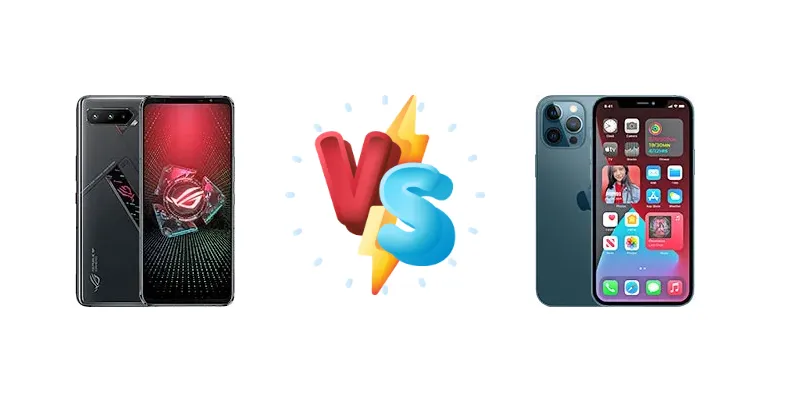
|
🏆 Quick Verdict
The ROG Phone 5 Pro dominates in raw gaming performance and charging speed, offering a more customizable experience. However, the iPhone 12 Pro Max boasts a superior camera system, tighter ecosystem integration, and longer software support, making it a better all-around choice for many.
| PHONES | ||
|---|---|---|
| Phone Names | Asus ROG Phone 5 Pro | Apple iPhone 12 Pro Max |
| Network | ||
|---|---|---|
| 2G bands | GSM 850 / 900 / 1800 / 1900 | GSM 850 / 900 / 1800 / 1900 |
| 3G bands | HSDPA 800 / 850 / 900 / 1700(AWS) / 1800 / 1900 / 2100 | HSDPA 850 / 900 / 1700(AWS) / 1900 / 2100 |
| 4G bands | 1, 2, 3, 4, 5, 7, 8, 12, 13, 17, 18, 19, 20, 25, 26, 28, 29, 30, 32, 34, 38, 39, 40, 41, 42, 48, 66, 71 | 1, 2, 3, 4, 5, 7, 8, 12, 13, 14, 17, 18, 19, 20, 25, 26, 28, 29, 30, 32, 34, 38, 39, 40, 41, 42, 46, 48, 66, 71 - A2342 |
| 5G bands | 1, 2, 3, 5, 7, 8, 12, 20, 25, 28, 38, 40, 41, 66, 71, 77, 78, 79 SA/NSA | 1, 2, 3, 5, 7, 8, 12, 20, 25, 28, 38, 40, 41, 66, 71, 77, 78, 79, 260, 261 Sub6/mmWave - A2342 |
| Speed | HSPA 42.2/5.76 Mbps, LTE (7CA) Cat20 1400/150 Mbps, 5G 4 Gbps DL | HSPA, LTE, 5G, EV-DO Rev.A 3.1 Mbps |
| Technology | GSM / HSPA / LTE / 5G | GSM / CDMA / HSPA / EVDO / LTE / 5G |
| - | 1, 2, 3, 5, 7, 8, 12, 20, 25, 28, 38, 40, 41, 66, 77, 78, 79 Sub6 - A2410, A2411, A2412 | |
| Launch | ||
|---|---|---|
| Announced | 2021, March 10 | 2020, October 13 |
| Status | Available. Released 2021, July 02 | Available. Released 2020, November 13 |
| Body | ||
|---|---|---|
| Build | Glass front (Gorilla Glass Victus), glass back (Gorilla Glass 3), aluminum frame | Glass front, glass back, stainless steel frame |
| Dimensions | 172.8 x 77.3 x 10.3 mm (6.80 x 3.04 x 0.41 in) | 160.8 x 78.1 x 7.4 mm (6.33 x 3.07 x 0.29 in) |
| SIM | Nano-SIM + Nano-SIM | · Nano-SIM + eSIM· Nano-SIM + Nano-SIM (China) |
| Weight | 238 g (8.40 oz) | 228 g (8.04 oz) |
| Pressure sensitive zones (Gaming triggers) Touch sensor; ROG Vision color PMOLED display (on the back) | IP68 dust/water resistant (up to 6m for 30 min) Apple Pay (Visa, MasterCard, AMEX certified) | |
| Display | ||
|---|---|---|
| Protection | Corning Gorilla Glass Victus | Ceramic Shield glass |
| Resolution | 1080 x 2448 pixels (~395 ppi density) | 1284 x 2778 pixels, 19.5:9 ratio (~458 ppi density) |
| Size | 6.78 inches, 109.5 cm2 (~82.0% screen-to-body ratio) | 6.7 inches, 109.8 cm2 (~87.4% screen-to-body ratio) |
| Type | AMOLED, 1B colors, 144Hz, HDR10+, 800 nits (typ), 1200 nits (peak) | Super Retina XDR OLED, HDR10, Dolby Vision, 800 nits (HBM), 1200 nits (peak) |
| Platform | ||
|---|---|---|
| CPU | Octa-core (1x2.84 GHz Cortex-X1 & 3x2.42 GHz Cortex-A78 & 4x1.80 GHz Cortex-A55) | Hexa-core (2x3.1 GHz Firestorm + 4x1.8 GHz Icestorm) |
| Chipset | Qualcomm SM8350 Snapdragon 888 5G (5 nm) | Apple A14 Bionic (5 nm) |
| GPU | Adreno 660 | Apple GPU (4-core graphics) |
| OS | Android 11, upgradable to Android 13, ROG UI | iOS 14.1, upgradable to iOS 26.1 |
| Memory | ||
|---|---|---|
| Card slot | No | No |
| Internal | 512GB 16GB RAM | 128GB 6GB RAM, 256GB 6GB RAM, 512GB 6GB RAM |
| UFS 3.1 | NVMe | |
| Main Camera | ||
|---|---|---|
| Features | LED flash, HDR, panorama | Dual-LED dual-tone flash, HDR (photo/panorama) |
| Triple | 64 MP, f/1.8, 26mm (wide), 1/1.73", 0.8µm, PDAF 13 MP, f/2.4, 11mm, 125˚ (ultrawide) 5 MP (macro) | 12 MP, f/1.6, 26mm (wide), 1/1.9", 1.7µm, dual pixel PDAF, sensor-shift OIS 12 MP, f/2.2, 65mm (telephoto), 1/3.4", 1.0µm, PDAF, OIS, 2.5x optical zoom 12 MP, f/2.4, 13mm, 120˚ (ultrawide), 1/3.4", 1.0µm TOF 3D LiDAR scanner (depth) |
| Video | 8K@30fps, 4K@30/60/120fps, 1080p@30/60/120/240fps, 720p@480fps; gyro-EIS | 4K@24/25/30/60fps, 1080p@25/30/60/120/240fps, 10‑bit HDR, Dolby Vision HDR (up to 60fps), stereo sound rec. |
| Selfie camera | ||
|---|---|---|
| Features | Panorama, HDR | HDR |
| Single | 24 MP, f/2.5, 27mm (wide), 0.9µm | 12 MP, f/2.2, 23mm (wide), 1/3.6", 1.0µm SL 3D, (depth/biometrics sensor) |
| Video | 1080p@30fps | 4K@24/25/30/60fps, 1080p@25/30/60/120fps, gyro-EIS |
| Sound | ||
|---|---|---|
| 3.5mm jack | Yes | No |
| 35mm jack | Yes | No |
| Loudspeaker | Yes, with DTS:X stereo speakers (2 dedicated amplifiers) | Yes, with stereo speakers |
| 24-bit/192kHz audio | - | |
| Comms | ||
|---|---|---|
| Bluetooth | 5.2, A2DP, LE, aptX HD, aptX Adaptive | 5.0, A2DP, LE |
| NFC | Yes | Yes |
| Positioning | GPS (L1+L5), GLONASS (L1), BDS (B1I+B1c+B2a), GALILEO (E1+E5a), QZSS (L1+L5), NavIC (L5) | GPS, GLONASS, GALILEO, QZSS |
| Radio | No | No |
| USB | USB Type-C 3.1 (side), USB Type-C 2.0 (bottom), OTG, accessory connector | Lightning, USB 2.0 |
| WLAN | Wi-Fi 802.11 a/b/g/n/ac/6e, dual-band, Wi-Fi Direct | Wi-Fi 802.11 a/b/g/n/ac/6, dual-band, hotspot |
| Features | ||
|---|---|---|
| Sensors | Fingerprint (under display, optical), accelerometer, gyro, proximity, compass | Face ID, accelerometer, gyro, proximity, compass, barometer |
| - | Ultra Wideband (UWB) support | |
| Battery | ||
|---|---|---|
| Charging | 65W wired, PD3.0, QC5, 70% in 30 min, 100% in 52 min 10W reverse wired | Wired, PD2.0, 50% in 30 min 15W wireless (MagSafe) 15W wireless (Qi2) - requires iOS 17.4 update |
| Type | Li-Po 6000 mAh | Li-Ion 3687 mAh (14.13 Wh) |
| Misc | ||
|---|---|---|
| Colors | Glossy Black | Silver, Graphite, Gold, Pacific Blue |
| Models | ZS673KS, ZS673KS-1A079IN | A2411, A2342, A2410, A2412, iPhone13,4 |
| Price | About 680 EUR | $ 328.00 / C$ 549.75 / £ 270.67 / € 339.00 |
| SAR EU | - | 0.99 W/kg (head) 0.99 W/kg (body) |
| Pricing | ||
|---|---|---|
| 128GB 6GB RAM | - | $ 599.99 |
| 256GB 6GB RAM | - | $ 728.45 |
| 512GB 6GB RAM | - | $ 886.67 |
| RENEWED | - | $ 627.00 |
| Tests | ||
|---|---|---|
| Battery life | - | Endurance rating 95h |
| Camera | - | Photo / Video |
| Display | - | Contrast ratio: Infinite (nominal) |
| Loudspeaker | - | -23.8 LUFS (Very good) |
| Performance | - | AnTuTu: 638584 (v8) GeekBench: 4240 (v5.1) GFXBench: 55fps (ES 3.1 onscreen) |
Asus ROG Phone 5 Pro
- Exceptional gaming performance
- 144Hz AMOLED display
- 65W fast charging
- Customizable software
- Reverse wired charging
- Camera not as good as iPhone
- Software updates may be less frequent
- Design less premium than iPhone
Apple iPhone 12 Pro Max
- Excellent camera system
- Seamless iOS ecosystem
- Long-term software support
- Premium design and build quality
- Impressive battery life
- Slower charging speeds
- Less customizable
- Higher price point
- No high refresh rate display
Display Comparison
The ROG Phone 5 Pro features a 144Hz AMOLED display, offering incredibly smooth visuals ideal for fast-paced gaming. The iPhone 12 Pro Max has a 6.7-inch Super Retina XDR display with excellent color accuracy and brightness (822 nits measured), but lacks the high refresh rate. While both are excellent, the ROG Phone 5 Pro's refresh rate gives it an edge for gamers.
Camera Comparison
The iPhone 12 Pro Max consistently delivers exceptional photo and video quality, thanks to its advanced image processing and hardware. The ROG Phone 5 Pro's camera is capable, but doesn't match the iPhone's overall quality and consistency. Apple's computational photography is a significant advantage.
Performance
The Snapdragon 888 in the ROG Phone 5 Pro is a beast for gaming, easily handling demanding titles. The A14 Bionic in the iPhone 12 Pro Max is incredibly powerful and efficient, providing smooth performance across all tasks. While the ROG Phone 5 Pro has the raw horsepower for gaming, the A14 Bionic's optimization and efficiency are impressive.
Battery Life
The iPhone 12 Pro Max boasts an impressive endurance rating of 95 hours, showcasing exceptional battery life. The ROG Phone 5 Pro's battery life is good, but not as exceptional as the iPhone. The ROG Phone 5 Pro's 65W charging is significantly faster than the iPhone's charging speeds.
Buying Guide
Buy the Asus ROG Phone 5 Pro if you're a serious mobile gamer prioritizing performance, customization, and fast charging. Buy the Apple iPhone 12 Pro Max if you value a premium camera, seamless iOS experience, and long-term software updates, even if it means sacrificing some gaming-specific features.