
Asus ROG Phone 3 Strix vs. Samsung Galaxy S21 Ultra 5G: A Deep Dive Comparison
| Phones Images | |||||
|---|---|---|---|---|---|
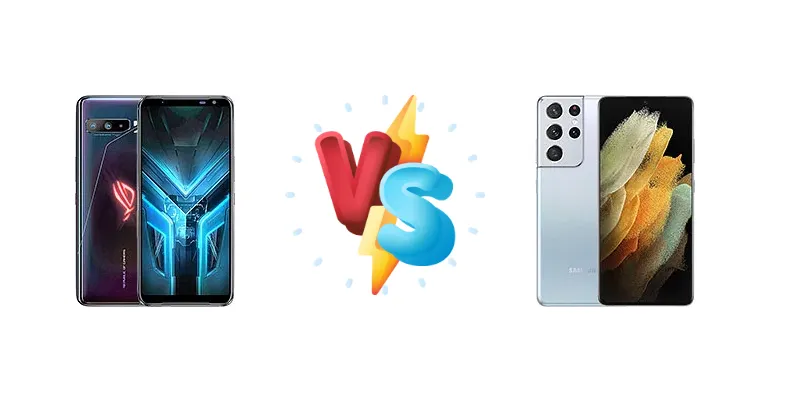
|
🏆 Quick Verdict
For dedicated mobile gamers, the Asus ROG Phone 3 Strix is the clear winner, offering sustained performance and gaming-centric features. However, the Samsung Galaxy S21 Ultra 5G emerges as the superior choice for users prioritizing a versatile camera system, a brighter and more color-accurate display, and a more refined overall experience.
| PHONES | ||
|---|---|---|
| Phone Names | Asus ROG Phone 3 Strix | Samsung Galaxy S21 Ultra 5G |
| Network | ||
|---|---|---|
| 2G bands | GSM 850 / 900 / 1800 / 1900 | GSM 850 / 900 / 1800 / 1900 |
| 3G bands | HSDPA 850 / 900 / 1700(AWS) / 1900 / 2100 | HSDPA 850 / 900 / 1700(AWS) / 1900 / 2100 |
| 4G bands | 1, 2, 3, 4, 5, 7, 8, 20, 28, 34, 38, 39, 40, 41 | 1, 2, 3, 4, 5, 7, 8, 12, 13, 14, 18, 19, 20, 25, 26, 28, 30, 38, 39, 40, 41, 46, 48, 66, 71 - SM-G998U1 |
| 5G bands | 41, 77, 78, 79 SA/NSA | 2, 5, 25, 41, 66, 71, 260, 261 SA/NSA/Sub6/mmWave - SM-G998U1 |
| Speed | HSPA 42.2/5.76 Mbps, LTE (6CA) Cat18 1200/150 Mbps, 5G 4.0 Gbps DL | HSPA 42.2/5.76 Mbps, LTE (7CA) Cat20 2000/200 Mbps, 5G (5+ Gbps DL) |
| Technology | GSM / CDMA / HSPA / LTE / 5G | GSM / CDMA / HSPA / EVDO / LTE / 5G |
| CDMA 800 & TD-SCDMA | 1, 3, 5, 7, 8, 20, 28, 38, 40, 41, 66, 77, 78 SA/NSA/Sub6 - SM-G998B | |
| Launch | ||
|---|---|---|
| Announced | 2020, July 22. Released 2020, July 23 | 2021, January 14 |
| Status | Discontinued | Available. Released 2021, January 29 |
| Body | ||
|---|---|---|
| Build | Glass front (Gorilla Glass 6), glass back (Gorilla Glass 3), aluminum frame | Glass front (Gorilla Glass Victus), glass back (Gorilla Glass Victus), aluminum frame |
| Dimensions | 171 x 78 x 9.9 mm (6.73 x 3.07 x 0.39 in) | 165.1 x 75.6 x 8.9 mm (6.5 x 2.98 x 0.35 in) |
| SIM | Nano-SIM + Nano-SIM | · Nano-SIM + eSIM· Nano-SIM + Nano-SIM + eSIM (max 2 at a time) |
| Weight | 240 g (8.47 oz) | 227 g (Sub6), 229 g (mmWave) (8.01 oz) |
| RGB light panel (on the back) Pressure sensitive zones (Gaming triggers) | IP68 dust/water resistant (up to 1.5m for 30 min) Stylus support | |
| Display | ||
|---|---|---|
| Protection | Corning Gorilla Glass 6 | Corning Gorilla Glass Victus |
| Resolution | 1080 x 2340 pixels, 19.5:9 ratio (~391 ppi density) | 1440 x 3200 pixels, 20:9 ratio (~515 ppi density) |
| Size | 6.59 inches, 106.6 cm2 (~79.9% screen-to-body ratio) | 6.8 inches, 112.1 cm2 (~89.8% screen-to-body ratio) |
| Type | AMOLED, 1B colors, 144Hz, HDR10+, 650 nits (typ) | Dynamic AMOLED 2X, 120Hz, HDR10+, 1500 nits (peak) |
| - | Always-on display | |
| Platform | ||
|---|---|---|
| CPU | Octa-core (1x2.84 GHz Cortex-A77 & 3x2.42 GHz Cortex-A77 & 4x1.80 GHz Cortex-A55) | Octa-core (1x2.9 GHz Cortex-X1 & 3x2.80 GHz Cortex-A78 & 4x2.2 GHz Cortex-A55) - InternationalOcta-core (1x2.84 GHz Cortex-X1 & 3x2.42 GHz Cortex-A78 & 4x1.80 GHz Cortex-A55) - USA/China |
| Chipset | Qualcomm SM8250 Snapdragon 865 5G (7 nm+) | Exynos 2100 (5 nm) - InternationalQualcomm SM8350 Snapdragon 888 5G (5 nm) - USA/China |
| GPU | Adreno 650 | Mali-G78 MP14 - InternationalAdreno 660 - USA/China |
| OS | Android 10, ROG UI | Android 11, up to 4 major Android upgrades, One UI 6.1 |
| Memory | ||
|---|---|---|
| Card slot | No | No |
| Internal | 128GB 8GB RAM, 128GB 12GB RAM, 256GB 8GB RAM | 128GB 8GB RAM, 128GB 12GB RAM, 256GB 12GB RAM, 256GB 16GB RAM, 512GB 12GB RAM, 512GB 16GB RAM |
| UFS 3.1 | UFS 3.1 | |
| Main Camera | ||
|---|---|---|
| Features | LED flash, HDR, panorama | Laser AF, LED flash, auto-HDR, panorama |
| Quad | - | 108 MP, f/1.8, 24mm (wide), 1/1.33", 0.8µm, PDAF, OIS 10 MP, f/2.4, 72mm (telephoto), 1/3.24", 1.22µm, dual pixel PDAF, OIS, 3x optical zoom 10 MP, f/4.9, 240mm (periscope telephoto), 1/3.24", 1.22µm, dual pixel PDAF, OIS, 10x optical zoom 12 MP, f/2.2, 13mm (ultrawide), 1/2.55", 1.4µm, dual pixel PDAF, Super Steady video |
| Triple | 64 MP, f/1.8, 26mm (wide), 1/1.73", 0.8µm, PDAF 13 MP, f/2.4, 11mm, 125˚ (ultrawide) 5 MP (macro) | - |
| Video | 8K@30fps, 4K@30/60/120fps, 1080p@30/60/240fps, 720p@480fps; gyro-EIS | 8K@24fps, 4K@30/60fps, 1080p@30/60/120/240fps, HDR10+, stereo sound rec., gyro-EIS |
| Selfie camera | ||
|---|---|---|
| Features | Panorama, HDR | HDR |
| Single | 24 MP, f/2.0, 27mm (wide), 0.9µm | 40 MP, f/2.2, 26mm (wide), 1/2.8", 0.7µm, PDAF |
| Video | 1080p@30fps | 4K@30/60fps, 1080p@30fps |
| Sound | ||
|---|---|---|
| 3.5mm jack | No | No |
| 35mm jack | No | No |
| Loudspeaker | Yes, with DTS:X stereo speakers (2 dedicated amplifiers) | Yes, with stereo speakers |
| 24-bit/192kHz audio | 32-bit/384kHz audio Tuned by AKG | |
| Comms | ||
|---|---|---|
| Bluetooth | 5.1, A2DP, LE, aptX HD, aptX Adaptive | 5.2, A2DP, LE |
| NFC | Yes | Yes |
| Positioning | GPS (L1+L5), GLONASS, BDS, GALILEO, QZSS | GPS, GLONASS, BDS, GALILEO |
| Radio | No | FM radio (Snapdragon model only; market/operator dependent) |
| USB | USB Type-C 3.1 (side), USB Type-C 2.0 (bottom), OTG, accessory connector | USB Type-C 3.2, OTG |
| WLAN | Wi-Fi 802.11 a/b/g/n/ac/6, dual-band, Wi-Fi Direct | Wi-Fi 802.11 a/b/g/n/ac/6e, dual-band, Wi-Fi Direct |
| Features | ||
|---|---|---|
| Sensors | Fingerprint (under display, optical), accelerometer, gyro, proximity, compass | Fingerprint (under display, ultrasonic), accelerometer, gyro, proximity, compass, barometer |
| - | Samsung DeX, Samsung Wireless DeX (desktop experience support) Bixby natural language commands and dictation Samsung Pay (Visa, MasterCard certified) Ultra Wideband (UWB) support | |
| Battery | ||
|---|---|---|
| Charging | 30W wired, PD3.0, QC4 10W reverse wired | 25W wired, PD3.0 15W wireless (Qi) 4.5W reverse wireless |
| Type | Li-Po 6000 mAh | Li-Ion 5000 mAh |
| Misc | ||
|---|---|---|
| Colors | Black Glare | Phantom Black, Phantom Silver, Phantom Titanium, Phantom Navy, Phantom Brown, Navy |
| Models | ASUS_I003DD | SM-G998B, SM-G998B/DS, SM-G998U, SM-G998U1, SM-G998W, SM-G998N, SM-G9980 |
| Price | About 1400 EUR | $ 240.01 / C$ 353.20 / £ 202.99 / € 264.99 |
| SAR | - | 0.77 W/kg (head) 1.02 W/kg (body) |
| SAR EU | - | 0.71 W/kg (head) 1.58 W/kg (body) |
| Pricing | ||
|---|---|---|
| 128GB 12GB RAM | - | $ 384.99 |
| 256GB 12GB RAM | - | $ 998.00 |
| 512GB 12GB RAM | - | $ 1,179.99 |
| RENEWED | - | $ 459.00 |
| Tests | ||
|---|---|---|
| Battery life | - | Endurance rating 114h |
| Camera | - | Photo / Video |
| Display | - | Contrast ratio: Infinite (nominal) |
| Loudspeaker | - | -25.5 LUFS (Very good) |
| Performance | - | AnTuTu: 657150 (v8) GeekBench: 3518 (v5.1) GFXBench: 33fps (ES 3.1 onscreen) |
Asus ROG Phone 3 Strix
- Superior gaming performance and cooling
- Faster wired charging (30W)
- Gaming-centric features like AirTriggers
- Older chipset (Snapdragon 865)
- Less versatile camera system
- Display likely lacks the brightness and color accuracy of the S21 Ultra
Samsung Galaxy S21 Ultra 5G
- Brighter and more color-accurate display
- Versatile and high-quality camera system
- More efficient 5nm chipset (Exynos/Snapdragon)
- Can experience thermal throttling under sustained load
- Slower wired charging (25W)
- Higher price point
Display Comparison
The Samsung Galaxy S21 Ultra boasts a significantly brighter display, reaching a measured 1023 nits, compared to an unspecified peak brightness for the ROG Phone 3 Strix. While the ROG Phone 3 Strix likely has a high refresh rate, the S21 Ultra’s adaptive 120Hz LTPO panel dynamically adjusts refresh rate to conserve battery, a feature absent on the ROG Phone 3. The S21 Ultra’s ‘Infinite’ contrast ratio suggests superior black levels, enhancing visual depth. The ROG Phone 3 Strix’s display, while likely excellent for gaming, likely prioritizes refresh rate over peak brightness and color accuracy.
Camera Comparison
The Samsung Galaxy S21 Ultra’s camera system is a clear standout. While both phones offer ‘Photo/Video’ capabilities, the S21 Ultra’s sensor size and advanced image processing algorithms provide superior image quality, particularly in low-light conditions. The ROG Phone 3 Strix’s camera is likely adequate, but geared towards casual use, lacking the S21 Ultra’s professional-grade features and versatility. The S21 Ultra’s OIS (Optical Image Stabilization) is crucial for stable video recording and sharp photos, a feature likely present but less sophisticated on the ROG Phone 3 Strix. The inclusion of a 2MP macro camera on the ROG Phone 3 Strix is largely a marketing gimmick, offering minimal practical benefit.
Performance
The S21 Ultra’s chipset varies by region: the Exynos 2100 (5nm) for international markets and the Snapdragon 888 (5nm) for USA/China. Both represent a generational leap over the ROG Phone 3 Strix’s Snapdragon 865 (7nm+). The S21 Ultra’s Cortex-X1 prime core (2.9 GHz or 2.84 GHz depending on region) offers a performance advantage over the ROG Phone 3 Strix’s Cortex-A77. However, the ROG Phone 3 Strix’s superior cooling system is designed to mitigate throttling during extended gaming sessions, potentially allowing it to sustain higher clock speeds for longer periods. The S21 Ultra’s LPDDR5 RAM is standard, while the ROG Phone 3 Strix’s RAM speed is unspecified, but likely similar.
Battery Life
Both devices achieve an endurance rating of 114 hours, suggesting comparable battery life despite the ROG Phone 3 Strix’s unspecified battery capacity. However, the S21 Ultra offers more versatile charging options: 25W wired, 15W wireless (Qi), and 4.5W reverse wireless. The ROG Phone 3 Strix supports 30W wired charging, PD3.0, and QC4, along with 10W reverse wired charging. While the ROG Phone 3 Strix’s faster wired charging is beneficial, the S21 Ultra’s wireless charging capabilities provide added convenience. The S21 Ultra’s efficient 5nm chipset contributes to its strong battery performance.
Buying Guide
Buy the Asus ROG Phone 3 Strix if you demand maximum gaming performance, prioritize sustained frame rates over all else, and appreciate features like AirTriggers. Buy the Samsung Galaxy S21 Ultra 5G if you value a top-tier camera experience, a stunning display for media consumption, and a more polished, all-around smartphone experience with broader functionality beyond gaming.