
Asus ROG Phone 3 Strix vs ROG Phone 5 Ultimate: Which Gaming Beast Reigns Supreme?
| Phones Images | |||||
|---|---|---|---|---|---|
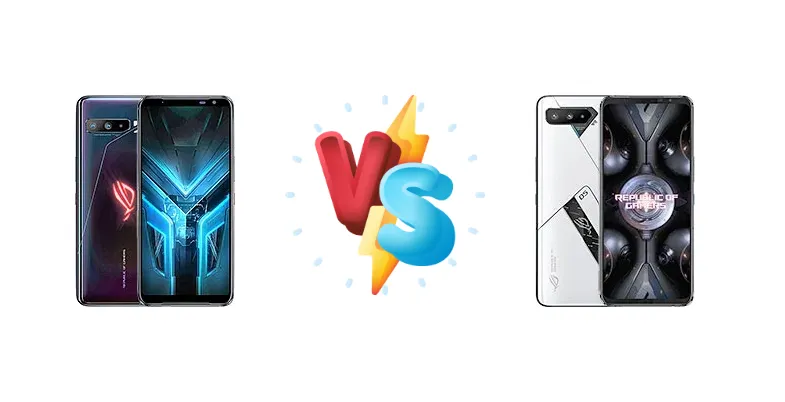
|
🏆 Quick Verdict
For most gamers, the Asus ROG Phone 5 Ultimate is the superior choice. The Snapdragon 888 provides a noticeable performance uplift, and the 65W charging dramatically reduces downtime. While the ROG Phone 3 Strix remains a capable device, the 5 Ultimate’s advancements justify the price premium for serious mobile gamers.
| PHONES | ||
|---|---|---|
| Phone Names | Asus ROG Phone 3 Strix | Asus ROG Phone 5 Ultimate |
| Network | ||
|---|---|---|
| 2G bands | GSM 850 / 900 / 1800 / 1900 | GSM 850 / 900 / 1800 / 1900 |
| 3G bands | HSDPA 850 / 900 / 1700(AWS) / 1900 / 2100 | HSDPA 800 / 850 / 900 / 1700(AWS) / 1800 / 1900 / 2100 |
| 4G bands | 1, 2, 3, 4, 5, 7, 8, 20, 28, 34, 38, 39, 40, 41 | 1, 2, 3, 4, 5, 7, 8, 12, 13, 17, 18, 19, 20, 25, 26, 28, 29, 30, 32, 34, 38, 39, 40, 41, 42, 48, 66, 71 |
| 5G bands | 41, 77, 78, 79 SA/NSA | 1, 2, 3, 5, 7, 8, 12, 20, 25, 28, 38, 40, 41, 66, 71, 77, 78, 79 SA/NSA |
| Speed | HSPA 42.2/5.76 Mbps, LTE (6CA) Cat18 1200/150 Mbps, 5G 4.0 Gbps DL | HSPA 42.2/5.76 Mbps, LTE (7CA) Cat20 1400/150 Mbps, 5G 4 Gbps DL |
| Technology | GSM / CDMA / HSPA / LTE / 5G | GSM / HSPA / LTE / 5G |
| CDMA 800 & TD-SCDMA | - | |
| Launch | ||
|---|---|---|
| Announced | 2020, July 22. Released 2020, July 23 | 2021, March 10 |
| Status | Discontinued | Available. Released 2021, June 07 |
| Body | ||
|---|---|---|
| Build | Glass front (Gorilla Glass 6), glass back (Gorilla Glass 3), aluminum frame | Glass front (Gorilla Glass Victus), glass back (Gorilla Glass 3), aluminum frame |
| Dimensions | 171 x 78 x 9.9 mm (6.73 x 3.07 x 0.39 in) | 172.8 x 77.3 x 10.3 mm (6.80 x 3.04 x 0.41 in) |
| SIM | Nano-SIM + Nano-SIM | Nano-SIM + Nano-SIM |
| Weight | 240 g (8.47 oz) | 238 g (8.40 oz) |
| RGB light panel (on the back) Pressure sensitive zones (Gaming triggers) | Pressure sensitive zones (Gaming triggers) Touch sensor; ROG Vision monochrome PMOLED display (on the back) | |
| Display | ||
|---|---|---|
| Protection | Corning Gorilla Glass 6 | Corning Gorilla Glass Victus |
| Resolution | 1080 x 2340 pixels, 19.5:9 ratio (~391 ppi density) | 1080 x 2448 pixels (~395 ppi density) |
| Size | 6.59 inches, 106.6 cm2 (~79.9% screen-to-body ratio) | 6.78 inches, 109.5 cm2 (~82.0% screen-to-body ratio) |
| Type | AMOLED, 1B colors, 144Hz, HDR10+, 650 nits (typ) | AMOLED, 1B colors, 144Hz, HDR10+, 800 nits (typ), 1200 nits (peak) |
| Platform | ||
|---|---|---|
| CPU | Octa-core (1x2.84 GHz Cortex-A77 & 3x2.42 GHz Cortex-A77 & 4x1.80 GHz Cortex-A55) | Octa-core (1x2.84 GHz Cortex-X1 & 3x2.42 GHz Cortex-A78 & 4x1.80 GHz Cortex-A55) |
| Chipset | Qualcomm SM8250 Snapdragon 865 5G (7 nm+) | Qualcomm SM8350 Snapdragon 888 5G (5 nm) |
| GPU | Adreno 650 | Adreno 660 |
| OS | Android 10, ROG UI | Android 11, upgradable to Android 13, ROG UI |
| Memory | ||
|---|---|---|
| Card slot | No | No |
| Internal | 128GB 8GB RAM, 128GB 12GB RAM, 256GB 8GB RAM | 512GB 18GB RAM |
| UFS 3.1 | UFS 3.1 | |
| Main Camera | ||
|---|---|---|
| Features | LED flash, HDR, panorama | LED flash, HDR, panorama |
| Triple | 64 MP, f/1.8, 26mm (wide), 1/1.73", 0.8µm, PDAF 13 MP, f/2.4, 11mm, 125˚ (ultrawide) 5 MP (macro) | 64 MP, f/1.8, 26mm (wide), 1/1.73", 0.8µm, PDAF 13 MP, f/2.4, 11mm, 125˚ (ultrawide) 5 MP (macro) |
| Video | 8K@30fps, 4K@30/60/120fps, 1080p@30/60/240fps, 720p@480fps; gyro-EIS | 8K@30fps, 4K@30/60/120fps, 1080p@30/60/120/240fps, 720p@480fps; gyro-EIS |
| Selfie camera | ||
|---|---|---|
| Features | Panorama, HDR | Panorama, HDR |
| Single | 24 MP, f/2.0, 27mm (wide), 0.9µm | 24 MP, f/2.5, 27mm (wide), 0.9µm |
| Video | 1080p@30fps | 1080p@30fps |
| Sound | ||
|---|---|---|
| 3.5mm jack | No | Yes |
| 35mm jack | No | Yes |
| Loudspeaker | Yes, with DTS:X stereo speakers (2 dedicated amplifiers) | Yes, with DTS:X stereo speakers (2 dedicated amplifiers) |
| 24-bit/192kHz audio | 24-bit/192kHz audio | |
| Comms | ||
|---|---|---|
| Bluetooth | 5.1, A2DP, LE, aptX HD, aptX Adaptive | 5.2, A2DP, LE, aptX HD, aptX Adaptive |
| NFC | Yes | Yes |
| Positioning | GPS (L1+L5), GLONASS, BDS, GALILEO, QZSS | GPS (L1+L5), GLONASS (L1), BDS (B1I+B1c+B2a), GALILEO (E1+E5a), QZSS (L1+L5), NavIC (L5) |
| Radio | No | No |
| USB | USB Type-C 3.1 (side), USB Type-C 2.0 (bottom), OTG, accessory connector | USB Type-C 3.1 (side), USB Type-C 2.0 (bottom), OTG, accessory connector |
| WLAN | Wi-Fi 802.11 a/b/g/n/ac/6, dual-band, Wi-Fi Direct | Wi-Fi 802.11 a/b/g/n/ac/6e, dual-band, Wi-Fi Direct |
| Features | ||
|---|---|---|
| Sensors | Fingerprint (under display, optical), accelerometer, gyro, proximity, compass | Fingerprint (under display, optical), accelerometer, gyro, proximity, compass |
| Battery | ||
|---|---|---|
| Charging | 30W wired, PD3.0, QC4 10W reverse wired | 65W wired, PD3.0, QC5, 70% in 30 min, 100% in 52 min 10W reverse wired |
| Type | Li-Po 6000 mAh | Li-Po 6000 mAh |
| Misc | ||
|---|---|---|
| Colors | Black Glare | Matte White |
| Models | ASUS_I003DD | ZS673KS, ZS673KS-1B063IN, I005DC |
| Price | About 1400 EUR | About 1300 EUR |
Asus ROG Phone 3 Strix
- More affordable price point
- Slightly more compact design
- Still a very capable gaming phone
- Slower charging speed (30W)
- Less powerful Snapdragon 865 chipset
- Potentially more thermal throttling
Asus ROG Phone 5 Ultimate
- Significantly faster 65W charging
- More powerful Snapdragon 888 chipset
- Improved thermal efficiency
- Potentially better camera performance
- Higher price tag
- Larger and heavier design
Display Comparison
While both phones feature high refresh rate AMOLED displays, the ROG Phone 5 Ultimate benefits from the more efficient Snapdragon 888, potentially allowing it to sustain peak brightness for longer periods. The ROG Phone 3 Strix’s display is still excellent, but the 5 Ultimate’s panel likely offers slightly improved color accuracy and HDR performance. Bezels are comparable, but the 5 Ultimate’s overall design feels more refined.
Camera Comparison
Both phones prioritize gaming over photography, but the ROG Phone 5 Ultimate likely features a more advanced image processing pipeline leveraging the 888’s ISP. While specific sensor details aren’t provided, the ROG Phone 5 Ultimate’s newer chipset allows for faster image processing and potentially better low-light performance. The ROG Phone 3 Strix’s camera is adequate for casual use, but the 5 Ultimate offers a more refined photographic experience.
Performance
The core difference lies in the chipsets. The ROG Phone 5 Ultimate’s Snapdragon 888 (5nm) represents a significant architectural leap over the ROG Phone 3 Strix’s Snapdragon 865 (7nm+). The 888’s Cortex-X1 prime core delivers a substantial performance boost in CPU-intensive tasks and gaming. The 5nm process also translates to improved thermal efficiency, potentially reducing throttling during extended gaming sessions. While both utilize LPDDR5 RAM, the 888’s improved memory controller further enhances performance. The ROG Phone 5 Ultimate will consistently deliver higher and more stable frame rates in demanding titles.
Battery Life
The ROG Phone 5 Ultimate’s 65W charging is a game-changer, achieving a 70% charge in just 30 minutes and a full charge in 52 minutes. This is a massive improvement over the ROG Phone 3 Strix’s 30W charging. While the ROG Phone 3 Strix’s battery capacity might be comparable, the faster charging of the 5 Ultimate minimizes downtime and keeps you gaming longer. The Snapdragon 888’s efficiency also contributes to better overall battery life, despite potentially higher power draw during peak performance.
Buying Guide
Buy the Asus ROG Phone 3 Strix if you prioritize value and a slightly more manageable size, and are content with good, but not leading-edge, performance. It’s ideal for gamers who enjoy titles at medium to high settings and don’t require the absolute fastest charging speeds. Buy the Asus ROG Phone 5 Ultimate if you demand the best possible gaming performance, fastest charging, and are willing to pay a premium for the latest technology. This is the phone for competitive gamers and those who want to future-proof their mobile gaming experience.