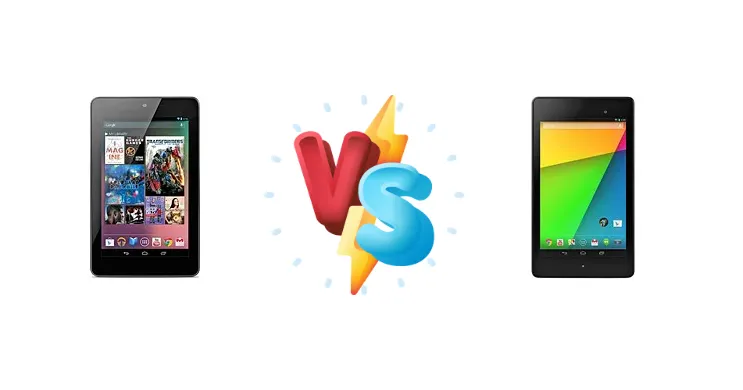
The original Asus Google Nexus 7 launched in 2012, quickly becoming the gold standard for affordable, high-quality Android tablets. The 2013 refresh aimed to build on that success, introducing a faster processor and new features. This comparison dissects the key differences between these two generations to determine which one remains the better choice in today’s landscape.
🏆 Quick Verdict
For most users, the Nexus 7 (2013) is the superior choice. The Qualcomm Snapdragon S4 Pro offers a noticeable performance boost over the Tegra 3, and the addition of wireless charging adds a layer of convenience. While the display contrast remains similar, the overall responsiveness and future-proofing of the 2013 model make it the winner.
| Network |
|---|
| 2G bands | N/A | GSM 850 / 900 / 1800 / 1900 - all versions |
| 3G bands | - | HSDPA 850 / 900 / 1700 / 1900 / 2100 |
| 4G bands | - | 1, 2, 3, 4, 5, 7, 20 - EU |
| EDGE | No | - |
| GPRS | No | - |
| Speed | - | HSPA, LTE |
| Technology | No cellular connectivity | GSM / HSPA / LTE |
| | - | 1, 2, 3, 4, 5, 13, 17 - North America |
| Launch |
|---|
| Announced | 2012, June. Released 2012, July | 2013, July. Released 2013, July |
| Status | Discontinued | Discontinued |
| Body |
|---|
| Dimensions | 198.5 x 120 x 10.5 mm (7.81 x 4.72 x 0.41 in) | 200 x 114 x 8.7 mm (7.87 x 4.49 x 0.34 in) |
| SIM | No | Micro-SIM |
| Weight | 340 g (11.99 oz) | 290 g (Wi-Fi), 299 g (LTE) (10.55 oz) |
| Display |
|---|
| Protection | Corning Gorilla Glass | Corning Gorilla Glass |
| Resolution | 800 x 1280 pixels, 16:10 ratio (~216 ppi density) | 1200 x 1920 pixels, 16:10 ratio (~323 ppi density) |
| Size | 7.0 inches, 142.1 cm2 (~59.6% screen-to-body ratio) | 7.0 inches, 142.1 cm2 (~62.3% screen-to-body ratio) |
| Type | LED-backlit IPS LCD | LED-backlit IPS LCD |
| Platform |
|---|
| CPU | Quad-core 1.2 GHz Cortex-A9 | Quad-core 1.5 GHz Krait |
| Chipset | Nvidia Tegra 3 | Qualcomm Snapdragon S4 Pro |
| GPU | ULP GeForce | Adreno 320 |
| OS | Android 4.1.2 (Jelly Bean), upgradable to 5.1.1 (Lollipop) | Android 4.3 (Jelly Bean), upgradable to 6.0 (Marshmallow) |
| Memory |
|---|
| Card slot | No | No |
| Internal | 8GB 1GB RAM, 16GB 1GB RAM, 32GB 1GB RAM | 16GB 2GB RAM, 32GB 2GB RAM |
| Main Camera |
|---|
| Single | 1.2 MP | 5 MP, f/2.4, AF |
| Video | 720p | 1080p@30fps |
| Selfie camera |
|---|
| Single | - | 1.2 MP |
| Sound |
|---|
| 3.5mm jack | - | Yes |
| 35mm jack | Yes | Yes |
| Loudspeaker | Yes, with stereo speakers | Yes, with stereo speakers |
| Comms |
|---|
| Bluetooth | 3.0 | 4.0, A2DP, LE |
| NFC | Yes | Yes |
| Positioning | GPS | GPS |
| Radio | No | No |
| USB | microUSB 2.0 | microUSB 2.0 (SlimPort) |
| WLAN | Wi-Fi 802.11 b/g/n | Wi-Fi 802.11 a/b/g/n, dual-band |
| Features |
|---|
| Sensors | Accelerometer, gyro, proximity, compass | Accelerometer, gyro, proximity, compass |
| Battery |
|---|
| Charging | - | Wireless (Qi) |
| Talk time | Up to 10 h (multimedia) | Up to 9 h (multimedia) |
| Type | Non-removable Li-Ion 4325 mAh battery (16 Wh) | Li-Ion 3950 mAh, non-removable |
| Misc |
|---|
| Colors | Black | Black |
| Price | About 150 EUR | About 230 EUR |
| SAR EU | 1.39 W/kg (body) | - |
| Tests |
|---|
| Audio quality | - |
Noise -92.2dB / Crosstalk -92.3dB |
Asus Google Nexus 7
- Lower price point (typically)
- Still functional for basic tasks
- Compact and lightweight
- Slower processor (Tegra 3)
- Less responsive user experience
- No wireless charging
Asus Google Nexus 7 (2013)
- Faster processor (Snapdragon S4 Pro)
- Wireless charging (Qi)
- More responsive user experience
- Generally more expensive
- Battery life may not be significantly better
- Still an older device with limited software support
Display Comparison
Both Nexus 7 models feature a 7-inch display, but detailed specifications beyond the 908:1 contrast ratio for the original are scarce. The similar contrast ratios suggest a comparable viewing experience in terms of black levels and color depth. However, the 2013 model benefits from the faster processor, which contributes to smoother animations and a more responsive touchscreen experience. The original's display, while adequate, may feel less fluid in comparison.
Camera Comparison
Neither tablet was ever lauded for its camera capabilities. Detailed camera specs are unavailable for either model, making a direct comparison difficult. Given the era, both likely featured similar low-resolution sensors. The focus should not be on photography when considering either device.
Performance
The core difference lies in the chipset. The original Nexus 7 utilizes the Nvidia Tegra 3, featuring a quad-core 1.2 GHz Cortex-A9 CPU. The 2013 model upgrades to the Qualcomm Snapdragon S4 Pro with a quad-core 1.5 GHz Krait CPU. This represents a significant architectural leap; the Krait architecture is more efficient and delivers better single-core performance, crucial for everyday tasks. While both are quad-core, the Snapdragon S4 Pro’s higher clock speed and more modern architecture translate to faster app loading times and smoother multitasking. The 2013 model will handle more demanding applications and games with greater ease.
Battery Life
Battery capacity details are missing for both devices. However, the Snapdragon S4 Pro in the 2013 model is built on a 28nm process, compared to the Tegra 3’s larger process node. This improved manufacturing process contributes to better power efficiency, potentially offsetting any difference in battery capacity. The addition of wireless charging (Qi) on the 2013 model provides a convenient alternative to traditional charging, though charging speeds via Qi are likely slower than a wired connection.
Buying Guide
Buy the Asus Google Nexus 7 (2012) if you prioritize finding the absolute cheapest functional tablet for basic tasks like reading and light web browsing. Its lower price point makes it a viable option for those on a very tight budget. Buy the Asus Google Nexus 7 (2013) if you value performance, responsiveness, and modern conveniences like wireless charging. It’s a better long-term investment for users who want a smoother experience and a more versatile device.
Frequently Asked Questions
❓ Will the Nexus 7 (2013) receive Android updates?
Officially, no. Google stopped providing updates for both Nexus 7 models years ago. However, the 2013 model's more powerful processor makes it a better candidate for custom ROMs, allowing users to potentially run newer versions of Android.
❓ Is wireless charging on the Nexus 7 (2013) fast?
No. Wireless charging speeds on the Nexus 7 (2013) are relatively slow compared to modern wireless charging standards. Expect significantly longer charging times than with a wired connection. It's primarily a convenience feature rather than a speed booster.
❓ Can the Nexus 7 (2012) handle modern Android apps?
The original Nexus 7's Tegra 3 processor and limited RAM will struggle with many modern Android apps. Expect slowdowns, crashes, and compatibility issues. It's best suited for lightweight apps and basic tasks.
❓ Which Nexus 7 is better for gaming?
The Nexus 7 (2013) is significantly better for gaming due to the Snapdragon S4 Pro's superior GPU performance. It will handle more demanding games with smoother frame rates and fewer graphical glitches.