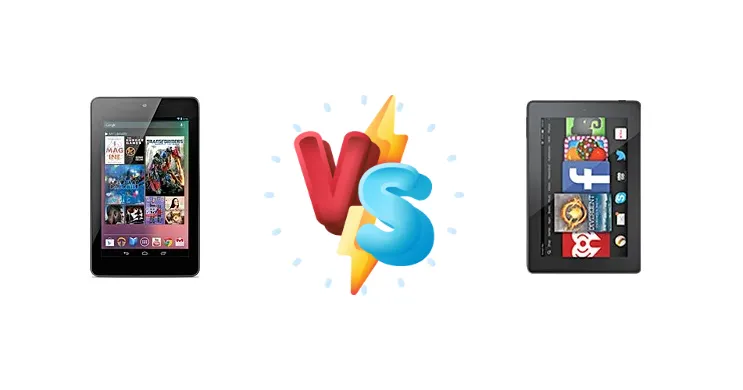
The Asus Google Nexus 7 and Amazon Fire HD 7 represent distinct approaches to the 7-inch tablet market. The Nexus 7, with its Nvidia Tegra 3 chipset, aimed for a premium Android experience, while the Fire HD 7 prioritized affordability and Amazon's ecosystem. This comparison dissects their core differences to help you decide which tablet best suits your needs.
🏆 Quick Verdict
For users prioritizing raw performance and a cleaner Android experience, the Asus Google Nexus 7 is the superior choice, thanks to its Nvidia Tegra 3 processor. However, the Amazon Fire HD 7 offers compelling value for those deeply invested in Amazon's services and content, and are willing to trade performance for price.
| Network |
|---|
| 2G bands | N/A | N/A |
| EDGE | No | No |
| GPRS | No | No |
| Technology | No cellular connectivity | No cellular connectivity |
| Launch |
|---|
| Announced | 2012, June. Released 2012, July | 2014, September. Released 2014, October |
| Status | Discontinued | Discontinued |
| Body |
|---|
| Dimensions | 198.5 x 120 x 10.5 mm (7.81 x 4.72 x 0.41 in) | 191 x 128 x 10.6 mm (7.52 x 5.04 x 0.42 in) |
| SIM | No | No |
| Weight | 340 g (11.99 oz) | 337 g (11.89 oz) |
| Display |
|---|
| Protection | Corning Gorilla Glass | Corning Gorilla Glass |
| Resolution | 800 x 1280 pixels, 16:10 ratio (~216 ppi density) | 800 x 1280 pixels, 16:10 ratio (~216 ppi density) |
| Size | 7.0 inches, 142.1 cm2 (~59.6% screen-to-body ratio) | 7.0 inches, 142.1 cm2 (~58.1% screen-to-body ratio) |
| Type | LED-backlit IPS LCD | IPS LCD |
| Platform |
|---|
| CPU | Quad-core 1.2 GHz Cortex-A9 | Quad-core (2x1.5 GHz & 2x1.2 GHz) |
| Chipset | Nvidia Tegra 3 | - |
| GPU | ULP GeForce | - |
| OS | Android 4.1.2 (Jelly Bean), upgradable to 5.1.1 (Lollipop) | Android 4.4 (KitKat - customized), Fire 4 |
| Memory |
|---|
| Card slot | No | No |
| Internal | 8GB 1GB RAM, 16GB 1GB RAM, 32GB 1GB RAM | 8GB 1GB RAM, 16GB 1GB RAM |
| Main Camera |
|---|
| Single | 1.2 MP | 2 MP |
| Video | 720p | 1080p@30fps |
| Sound |
|---|
| 3.5mm jack | - | Yes |
| 35mm jack | Yes | Yes |
| Loudspeaker | Yes, with stereo speakers | Yes, with stereo speakers |
| Comms |
|---|
| Bluetooth | 3.0 | 4.0, A2DP |
| NFC | Yes | No |
| Positioning | GPS | No |
| Radio | No | No |
| USB | microUSB 2.0 | microUSB 2.0 (SlimPort) |
| WLAN | Wi-Fi 802.11 b/g/n | Wi-Fi 802.11 b/g/n |
| Features |
|---|
| Sensors | Accelerometer, gyro, proximity, compass | Accelerometer, gyro |
| | - | Text-to-Speech English-language content reader |
| Battery |
|---|
| Talk time | Up to 10 h (multimedia) | Up to 8 h |
| Type | Non-removable Li-Ion 4325 mAh battery (16 Wh) | Li-Ion, non-removable |
| Misc |
|---|
| Colors | Black | Black, White, Cobalt, Magenta, Citron |
| Models | - | KFASWI |
| Price | About 150 EUR | About 120 EUR |
| SAR EU | 1.39 W/kg (body) | - |
Asus Google Nexus 7
- Superior performance thanks to the Nvidia Tegra 3 chipset.
- Higher display contrast ratio for better image quality.
- Stock Android experience with access to the full Google Play Store.
- May be harder to find and potentially more expensive due to its age.
- Limited storage options without microSD card support.
Amazon Fire HD 7
- Significantly more affordable.
- Deep integration with Amazon's ecosystem (Kindle, Prime Video).
- Access to Amazon's Appstore and a curated selection of apps.
- Lower performance compared to the Nexus 7.
- Fire OS is heavily customized and lacks full Google Play Store access.
- Display quality likely inferior to the Nexus 7.
Display Comparison
The Asus Google Nexus 7 boasts a contrast ratio of 908:1, indicating a good level of black depth and color vibrancy for its time. While the Fire HD 7's display specifications are less readily available, it's reasonable to assume it doesn't match the Nexus 7's contrast. The Nexus 7's display was lauded for its clarity and viewing angles, making it better suited for media consumption. The Fire HD 7 likely prioritizes cost savings in its display panel, potentially resulting in narrower viewing angles and less accurate color reproduction.
Camera Comparison
Neither tablet was known for its camera prowess. Given the context data, a detailed camera comparison is limited. Both likely featured basic cameras suitable for casual snapshots. The Nexus 7, being a Google-branded device, likely benefited from slightly better image processing algorithms, but the difference would be minimal. Focusing on camera quality for either device is not a primary purchasing consideration.
Performance
The core difference lies in the chipsets. The Nexus 7 utilizes the Nvidia Tegra 3, a quad-core 1.2 GHz Cortex-A9 processor known for its gaming capabilities and relatively efficient power consumption. The Amazon Fire HD 7 features a quad-core CPU clocked at 1.5 GHz and 1.2 GHz, suggesting a big.LITTLE architecture. While the Fire HD 7's clock speeds appear higher, the Tegra 3's architecture and GPU were more advanced for the time, offering superior graphics performance. This translates to smoother gameplay and faster application loading times on the Nexus 7. The Fire HD 7's performance is adequate for basic tasks, but will struggle with demanding games or multitasking.
Battery Life
Battery life is difficult to compare without specific mAh ratings for the Fire HD 7. However, the Tegra 3 in the Nexus 7 was designed with power efficiency in mind. The Fire HD 7's dual-core clock speed configuration suggests an attempt to balance performance and battery life. Real-world usage would likely reveal similar battery performance, with both tablets offering around 6-8 hours of mixed use. Charging speeds are also unknown for both devices, making a direct comparison impossible.
Buying Guide
Buy the Asus Google Nexus 7 if you need a tablet for general productivity, media consumption with a focus on gaming, and prefer a stock Android experience. Its Tegra 3 chipset provides a noticeable performance edge. Buy the Amazon Fire HD 7 if you primarily consume Amazon content (Kindle books, Prime Video), value affordability above all else, and are comfortable with Amazon's Fire OS, which is heavily customized and lacks full Google Play Store access.
Frequently Asked Questions
❓ Is the Nvidia Tegra 3 in the Nexus 7 still capable of running modern Android apps?
While the Tegra 3 is an older processor, it can run many modern Android apps, albeit with potentially slower loading times and reduced graphical fidelity. Apps optimized for newer architectures may experience performance issues. However, for basic tasks and older games, the Tegra 3 remains capable.
❓ Can I install the Google Play Store on the Amazon Fire HD 7?
Installing the Google Play Store on the Fire HD 7 is possible, but it requires a complex process involving sideloading and custom ROMs. It's not officially supported by Amazon and can void your warranty. Furthermore, the process can be unstable and may not work reliably.
❓ Which tablet is better for reading Kindle books?
The Amazon Fire HD 7 is specifically designed for consuming Amazon content, including Kindle books. It offers a seamless integration with the Kindle app and provides a comfortable reading experience. While the Nexus 7 can also run the Kindle app, the Fire HD 7's optimized software and ecosystem make it the better choice for dedicated Kindle readers.