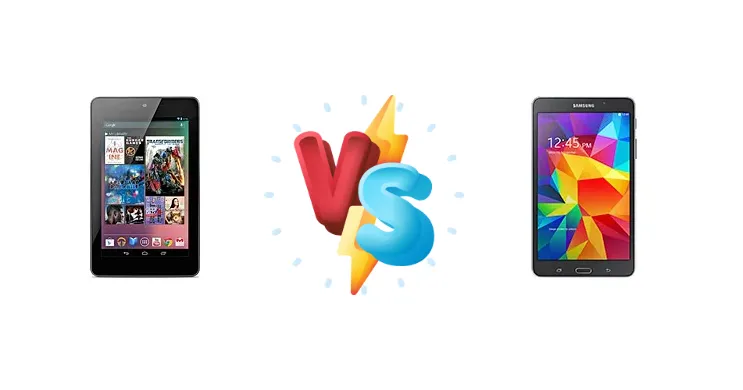
Released two years apart, the Asus Google Nexus 7 Cellular and the Samsung Galaxy Tab 4 7.0 LTE represent different approaches to the 7-inch tablet market. The Nexus 7 aimed for a performance-focused experience, while the Tab 4 prioritized Samsung’s ecosystem and broader feature set. Today, we revisit these devices to determine which offers the better experience in 2024, considering their age and original positioning.
🏆 Quick Verdict
For the average user seeking a functional, portable tablet experience, the Asus Google Nexus 7 Cellular edges out the Samsung Galaxy Tab 4 7.0 LTE. The Nexus 7’s Tegra 3 chipset, despite its age, provides a more responsive experience due to its architectural advantages, and its superior contrast ratio enhances media consumption. However, the Tab 4’s LTE connectivity is a significant benefit for on-the-go users.
| Network |
|---|
| 2G bands | GSM 850 / 900 / 1800 / 1900 | GSM 850 / 900 / 1800 / 1900 |
| 3G bands | HSDPA 850 / 900 / 1700 / 1900 / 2100 | HSDPA 850 / 900 / 1900 / 2100 |
| 4G bands | - | 1, 3, 5, 7, 8, 20 |
| Speed | HSPA 21.1/5.76 Mbps | HSPA 42.2/5.76 Mbps, LTE Cat4 150/50 Mbps |
| Technology | GSM / HSPA | GSM / HSPA / LTE |
| Launch |
|---|
| Announced | 2012, October. Released 2012, November | 2014, April. Released 2014, May |
| Status | Discontinued | Discontinued |
| Body |
|---|
| Dimensions | 198.5 x 120 x 10.5 mm (7.81 x 4.72 x 0.41 in) | 186.9 x 107.9 x 9 mm (7.36 x 4.25 x 0.35 in) |
| SIM | Micro-SIM | Micro-SIM |
| Weight | 347 g (12.24 oz) | 276 g (9.74 oz) |
| Display |
|---|
| Protection | Corning Gorilla Glass | - |
| Resolution | 800 x 1280 pixels, 16:10 ratio (~216 ppi density) | 800 x 1280 pixels, 16:10 ratio (~216 ppi density) |
| Size | 7.0 inches, 142.1 cm2 (~59.6% screen-to-body ratio) | 7.0 inches, 142.1 cm2 (~70.5% screen-to-body ratio) |
| Type | LED-backlit IPS LCD | TFT |
| Platform |
|---|
| CPU | Quad-core 1.2 GHz Cortex-A9 | Quad-core 1.2 GHz Cortex-A7 |
| Chipset | Nvidia Tegra 3 | Exynos 3470 Quad |
| GPU | ULP GeForce | Mali-400MP4 |
| OS | Android 4.1 (Jelly Bean), upgradable to 5.1.1 (Lollipop) | Android 4.4.2 (KitKat), TouchWiz UX UI |
| Memory |
|---|
| Card slot | No | microSDXC (dedicated slot) |
| Internal | 16GB 1GB RAM, 32GB 1GB RAM | 8GB 1.5GB RAM, 16GB 1.5GB RAM |
| Main Camera |
|---|
| Single | 1.2 MP | 3.15 MP |
| Video | 720p | 720p@30fps |
| Selfie camera |
|---|
| Single | - | 1.3 MP |
| Sound |
|---|
| 3.5mm jack | - | Yes |
| 35mm jack | Yes | Yes |
| Loudspeaker | Yes, with stereo speakers | Yes, with dual speakers |
| Comms |
|---|
| Bluetooth | 3.0 | 4.0, A2DP |
| Infrared port | - | Yes |
| NFC | Yes | No |
| Positioning | GPS | GPS, GLONASS |
| Radio | No | No |
| USB | microUSB 2.0 | microUSB 2.0 |
| WLAN | Wi-Fi 802.11 b/g/n, hotspot | Wi-Fi 802.11 a/b/g/n, dual-band, Wi-Fi Direct, hotspot |
| Features |
|---|
| Sensors | Accelerometer, gyro, proximity, compass | Accelerometer |
| Battery |
|---|
| Music play | - | Up to 190 h |
| Stand-by | Up to 300 h | - |
| Talk time | Up to 9 h (multimedia) | Up to 10 h (multimedia) |
| Type | Li-Ion 4325 mAh, non-removable (16 Wh) | Li-Po 4000 mAh, non-removable |
| Misc |
|---|
| Colors | Black | White, Black |
| Models | - | SM-T235, SM-T235Y, SM-T239 |
| Price | About 230 EUR | About 280 EUR |
Asus Google Nexus 7 Cellular
- Superior display contrast ratio for better visuals.
- More responsive performance due to the Tegra 3’s Cortex-A9 cores.
- Clean Android experience (stock Android).
- Lacks built-in LTE connectivity.
- Older device with limited software support.
Samsung Galaxy Tab 4 7.0 LTE
- Built-in LTE connectivity for on-the-go access.
- Samsung’s ecosystem integration and features.
- Potentially longer battery life due to the Exynos 3470’s efficiency.
- Less responsive performance compared to the Nexus 7.
- Samsung’s TouchWiz interface can feel bloated.
Display Comparison
The Asus Nexus 7 boasts a contrast ratio of 908:1, indicating deeper blacks and more vibrant colors compared to what was typical for the Galaxy Tab 4’s display. While specific contrast data for the Tab 4 is unavailable, Samsung’s LCD panels of that era generally fell below this mark. Both devices feature 7-inch displays, but the Nexus 7’s higher contrast ratio translates to a more immersive viewing experience, particularly for videos and photos. Bezels are comparable, reflecting the design trends of their respective release years.
Camera Comparison
Neither tablet excels in the camera department. Both likely feature relatively low-resolution sensors, typical for tablets of that era. Detailed camera specs are unavailable, but focusing on camera performance for either device is unrealistic in 2024. The primary use case for these tablets won’t revolve around photography.
Performance
The core difference lies in the chipsets: Nvidia’s Tegra 3 in the Nexus 7 versus Samsung’s Exynos 3470 Quad in the Tab 4. Both are quad-core 1.2 GHz processors, but the architecture is crucial. The Tegra 3 utilizes Cortex-A9 cores, which, while older, offer higher single-core performance than the Cortex-A7 cores found in the Exynos 3470. This translates to snappier app launches and a more fluid user experience on the Nexus 7. The Exynos 3470 prioritizes power efficiency, but at the cost of raw processing power. The Nexus 7’s GPU, also part of the Tegra 3, likely provides a more capable gaming experience, though both tablets are limited by their age.
Battery Life
Battery capacity data is unavailable for both devices. However, the Exynos 3470’s focus on power efficiency suggests the Galaxy Tab 4 might offer slightly longer battery life during typical usage. The Nexus 7’s more powerful Tegra 3 will likely consume more power under load. Charging speeds were slow by today’s standards on both devices, and neither supports fast charging technologies.
Buying Guide
Buy the Asus Google Nexus 7 Cellular if you prioritize a smoother, more responsive user interface and better display quality for media consumption, even if it means sacrificing built-in cellular connectivity. It’s ideal for home use, reading, and light gaming. Buy the Samsung Galaxy Tab 4 7.0 LTE if reliable mobile data connectivity is essential, and you prefer Samsung’s TouchWiz interface and ecosystem integration. It’s better suited for users who need constant access to the internet while traveling.
Frequently Asked Questions
❓ Does the Exynos 3470 in the Galaxy Tab 4 overheat during prolonged use, like video playback?
While the Exynos 3470 is power-efficient, prolonged high-intensity tasks like extended video playback or gaming can still lead to noticeable warming. However, it’s unlikely to experience significant thermal throttling due to the relatively low power draw of the chipset. The Nexus 7’s Tegra 3 may also warm up, but its more aggressive performance profile could lead to more noticeable throttling.
❓ Is the Nexus 7 still usable with modern apps, or are there compatibility issues with newer Android versions?
The Nexus 7’s last official Android update was KitKat (4.4.4). While some users have successfully installed custom ROMs to run newer Android versions, compatibility with modern apps is limited. Many apps may not function correctly or at all due to outdated APIs and security requirements. The Galaxy Tab 4, with its later Android release, may have slightly better compatibility, but it still faces similar limitations.
❓ Can either of these tablets be reliably used for video conferencing in 2024?
Video conferencing is possible on both tablets, but the experience will be subpar. The front-facing cameras are likely low resolution, and the processors may struggle with the demands of video encoding and decoding. Expect lag, poor image quality, and limited battery life during video calls.