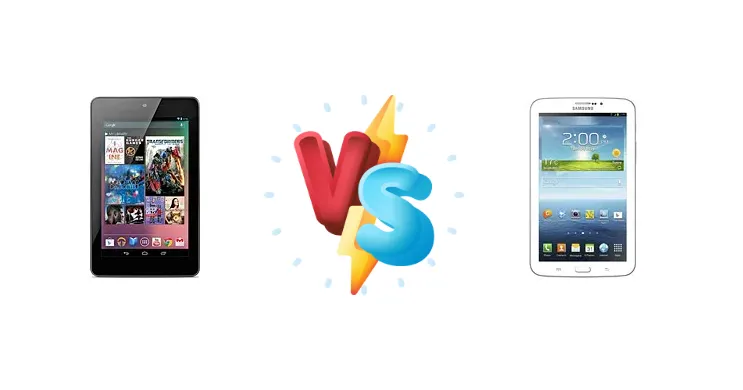
In 2013, the Asus Google Nexus 7 (Cellular) and the Samsung Galaxy Tab 3 7.0 represented distinct approaches to the 7-inch Android tablet market. The Nexus 7 aimed for a premium experience with a powerful Nvidia Tegra 3 chipset, while the Tab 3 focused on broader Samsung ecosystem integration and affordability. Today, as these tablets appear on the used market, understanding their core differences is crucial for potential buyers.
🏆 Quick Verdict
For the average user seeking a functional and relatively snappy 7-inch Android tablet on a budget, the Asus Google Nexus 7 Cellular is the better choice. Its Nvidia Tegra 3 processor provides a noticeable performance advantage over the Samsung Galaxy Tab 3’s Marvell PXA986, making it more suitable for gaming and demanding applications.
| Network |
|---|
| 2G bands | GSM 850 / 900 / 1800 / 1900 | GSM 850 / 900 / 1800 / 1900 - SM-T211, SM-T215 |
| 3G bands | HSDPA 850 / 900 / 1700 / 1900 / 2100 | HSDPA 850 / 900 / 1900 / 2100 - SM-T211, SM-T215 |
| 4G bands | - | 3, 7 - SM-T215 |
| Speed | HSPA 21.1/5.76 Mbps | HSPA 21.1/5.76 Mbps, LTE Cat3 100/50 Mbps (SM-T215) |
| Technology | GSM / HSPA | GSM / HSPA / LTE |
| Launch |
|---|
| Announced | 2012, October. Released 2012, November | 2013, April. Released 2013, July |
| Status | Discontinued | Discontinued |
| Body |
|---|
| Dimensions | 198.5 x 120 x 10.5 mm (7.81 x 4.72 x 0.41 in) | 188 x 111.1 x 9.9 mm (7.40 x 4.37 x 0.39 in) |
| SIM | Micro-SIM | Micro-SIM |
| Weight | 347 g (12.24 oz) | 306 g (10.79 oz) |
| Display |
|---|
| Protection | Corning Gorilla Glass | - |
| Resolution | 800 x 1280 pixels, 16:10 ratio (~216 ppi density) | 600 x 1024 pixels, 16:9 ratio (~170 ppi density) |
| Size | 7.0 inches, 142.1 cm2 (~59.6% screen-to-body ratio) | 7.0 inches, 137.9 cm2 (~66.0% screen-to-body ratio) |
| Type | LED-backlit IPS LCD | TFT |
| Platform |
|---|
| CPU | Quad-core 1.2 GHz Cortex-A9 | Dual-core 1.2 GHz Cortex-A9 |
| Chipset | Nvidia Tegra 3 | Marvell PXA986 |
| GPU | ULP GeForce | PowerVR SGX540 |
| OS | Android 4.1 (Jelly Bean), upgradable to 5.1.1 (Lollipop) | Android 4.1.2 (Jelly Bean), TouchWiz UX UI |
| Memory |
|---|
| Card slot | No | microSDXC (dedicated slot) |
| Internal | 16GB 1GB RAM, 32GB 1GB RAM | 8GB 1GB RAM, 16GB 1GB RAM |
| Main Camera |
|---|
| Single | 1.2 MP | 3.15 MP |
| Video | 720p | 720p@30fps |
| Selfie camera |
|---|
| Single | - | 1.3 MP |
| Sound |
|---|
| 3.5mm jack | - | Yes |
| 35mm jack | Yes | Yes |
| Loudspeaker | Yes, with stereo speakers | Yes |
| Comms |
|---|
| Bluetooth | 3.0 | 3.0, A2DP |
| Infrared port | - | Yes |
| NFC | Yes | No |
| Positioning | GPS | GPS, GLONASS |
| Radio | No | No |
| USB | microUSB 2.0 | 2.0 (TV-out) |
| WLAN | Wi-Fi 802.11 b/g/n, hotspot | Wi-Fi 802.11 a/b/g/n, dual-band, Wi-Fi Direct, DLNA, hotspot |
| Features |
|---|
| Sensors | Accelerometer, gyro, proximity, compass | Accelerometer, gyro, proximity, compass |
| Battery |
|---|
| Music play | - | Up to 108 h |
| Stand-by | Up to 300 h | - |
| Talk time | Up to 9 h (multimedia) | Up to 8 h (multimedia) |
| Type | Li-Ion 4325 mAh, non-removable (16 Wh) | Li-Ion 4000 mAh, non-removable |
| Misc |
|---|
| Colors | Black | White |
| Models | - | GT-P3200, SM-T211, SM-T215, SM-T217S, SM-T217T |
| Price | About 230 EUR | About 150 EUR |
| SAR | - | 0.63 W/kg (head) 1.59 W/kg (body) |
| SAR EU | - | 0.71 W/kg (head) 0.98 W/kg (body) |
| Tests |
|---|
| Display | - |
Contrast ratio: 1098 (nominal) |
Asus Google Nexus 7 Cellular
- Superior performance with Nvidia Tegra 3
- Smoother multitasking and gaming experience
- Clean Android experience (closer to stock)
- Lower nominal contrast ratio compared to Tab 3
- Potentially shorter battery life under heavy load
Samsung Galaxy Tab 3 7.0
- Higher nominal contrast ratio (1098:1)
- Samsung’s TouchWiz interface (preference-based)
- MicroSD card slot for expandable storage
- Significantly slower performance with Marvell PXA986
- Laggy user experience, especially with demanding apps
Display Comparison
Both tablets feature 7-inch displays, but diverge in contrast performance. The Samsung Galaxy Tab 3 7.0 boasts a nominal contrast ratio of 1098:1, exceeding the Asus Nexus 7 Cellular’s 908:1. While the Tab 3’s number is higher, the real-world impact is likely subtle. Neither device offers particularly high brightness, and both rely on TN panels, meaning viewing angles will be limited. The Nexus 7’s lower contrast may result in less 'pop' in darker scenes, but the difference is unlikely to be dramatic for casual use.
Camera Comparison
Neither tablet excels in the camera department. Both feature basic cameras suitable for casual snapshots, but image quality is limited by sensor size and processing capabilities. Detailed camera specs are unavailable, making a direct comparison difficult. However, given Samsung’s general camera software prowess, the Tab 3 might offer slightly better image processing, but the difference will be minimal. Focusing on camera performance is not a strong reason to choose either device.
Performance
The core difference lies in the chipsets. The Asus Nexus 7 Cellular utilizes the Nvidia Tegra 3, a quad-core 1.2 GHz Cortex-A9 processor, while the Samsung Galaxy Tab 3 7.0 is powered by the dual-core 1.2 GHz Cortex-A9 Marvell PXA986. The Tegra 3’s additional cores and more powerful GPU provide a significant performance advantage in graphics-intensive tasks like gaming and video decoding. The PXA986, while efficient, struggles to keep pace, resulting in noticeable lag and slower app loading times. The Nexus 7 will offer a smoother, more responsive user experience.
Battery Life
Battery capacity data is unavailable for both devices. However, given the Tegra 3’s higher power consumption, the Nexus 7 likely has a shorter battery life under heavy load. The Marvell PXA986 in the Tab 3 is more power-efficient, potentially offering longer runtime for basic tasks like web browsing and video playback. Charging speeds are also unknown, but both tablets likely utilize micro-USB, limiting charging speed compared to modern USB-C standards.
Buying Guide
Buy the Asus Google Nexus 7 Cellular if you prioritize performance for light gaming, smoother multitasking, and a higher-contrast display. This is the tablet for users who want a responsive experience even with older software. Buy the Samsung Galaxy Tab 3 7.0 if you prefer Samsung’s TouchWiz interface, expandable storage via microSD, and a slightly higher nominal contrast ratio, potentially offering a marginally better viewing experience in certain lighting conditions, but at the cost of overall speed.
Frequently Asked Questions
❓ Is the cellular connectivity on the Nexus 7 still functional in 2024?
Cellular connectivity depends on carrier support and SIM card availability. Many carriers have phased out 2G/3G networks, which the Nexus 7 likely relies on. Functionality is not guaranteed and will vary by region and carrier.
❓ Can I update the Nexus 7 to a modern version of Android?
The Nexus 7 (2013) officially stopped receiving Android updates with Android 5.1.1 Lollipop. While custom ROMs are available, installing them requires technical expertise and voids the warranty (if any remains). Expect limited app compatibility with newer Android versions.
❓ Will the Nvidia Tegra 3 in the Nexus 7 handle modern mobile games?
The Tegra 3 will struggle with most modern, graphically demanding mobile games. While it can run older titles, expect low frame rates and reduced graphical settings. It's best suited for less intensive games and apps.
❓ Is the Samsung Galaxy Tab 3's microSD card slot a significant advantage?
Yes, the microSD card slot is a key advantage for the Tab 3, especially considering the limited internal storage of both devices. It allows users to expand storage for media files, apps, and other data, extending the tablet's usability.