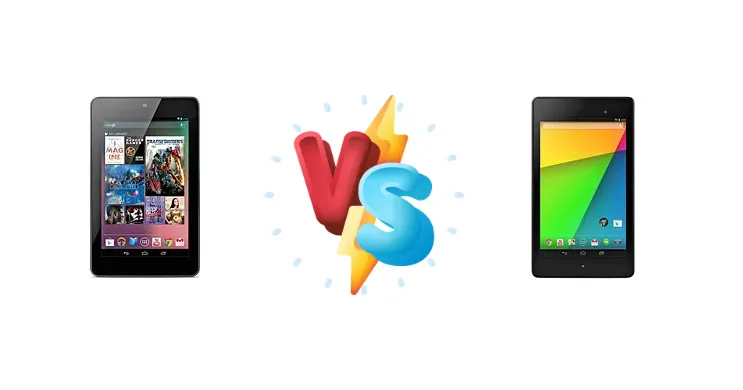
The Google Nexus 7 line, co-developed with Asus, represented a pivotal moment for Android tablets. The original 2012 model, available in a cellular variant, offered a compelling entry point, but the 2013 refresh brought significant internal changes. This comparison dissects the differences between the Asus Google Nexus 7 Cellular and the Asus Google Nexus 7 (2013) to determine which tablet offers the better experience in 2024, considering their age and original market positioning.
🏆 Quick Verdict
For the average user seeking a functional, affordable tablet for media consumption, the Asus Google Nexus 7 (2013) is the superior choice. The Snapdragon S4 Pro provides a noticeable performance uplift over the Tegra 3, and the addition of wireless charging adds a modern convenience the 2012 model lacks. While the cellular connectivity of the original is a plus for some, the performance gains outweigh this benefit for most.
| Network |
|---|
| 2G bands | GSM 850 / 900 / 1800 / 1900 | GSM 850 / 900 / 1800 / 1900 - all versions |
| 3G bands | HSDPA 850 / 900 / 1700 / 1900 / 2100 | HSDPA 850 / 900 / 1700 / 1900 / 2100 |
| 4G bands | - | 1, 2, 3, 4, 5, 7, 20 - EU |
| Speed | HSPA 21.1/5.76 Mbps | HSPA, LTE |
| Technology | GSM / HSPA | GSM / HSPA / LTE |
| | - | 1, 2, 3, 4, 5, 13, 17 - North America |
| Launch |
|---|
| Announced | 2012, October. Released 2012, November | 2013, July. Released 2013, July |
| Status | Discontinued | Discontinued |
| Body |
|---|
| Dimensions | 198.5 x 120 x 10.5 mm (7.81 x 4.72 x 0.41 in) | 200 x 114 x 8.7 mm (7.87 x 4.49 x 0.34 in) |
| SIM | Micro-SIM | Micro-SIM |
| Weight | 347 g (12.24 oz) | 290 g (Wi-Fi), 299 g (LTE) (10.55 oz) |
| Display |
|---|
| Protection | Corning Gorilla Glass | Corning Gorilla Glass |
| Resolution | 800 x 1280 pixels, 16:10 ratio (~216 ppi density) | 1200 x 1920 pixels, 16:10 ratio (~323 ppi density) |
| Size | 7.0 inches, 142.1 cm2 (~59.6% screen-to-body ratio) | 7.0 inches, 142.1 cm2 (~62.3% screen-to-body ratio) |
| Type | LED-backlit IPS LCD | LED-backlit IPS LCD |
| Platform |
|---|
| CPU | Quad-core 1.2 GHz Cortex-A9 | Quad-core 1.5 GHz Krait |
| Chipset | Nvidia Tegra 3 | Qualcomm Snapdragon S4 Pro |
| GPU | ULP GeForce | Adreno 320 |
| OS | Android 4.1 (Jelly Bean), upgradable to 5.1.1 (Lollipop) | Android 4.3 (Jelly Bean), upgradable to 6.0 (Marshmallow) |
| Memory |
|---|
| Card slot | No | No |
| Internal | 16GB 1GB RAM, 32GB 1GB RAM | 16GB 2GB RAM, 32GB 2GB RAM |
| Main Camera |
|---|
| Single | 1.2 MP | 5 MP, f/2.4, AF |
| Video | 720p | 1080p@30fps |
| Selfie camera |
|---|
| Single | - | 1.2 MP |
| Sound |
|---|
| 3.5mm jack | - | Yes |
| 35mm jack | Yes | Yes |
| Loudspeaker | Yes, with stereo speakers | Yes, with stereo speakers |
| Comms |
|---|
| Bluetooth | 3.0 | 4.0, A2DP, LE |
| NFC | Yes | Yes |
| Positioning | GPS | GPS |
| Radio | No | No |
| USB | microUSB 2.0 | microUSB 2.0 (SlimPort) |
| WLAN | Wi-Fi 802.11 b/g/n, hotspot | Wi-Fi 802.11 a/b/g/n, dual-band |
| Features |
|---|
| Sensors | Accelerometer, gyro, proximity, compass | Accelerometer, gyro, proximity, compass |
| Battery |
|---|
| Charging | - | Wireless (Qi) |
| Stand-by | Up to 300 h | - |
| Talk time | Up to 9 h (multimedia) | Up to 9 h (multimedia) |
| Type | Li-Ion 4325 mAh, non-removable (16 Wh) | Li-Ion 3950 mAh, non-removable |
| Misc |
|---|
| Colors | Black | Black |
| Price | About 230 EUR | About 230 EUR |
| Tests |
|---|
| Audio quality | - |
Noise -92.2dB / Crosstalk -92.3dB |
Asus Google Nexus 7 Cellular
- Integrated cellular connectivity for on-the-go access.
- Lower initial purchase price (likely, given its age).
- Established Android ecosystem support.
- Slower processor and less efficient architecture.
- Lacks wireless charging.
- Potentially shorter battery life.
Asus Google Nexus 7 (2013)
- Faster and more efficient Snapdragon S4 Pro processor.
- Wireless (Qi) charging for added convenience.
- Improved overall performance and responsiveness.
- Lacks integrated cellular connectivity.
- May be slightly more expensive than the 2012 model.
- Older Android version, potentially limited app compatibility.
Display Comparison
Both Nexus 7 models share a 7-inch display, but detailed specifications beyond the 908:1 contrast ratio on the Cellular model are scarce. The 2013 model likely benefits from panel refinements, though these are not quantifiable with available data. The real-world impact is likely subtle, with both offering acceptable viewing angles and color reproduction for the time. Bezels are comparable, reflecting the design trends of the early 2010s. The lack of detailed display specs makes a definitive winner difficult to declare, but the 2013 model likely benefits from incremental improvements in color accuracy and brightness.
Camera Comparison
Neither tablet was known for its camera prowess. Detailed camera specifications are unavailable, making a direct comparison challenging. Given the era, both likely featured similar low-resolution sensors and limited image processing capabilities. Focusing on the core strengths of these devices – media consumption and light productivity – is more relevant than scrutinizing their camera performance. Any differences in image quality would likely be minimal and attributable to software processing rather than hardware improvements.
Performance
The core difference lies in the chipset. The Asus Google Nexus 7 Cellular utilizes the Nvidia Tegra 3, featuring a quad-core 1.2 GHz Cortex-A9 CPU. The 2013 model leaps forward with the Qualcomm Snapdragon S4 Pro, boasting a quad-core 1.5 GHz Krait CPU. This represents a significant architectural improvement; the Krait architecture is demonstrably more efficient and powerful than the Cortex-A9. While both are quad-core, the Snapdragon S4 Pro’s higher clock speed and superior architecture translate to faster app loading, smoother multitasking, and improved gaming performance. The Snapdragon’s Adreno GPU also offers a substantial advantage over the Tegra 3’s GPU. This benefits users who engage in graphically intensive tasks.
Battery Life
Battery capacity figures are not provided in the context data. However, the Snapdragon S4 Pro’s improved power efficiency likely contributes to longer battery life on the 2013 model, despite potentially having a similar battery size. The addition of wireless (Qi) charging on the 2013 model is a significant convenience feature, allowing for effortless top-ups without the need for cables. The 2012 model relies solely on micro-USB charging, which is slower and less convenient.
Buying Guide
Buy the Asus Google Nexus 7 Cellular if you absolutely require integrated cellular data connectivity and are on a very tight budget. Its primary advantage is the ability to connect without Wi-Fi, making it ideal for frequent travelers or those without reliable home internet. Buy the Asus Google Nexus 7 (2013) if you prioritize performance, future-proofing (relatively speaking), and convenience features like wireless charging. It’s the better all-around tablet for everyday use and offers a smoother, more responsive experience.
Frequently Asked Questions
❓ Is the cellular connectivity on the 2012 Nexus 7 still functional on modern networks?
While the 2012 Nexus 7's cellular radio *may* still connect to older 3G networks, support for these networks is dwindling globally. Many carriers are phasing out 3G, rendering the cellular functionality increasingly unreliable and potentially unusable. Check with your local carrier for compatibility before relying on this feature.
❓ Can I expect to play modern Android games on either of these tablets?
While both tablets can run some Android games, performance will be limited. The Tegra 3 in the 2012 model will struggle with most modern titles, even at low settings. The Snapdragon S4 Pro in the 2013 model offers a better experience, but still won't deliver a flagship-level gaming experience. Expect lower frame rates and graphical settings.
❓ What is the likelihood of receiving software updates on either device?
Neither the Asus Google Nexus 7 Cellular nor the 2013 model receive official software updates from Google. They are both well past their end-of-life support dates. However, the Android open-source community maintains custom ROMs that can breathe new life into these devices, offering newer Android versions and security patches. This requires technical expertise and carries inherent risks.