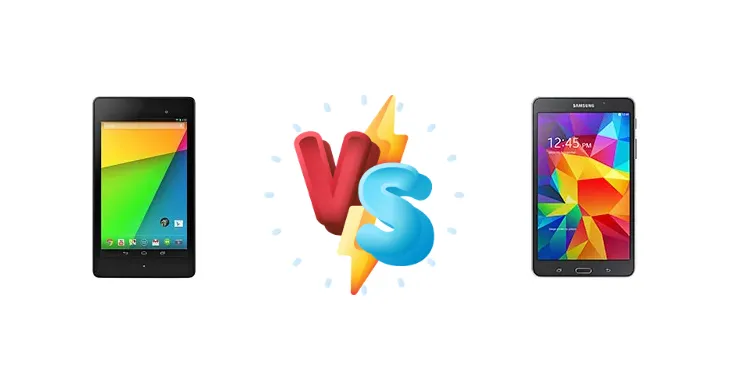
The 7-inch tablet market was once booming, and these two devices, the Asus Google Nexus 7 (2013) and the Samsung Galaxy Tab 4 7.0 LTE, were key players. Both offered compact portability and Android functionality, but catered to slightly different audiences. Let's dive into a head-to-head comparison to see which one holds up best today.
🏆 Quick Verdict
The Nexus 7 (2013) wins on performance thanks to its superior processor and RAM. However, the Tab 4 7.0 LTE boasts LTE connectivity and potentially better software support over time. Ultimately, the Nexus 7 is the better choice for those prioritizing speed and a cleaner Android experience.
| Network |
|---|
| 2G bands | GSM 850 / 900 / 1800 / 1900 - all versions | GSM 850 / 900 / 1800 / 1900 |
| 3G bands | HSDPA 850 / 900 / 1700 / 1900 / 2100 | HSDPA 850 / 900 / 1900 / 2100 |
| 4G bands | 1, 2, 3, 4, 5, 7, 20 - EU | 1, 3, 5, 7, 8, 20 |
| Speed | HSPA, LTE | HSPA 42.2/5.76 Mbps, LTE Cat4 150/50 Mbps |
| Technology | GSM / HSPA / LTE | GSM / HSPA / LTE |
| | 1, 2, 3, 4, 5, 13, 17 - North America | - |
| Launch |
|---|
| Announced | 2013, July. Released 2013, July | 2014, April. Released 2014, May |
| Status | Discontinued | Discontinued |
| Body |
|---|
| Dimensions | 200 x 114 x 8.7 mm (7.87 x 4.49 x 0.34 in) | 186.9 x 107.9 x 9 mm (7.36 x 4.25 x 0.35 in) |
| SIM | Micro-SIM | Micro-SIM |
| Weight | 290 g (Wi-Fi), 299 g (LTE) (10.55 oz) | 276 g (9.74 oz) |
| Display |
|---|
| Protection | Corning Gorilla Glass | - |
| Resolution | 1200 x 1920 pixels, 16:10 ratio (~323 ppi density) | 800 x 1280 pixels, 16:10 ratio (~216 ppi density) |
| Size | 7.0 inches, 142.1 cm2 (~62.3% screen-to-body ratio) | 7.0 inches, 142.1 cm2 (~70.5% screen-to-body ratio) |
| Type | LED-backlit IPS LCD | TFT |
| Platform |
|---|
| CPU | Quad-core 1.5 GHz Krait | Quad-core 1.2 GHz Cortex-A7 |
| Chipset | Qualcomm Snapdragon S4 Pro | Exynos 3470 Quad |
| GPU | Adreno 320 | Mali-400MP4 |
| OS | Android 4.3 (Jelly Bean), upgradable to 6.0 (Marshmallow) | Android 4.4.2 (KitKat), TouchWiz UX UI |
| Memory |
|---|
| Card slot | No | microSDXC (dedicated slot) |
| Internal | 16GB 2GB RAM, 32GB 2GB RAM | 8GB 1.5GB RAM, 16GB 1.5GB RAM |
| Main Camera |
|---|
| Single | 5 MP, f/2.4, AF | 3.15 MP |
| Video | 1080p@30fps | 720p@30fps |
| Selfie camera |
|---|
| Single | 1.2 MP | 1.3 MP |
| Sound |
|---|
| 3.5mm jack | Yes | Yes |
| 35mm jack | Yes | Yes |
| Loudspeaker | Yes, with stereo speakers | Yes, with dual speakers |
| Comms |
|---|
| Bluetooth | 4.0, A2DP, LE | 4.0, A2DP |
| Infrared port | - | Yes |
| NFC | Yes | No |
| Positioning | GPS | GPS, GLONASS |
| Radio | No | No |
| USB | microUSB 2.0 (SlimPort) | microUSB 2.0 |
| WLAN | Wi-Fi 802.11 a/b/g/n, dual-band | Wi-Fi 802.11 a/b/g/n, dual-band, Wi-Fi Direct, hotspot |
| Features |
|---|
| Sensors | Accelerometer, gyro, proximity, compass | Accelerometer |
| Battery |
|---|
| Charging | Wireless (Qi) | - |
| Music play | - | Up to 190 h |
| Talk time | Up to 9 h (multimedia) | Up to 10 h (multimedia) |
| Type | Li-Ion 3950 mAh, non-removable | Li-Po 4000 mAh, non-removable |
| Misc |
|---|
| Colors | Black | White, Black |
| Models | - | SM-T235, SM-T235Y, SM-T239 |
| Price | About 230 EUR | About 280 EUR |
| Tests |
|---|
| Audio quality |
Noise -92.2dB / Crosstalk -92.3dB | - |
Asus Google Nexus 7 (2013)
- Superior Performance
- Higher Resolution Display
- Wireless Charging (Qi)
- Stock Android Experience
- Compact and Portable
- Older Software Support
- Mediocre Camera
- No LTE Connectivity (Original Model)
Samsung Galaxy Tab 4 7.0 LTE
- LTE Connectivity
- Potentially Longer Software Support (Samsung)
- Slightly Better Battery Life
- Samsung's One UI
- Slower Performance
- Lower Resolution Display
- Less Responsive
- Mediocre Camera
Display Comparison
Both tablets feature 7-inch displays, but the Nexus 7 boasts a higher resolution (1920x1200) compared to the Tab 4's (1280x800). This results in a noticeably sharper image on the Nexus 7, making it better for media consumption and reading. The Tab 4's display is adequate, but lacks the crispness of the Nexus 7.
Camera Comparison
Neither tablet excels in the camera department. The Nexus 7 has a 5MP rear camera and a 1.2MP front camera, while the Tab 4 has a 3MP rear and 1.2MP front camera. Image quality is mediocre on both, suitable for basic snapshots but not for serious photography. Low-light performance is poor on both devices.
Performance
The Nexus 7's Qualcomm Snapdragon S4 Pro with a 1.5 GHz Krait quad-core processor and 2GB of RAM significantly outperforms the Tab 4's Exynos 3470 Quad with a 1.2 GHz Cortex-A7 quad-core processor and 1.5GB of RAM. Apps launch faster, multitasking is smoother, and overall responsiveness is superior on the Nexus 7. The Tab 4 can feel sluggish at times, especially with demanding apps.
Battery Life
The Tab 4 7.0 LTE generally offers slightly better battery life due to its more efficient processor and larger battery capacity (4000 mAh vs Nexus 7's 3950 mAh). However, the Nexus 7's more efficient software optimization can sometimes offset this difference. Expect around 8-10 hours of moderate use on both devices.
Buying Guide
The Asus Google Nexus 7 (2013) is ideal for users who value performance and a stock Android experience, and don't necessarily need cellular connectivity. The Samsung Galaxy Tab 4 7.0 LTE is better suited for those who want a tablet with LTE for on-the-go internet access and prefer Samsung's One UI.
Frequently Asked Questions
❓ Is the Nexus 7 (2013) still worth buying?
If you prioritize performance and a clean Android experience and don't need LTE, the Nexus 7 can still be a decent option for basic tasks. However, be aware of its age and limited software updates.
❓ Which tablet has better software support?
Samsung generally provides longer software support for its devices compared to the Nexus 7, which has reached its end of life.