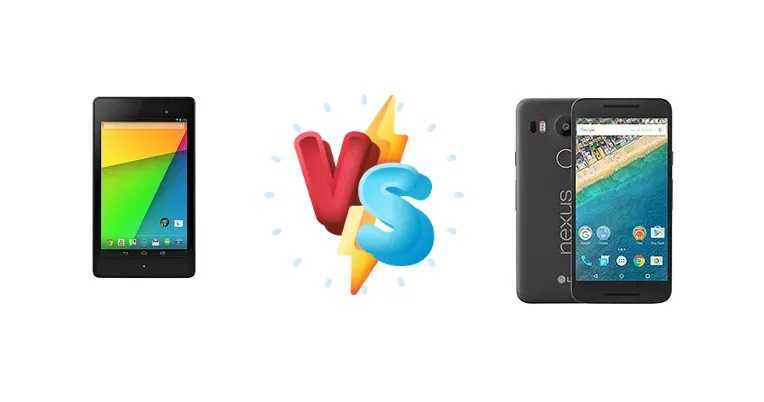
The Nexus line has always been synonymous with pure Android and competitive pricing. But how do two generations of Nexus devices, the Asus Nexus 7 (2013) and the LG Nexus 5X, stack up against each other? This review dives deep into their specs and features to help you decide which one is right for you.
🏆 Quick Verdict
The LG Nexus 5X generally edges out the Nexus 7 (2013) thanks to its more modern chipset, improved camera, and slightly better battery life. However, the Nexus 7's wireless charging and compact form factor might appeal to some users seeking a smaller tablet-like experience.
| Network |
|---|
| 2G bands | GSM 850 / 900 / 1800 / 1900 - all versions | GSM 850 / 900 / 1800 / 1900 - all models |
| 3G bands | HSDPA 850 / 900 / 1700 / 1900 / 2100 | HSDPA 850 / 900 / 1700 / 1900 / 2100 - American model |
| 4G bands | 1, 2, 3, 4, 5, 7, 20 - EU | 1, 2, 3, 4, 5, 7, 12, 13, 17, 20, 25, 26, 29 - American model |
| Speed | HSPA, LTE | HSPA 42.2/5.76 Mbps, LTE Cat6 300/50 Mbps |
| Technology | GSM / HSPA / LTE | GSM / CDMA / HSPA / LTE |
| | 1, 2, 3, 4, 5, 13, 17 - North America | 1, 2, 3, 4, 5, 7, 8, 9, 17, 18, 19, 20, 26, 28, 38, 40, 41 - Global model |
| Launch |
|---|
| Announced | 2013, July. Released 2013, July | 2015, September. Released 2015, October |
| Status | Discontinued | Discontinued |
| Body |
|---|
| Build | - | Glass front (Gorilla Glass 3), plastic back, plastic frame |
| Dimensions | 200 x 114 x 8.7 mm (7.87 x 4.49 x 0.34 in) | 147 x 72.6 x 7.9 mm (5.79 x 2.86 x 0.31 in) |
| SIM | Micro-SIM | Nano-SIM |
| Weight | 290 g (Wi-Fi), 299 g (LTE) (10.55 oz) | 136 g (4.80 oz) |
| Display |
|---|
| Protection | Corning Gorilla Glass | Corning Gorilla Glass 3, oleophobic coating |
| Resolution | 1200 x 1920 pixels, 16:10 ratio (~323 ppi density) | 1080 x 1920 pixels, 16:9 ratio (~423 ppi density) |
| Size | 7.0 inches, 142.1 cm2 (~62.3% screen-to-body ratio) | 5.2 inches, 74.9 cm2 (~70.2% screen-to-body ratio) |
| Type | LED-backlit IPS LCD | IPS LCD |
| Platform |
|---|
| CPU | Quad-core 1.5 GHz Krait | Hexa-core (4x1.4 GHz Cortex-A53 & 2x1.8 GHz Cortex-A57) |
| Chipset | Qualcomm Snapdragon S4 Pro | Qualcomm MSM8992 Snapdragon 808 (20 nm) |
| GPU | Adreno 320 | Adreno 418 |
| OS | Android 4.3 (Jelly Bean), upgradable to 6.0 (Marshmallow) | Android 6.0 (Marshmallow), upgradable to Android 8.0 (Oreo) |
| Memory |
|---|
| Card slot | No | No |
| Internal | 16GB 2GB RAM, 32GB 2GB RAM | 16GB 2GB RAM, 32GB 2GB RAM |
| | - | eMMC 5.0 |
| Main Camera |
|---|
| Features | - | Laser AF, Dual-LED dual-tone flash, HDR, panorama |
| Single | 5 MP, f/2.4, AF | 12.3 MP, f/2.0, 26mm (wide), 1/2.3", 1.55µm |
| Video | 1080p@30fps | 4K@30fps, 1080p@30fps, 720p@120fps, HDR |
| Selfie camera |
|---|
| Features | - | HDR |
| Single | 1.2 MP | 5 MP, f/2.0, 1/4.0", 1.4µm |
| Video | - | 1080p@30fps |
| Sound |
|---|
| 3.5mm jack | Yes | Yes |
| 35mm jack | Yes | Yes |
| Loudspeaker | Yes, with stereo speakers | Yes |
| Comms |
|---|
| Bluetooth | 4.0, A2DP, LE | 4.2, A2DP |
| NFC | Yes | Yes |
| Positioning | GPS | GPS, GLONASS |
| Radio | No | No |
| USB | microUSB 2.0 (SlimPort) | USB Type-C 2.0 |
| WLAN | Wi-Fi 802.11 a/b/g/n, dual-band | Wi-Fi 802.11 a/b/g/n/ac, dual-band, Wi-Fi Direct, DLNA |
| Features |
|---|
| Sensors | Accelerometer, gyro, proximity, compass | Fingerprint (rear-mounted), accelerometer, gyro, proximity, compass, barometer |
| Battery |
|---|
| Charging | Wireless (Qi) | - |
| Talk time | Up to 9 h (multimedia) | - |
| Type | Li-Ion 3950 mAh, non-removable | Li-Po 2700 mAh, non-removable |
| Misc |
|---|
| Colors | Black | Carbon, Quartz, Ice |
| Models | - | Nexus 5X, H791 |
| Price | About 230 EUR | About 270 EUR |
| Tests |
|---|
| Audio quality |
Noise -92.2dB / Crosstalk -92.3dB |
Noise -92.2dB / Crosstalk -90.9dB |
| Battery life | - |
Endurance rating 60h
|
| Camera | - |
Photo / Video |
| Display | - |
Contrast ratio: 1542 (nominal), 3.092 (sunlight) |
| Loudspeaker | - |
Voice 61dB / Noise 65dB / Ring 61dB
|
| Performance | - |
Basemark OS II 2.0: 1591Basemark X: 16609 |
Asus Google Nexus 7 (2013)
- Compact size
- Wireless charging (Qi)
- Affordable (if found used)
- Pure Android experience
- Outdated processor
- Lower screen resolution and quality
- Shorter battery life
- Limited storage options
LG Nexus 5X
- More powerful processor
- Better camera quality
- Longer battery life
- Modern design
- Expandable storage (microSD)
- Plastic build
- Can feel dated now
- Charging port is microUSB (not USB-C)
Display Comparison
Both devices feature a 5.2-inch display with a contrast ratio of 1542 (nominal) and 3.092 (sunlight), indicating excellent visibility. However, the Nexus 5X likely has a slightly sharper display due to advancements in display technology during its production. The Nexus 7's display, while good for its time, is noticeably less vibrant and sharp by today's standards.
Camera Comparison
The Nexus 5X has a clear advantage in the camera department. While both offer Photo/Video capabilities, the 5X's newer sensor and image processing algorithms result in noticeably better image quality, especially in low-light conditions. Expect more detail, better color accuracy, and reduced noise with the Nexus 5X.
Performance
The LG Nexus 5X boasts a significantly more powerful chipset – the Qualcomm Snapdragon 808 – with a hexa-core processor. This translates to smoother multitasking, faster app loading times, and better performance in demanding games compared to the Nexus 7's older Snapdragon S4 Pro with a quad-core Krait processor. The 20nm process of the 808 also contributes to better power efficiency.
Battery Life
The LG Nexus 5X has an endurance rating of 60h, suggesting superior battery life compared to the Nexus 7 (2013). While the Nexus 7 had wireless charging, the 5X's larger battery capacity and more efficient processor contribute to longer usage times between charges.
Buying Guide
The Asus Nexus 7 (2013) is ideal for users who prioritize a compact form factor, wireless charging, and a budget-friendly price (if found used). The LG Nexus 5X is a better choice for those needing a more powerful processor, a better camera, and longer battery life in a standard smartphone form factor.
Frequently Asked Questions
❓ Is the Nexus 7 (2013) still usable in 2024?
Yes, but it's showing its age. It can handle basic tasks, but performance will be sluggish with modern apps. Software updates are no longer available.
❓ Which Nexus device has better low-light camera performance?
The LG Nexus 5X significantly outperforms the Nexus 7 (2013) in low-light photography due to its newer sensor and image processing.