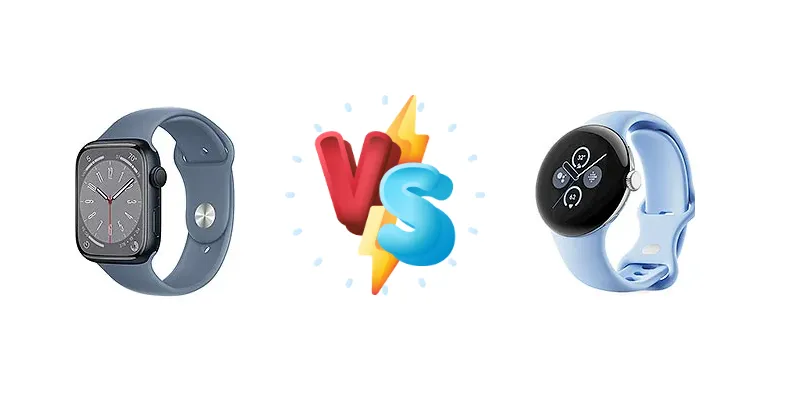
The smartwatch market is largely dominated by Apple, but Google’s second-generation Pixel Watch aims to disrupt that dominance. This comparison focuses on the core hardware differences between the Apple Watch Series 8 Aluminum and the Google Pixel Watch 2, specifically examining the implications of their respective chipsets and charging solutions for the average user.
🏆 Quick Verdict
For users deeply embedded in the Apple ecosystem, the Apple Watch Series 8 remains the more seamless choice due to its optimized software integration. However, the Google Pixel Watch 2, powered by the Qualcomm 5100, presents a compelling alternative, particularly for Android users seeking a refined Wear OS experience and potentially improved efficiency.
| Network |
|---|
| 2G bands | GSM 850 / 900 / 1800 / 1900 | GSM 850 / 900 / 1800 / 1900 |
| 3G bands | HSDPA 850 / 900 / 1700(AWS) / 1900 / 2100 - International, China, HK | HSDPA 850 / 900 / 1700(AWS) / 1900 / 2100 |
| 4G bands | 1, 2, 3, 4, 5, 6, 7, 8, 18, 19, 20, 25, 26, 28, 39, 40, 41, 66 - International, China, HK | LTE |
| Speed | HSPA, LTE | HSPA, LTE |
| Technology | GSM / HSPA / LTE | GSM / HSPA / LTE |
| | 1, 2, 3, 4, 5, 6, 7, 12, 13, 14, 17, 18, 19, 25, 26, 39, 40, 41, 66 - USA, LATAM, Canada | - |
| Launch |
|---|
| Announced | 2022, September 07 | 2023, October 04 |
| Status | Available. Released 2022, September 16 | Available. Released 2023, October 12 |
| Body |
|---|
| Build | Glass front, ceramic/sapphire crystal back, aluminum frame | Glass front (Gorilla Glass 5), aluminum frame |
| Dimensions | 45 x 38 x 10.7 mm (1.77 x 1.50 x 0.42 in) | 41 x 41 x 12.3 mm (1.61 x 1.61 x 0.48 in) |
| SIM | eSIM | eSIM |
| Weight | 32 g (41mm), 38.8 g (45mm) (1.13 oz) | 31 g (1.09 oz) |
| | IP6X certified
50m water resistant
ECG certified (region dependent SW application; HW available on all models) | - |
| Display |
|---|
| Protection | Ion-X strengthened glass | Corning Gorilla Glass 5 |
| Resolution | 484 x 396 pixels (~326 ppi density) | 450 x 450 pixels (~320 ppi density) |
| Size | 1.9 inches | 1.2 inches |
| Type | Retina LTPO OLED, 1000 nits (peak) | AMOLED, 1000 nits (peak) |
| | Always-on display | - |
| Platform |
|---|
| CPU | Dual-core | - |
| Chipset | Apple S8 | Qualcomm 5100 |
| GPU | PowerVR | - |
| OS | watchOS 9.0, upgradable to watchOS 26.1 | Android Wear OS 4 |
| Memory |
|---|
| Card slot | No | No |
| Internal | 32GB 1GB RAM | 32GB 2GB RAM |
| | eMMC 5.1 | - |
| Sound |
|---|
| 3.5mm jack | No | - |
| 35mm jack | No | No |
| Loudspeaker | Yes | Yes |
| Comms |
|---|
| Bluetooth | 5.3, A2DP, LE | 5.0, A2DP, LE |
| NFC | Yes | Yes |
| Positioning | GPS, GLONASS, GALILEO, QZSS, BDS | GPS, GLONASS, GALILEO, BDS, QZSS |
| Radio | No | No |
| USB | No | No |
| WLAN | Wi-Fi 802.11 b/g/n, dual-band | Wi-Fi 802.11 b/g/n |
| Features |
|---|
| Sensors | Accelerometer, gyro, heart rate, barometer, always-on altimeter, compass, SpO2, VO2max, temperature (body) | Accelerometer, gyro, heart rate, altimeter, compass, SpO2, thermometer (skin temperature), skin conductance |
| | Temperature sensing (0.01˚ accuracy)
Natural language commands and dictation (talking mode)
Ultra Wideband (UWB) support | - |
| Battery |
|---|
| Charging | Wireless, 0-80% in 45 min | Wired, 80% in 45 min |
| Type | Li-Ion 308 mAh | Li-Ion 306 mAh |
| Misc |
|---|
| Colors | Midnight, Starlight, Silver, Red | Polished Silver, Matte Black, Champagne Gold |
| Models | A2773, A2775, A2772, A2774, A2857, A2858, A2770, A2771, watch6,14, watch6,15, watch6,16, watch6,17 | G4TSL, GC3G8, GD2WG |
| Price | About 340 EUR | About 160 EUR |
| SAR | 0.31 W/kg (head) 0.55 W/kg (body) | - |
| SAR EU | 0.31 W/kg (head) 0.55 W/kg (body) | - |
Apple Watch Series 8 Aluminum
- Seamless integration with Apple ecosystem
- Mature and feature-rich watchOS
- Established app ecosystem
- Limited compatibility with Android devices
- Wireless charging can be slower than wired
- Potentially less efficient chipset compared to Qualcomm 5100
Google Pixel Watch 2
- Wired charging for faster top-ups
- Potentially better battery efficiency with Qualcomm 5100
- Clean and intuitive Wear OS interface
- Less mature app ecosystem compared to watchOS
- Reliance on Google’s software updates
- Limited compatibility with iOS devices
Display Comparison
While display specifications aren't provided, the Apple Watch Series 8 is known for its always-on Retina display, likely utilizing LTPO technology for variable refresh rates and power savings. The Pixel Watch 2 likely also employs an OLED panel, but its peak brightness and color accuracy remain unknown. The Series 8’s established display technology likely offers a more refined visual experience, but the Pixel Watch 2’s curved glass design may offer a more immersive viewing angle. Bezels are a key differentiator, and a visual comparison is needed to assess which device maximizes screen real estate.
Camera Comparison
Neither watch is primarily marketed for its camera capabilities, and detailed camera specs are absent. Both likely feature minimal camera functionality for quick tasks. This section is largely irrelevant for a meaningful comparison.
Performance
The core difference lies in the chipsets: Apple’s S8 dual-core processor versus Qualcomm’s 5100. Apple designs its silicon with a focus on tight integration with watchOS, optimizing for responsiveness and power efficiency within its ecosystem. Qualcomm, conversely, focuses on broader compatibility and potentially leveraging advancements in their mobile chip design. While core count is the same, the architectural differences are significant. The Qualcomm 5100, built on a more modern process node (likely 4nm), *could* offer better thermal efficiency and sustained performance compared to the S8, though real-world testing is crucial. The S8 benefits from years of software optimization, potentially offsetting any raw processing power advantage the 5100 might have.
Battery Life
Both devices achieve 0-80% charge in 45 minutes, but the charging methods differ: Apple utilizes wireless charging, while the Pixel Watch 2 employs wired charging. The faster charging speed of the Pixel Watch 2, combined with the potentially more efficient Qualcomm 5100 chipset, suggests it *could* offer comparable or even better real-world battery life despite potentially having a smaller battery capacity. However, Apple’s software optimizations play a significant role in battery management, and a direct comparison requires extensive testing.
Buying Guide
Buy the Apple Watch Series 8 Aluminum if you prioritize seamless integration with iPhones, iPads, and other Apple devices, and value a mature, feature-rich ecosystem. Buy the Google Pixel Watch 2 if you are an Android user, appreciate the cleaner Wear OS interface, and are looking for a smartwatch with potentially better battery efficiency thanks to the Qualcomm 5100 chipset.
Frequently Asked Questions
❓ Does the Qualcomm 5100 chipset in the Pixel Watch 2 generate excessive heat during demanding tasks like GPS tracking or workout recording?
While the Qualcomm 5100 is a modern chipset, sustained performance and thermal management are key concerns. The 4nm process node should help mitigate heat, but real-world testing is needed to determine if throttling occurs during extended use. Apple’s S8, while potentially less powerful on paper, benefits from years of software optimization for thermal control.
❓ How does the software integration between the Pixel Watch 2 and Android phones compare to the Apple Watch Series 8 and iPhones?
The Pixel Watch 2 offers a more seamless experience with Android phones, leveraging features like Google Assistant and tight integration with Google services. The Apple Watch Series 8 excels in its integration with the Apple ecosystem, offering features like Handoff and Universal Control. Switching between devices within the same ecosystem is significantly smoother with the Apple Watch.
❓ Is the wireless charging of the Apple Watch Series 8 significantly slower than the wired charging of the Pixel Watch 2 in practical use?
While both reach 80% in 45 minutes, wireless charging generally takes longer to reach 100%. The convenience of wireless charging is a trade-off for speed. The Pixel Watch 2’s wired charging offers a more predictable and potentially faster full charge, especially for users who frequently need to top up their watch.