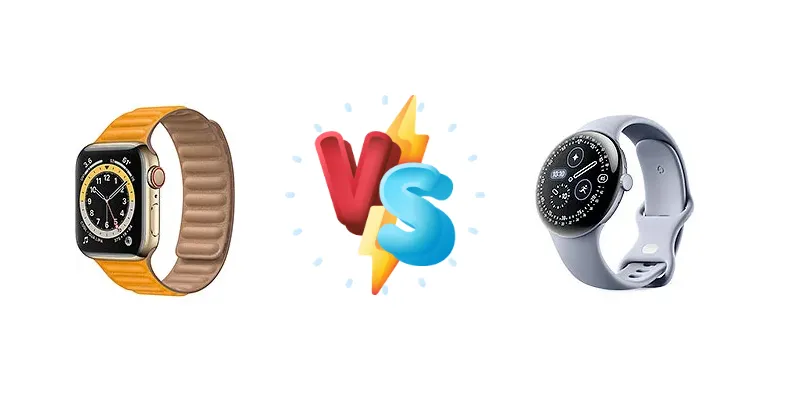
The smartwatch landscape has matured, but key choices remain. The Apple Watch Series 6, while older, represents a refined ecosystem. The Google Pixel Watch 4, powered by Qualcomm’s latest wearable chipset, aims to disrupt that dominance. This comparison dissects the core differences, focusing on performance, charging, and the overall user experience to determine which smartwatch best suits your needs.
🏆 Quick Verdict
For most users, the Google Pixel Watch 4 offers a compelling upgrade with its faster Snapdragon W5 Gen 2 processor and significantly quicker charging speeds. While the Apple Watch Series 6 benefits from a mature ecosystem, the Pixel Watch 4’s performance gains and modern charging capabilities make it the better choice for those prioritizing responsiveness and convenience.
| Network |
|---|
| 2G bands | GSM 850 / 900 / 1800 / 1900 | GSM 850 / 900 / 1800 / 1900 |
| 3G bands | HSDPA 850 / 1700(AWS) / 1900 / 2100 - USA, LATAM, Canada | HSDPA 850 / 900 / 1700(AWS) / 1900 / 2100 |
| 4G bands | 1, 2, 3, 4, 5, 7, 12, 13, 17, 18, 19, 25, 26, 39, 40, 41, 66 - USA, LATAM, Canada | LTE |
| Speed | HSPA, LTE | HSPA, LTE |
| Technology | GSM / HSPA / LTE | GSM / HSPA / LTE |
| | 1, 2, 3, 4, 5, 7, 8, 18, 19, 20, 25, 26, 28, 39, 40, 41, 66 - Global | - |
| Launch |
|---|
| Announced | 2020, September 15 | 2025, August 20 |
| Status | Available. Released 2020, September 18 | Available. Released 2025, October 09 |
| Body |
|---|
| Build | Glass front (Sapphire crystal), ceramic/sapphire crystal back, stainless steel frame | Glass front (Gorilla Glass 5), aluminum frame |
| Dimensions | 44 x 38 x 10.7 mm (1.73 x 1.50 x 0.42 in) | 45 x 45 x 12.3 mm (1.77 x 1.77 x 0.48 in) |
| SIM | eSIM | eSIM |
| Weight | 47.1 g (1.66 oz) | 31 g or 37 g (1.09 oz) |
| | 50m water resistant
ECG certified (region dependent SW application; HW available on all models) | - |
| Display |
|---|
| Protection | Sapphire crystal glass | Corning Gorilla Glass 5 |
| Resolution | 448 x 368 pixels (~326 ppi density) | 456 x 456 pixels (~320 ppi density) |
| Size | 1.78 inches | 1.4 inches |
| Type | Retina LTPO OLED, 1000 nits (peak) | LTPO AMOLED, 3000 nits (peak) |
| | Always-on display | - |
| Platform |
|---|
| CPU | Dual-core | Quad-core (4x1.7 GHz Cortex-A53) |
| Chipset | Apple S6 | Qualcomm Snapdragon W5 Gen 2 (4 nm) |
| GPU | PowerVR | Adreno A702 |
| OS | watchOS 7.0, upgradable to watchOS 26.1 | Android Wear OS 6 |
| Memory |
|---|
| Card slot | No | No |
| Internal | 32GB 1GB RAM | 32GB 2GB RAM |
| Sound |
|---|
| 3.5mm jack | No | - |
| 35mm jack | No | No |
| Loudspeaker | Yes | Yes |
| Comms |
|---|
| Bluetooth | 5.0, A2DP, LE | 6.0, A2DP |
| NFC | Yes | Yes |
| Positioning | GPS, GLONASS, GALILEO, QZSS | GPS (L1+L5), GLONASS, GALILEO (E1+E5a) |
| Radio | No | No |
| USB | No | No |
| WLAN | Wi-Fi 802.11 b/g/n, dual-band | Wi-Fi 802.11 a/b/g/n/ac/6, dual-band |
| Features |
|---|
| Sensors | Accelerometer, gyro, heart rate, barometer, always-on altimeter, compass, SpO2, VO2max | Accelerometer, gyro, heart rate, altimeter, compass, SpO2, thermometer (skin temperature), skin conductance |
| | Natural language commands and dictation (talking mode)
Ultra Wideband (UWB) support | - |
| Battery |
|---|
| Charging | Wireless | Wired, 50% in 15 min, 80% in 30 min, 100% in 60 min - 45mm model
Wired, 50% in 15 min, 80% in 25 min, 100% in 45 min - 41mm model |
| Type | Li-Ion 303.8 mAh | Li-Ion 455 mAh |
| Misc |
|---|
| Colors | Silver, Graphite (DLC), Gold (PVD) | Matte Black, Polished Silver, Champagne Gold, Satin Moonstone |
| Models | A2293, A2294, A2375, A2376 | - |
| Price | About 710 EUR | € 353.94 |
Apple Watch Series 6
- Mature watchOS ecosystem with extensive app support.
- Seamless integration with other Apple devices.
- Proven track record of software updates.
- Older processor (Apple S6) may show performance limitations.
- Slower wireless charging compared to the Pixel Watch 4.
- Potentially limited battery life compared to newer models.
Google Pixel Watch 4
- Faster quad-core Snapdragon W5 Gen 2 processor.
- Significantly faster wired charging (50% in 15 minutes).
- Wear OS offers a different, customizable experience.
- Wear OS ecosystem is still developing compared to watchOS.
- Potential for software bugs or inconsistencies.
- Reliance on Google’s software update schedule.
Display Comparison
Neither device's display specifications are provided, so a direct comparison is limited. However, given Apple’s historical emphasis on display quality, the Series 6 likely boasts excellent color accuracy and brightness. The Pixel Watch 4 benefits from a newer chipset potentially enabling more efficient display management. The absence of LTPO specification for either device means we cannot assess adaptive refresh rate capabilities, a key factor in battery life.
Camera Comparison
Neither device is known for its camera capabilities, and no camera specs were provided. Smartwatches are not primarily camera devices, so this is a minor consideration. Any camera functionality on either watch would likely be limited to basic video calls or quick snapshots.
Performance
The core difference lies in the processors. The Apple Watch Series 6 utilizes a dual-core Apple S6 chip, while the Google Pixel Watch 4 features a quad-core 1.7 GHz Qualcomm Snapdragon W5 Gen 2 built on a 4nm process. This architectural shift is significant; the 4nm node of the Snapdragon W5 Gen 2 offers superior power efficiency and transistor density compared to the S6, translating to potentially better sustained performance and reduced thermal throttling. The quad-core configuration further enhances multitasking capabilities, benefiting users who frequently switch between apps or utilize complex watch faces. The S6, while capable, is showing its age against the newer Snapdragon.
Battery Life
Battery capacity isn’t specified for either device, making a direct mAh comparison impossible. However, the Pixel Watch 4’s charging capabilities are a clear advantage. It achieves 50% charge in 15 minutes, 80% in 25-30 minutes (depending on the 41mm or 45mm model), and 100% in 45-60 minutes. The Apple Watch Series 6 relies on wireless charging, which is generally slower. The faster charging of the Pixel Watch 4 mitigates concerns about battery life, allowing for quick top-ups throughout the day, a crucial benefit for active users.
Buying Guide
Buy the Apple Watch Series 6 if you are deeply embedded in the Apple ecosystem, prioritizing seamless integration with iPhones and other Apple devices, and value a proven track record of software updates. Buy the Google Pixel Watch 4 if you prefer the Wear OS experience, desire faster performance thanks to the quad-core Snapdragon W5 Gen 2, and need the convenience of rapid charging – reaching 50% in just 15 minutes.
Frequently Asked Questions
❓ Does the Snapdragon W5 Gen 2 in the Pixel Watch 4 noticeably improve app loading times compared to the Apple S6?
Yes, the quad-core architecture and 4nm process of the Snapdragon W5 Gen 2 provide a significant performance boost over the dual-core Apple S6. Users should experience faster app launch times, smoother animations, and improved responsiveness when navigating the Wear OS interface.
❓ Is the wired charging of the Pixel Watch 4 a drawback compared to the wireless charging of the Apple Watch Series 6?
While wireless charging is convenient, the Pixel Watch 4’s significantly faster wired charging (50% in 15 minutes) outweighs the convenience of wireless. The time saved by the faster charging speeds makes the need for a cable a minor inconvenience.
❓ How does the Wear OS experience on the Pixel Watch 4 compare to watchOS on the Apple Watch Series 6 in terms of customization?
Wear OS generally offers greater customization options than watchOS. Users can change watch faces more extensively, install third-party complications, and personalize the interface to a greater degree. watchOS is more curated and streamlined, prioritizing simplicity and ease of use.