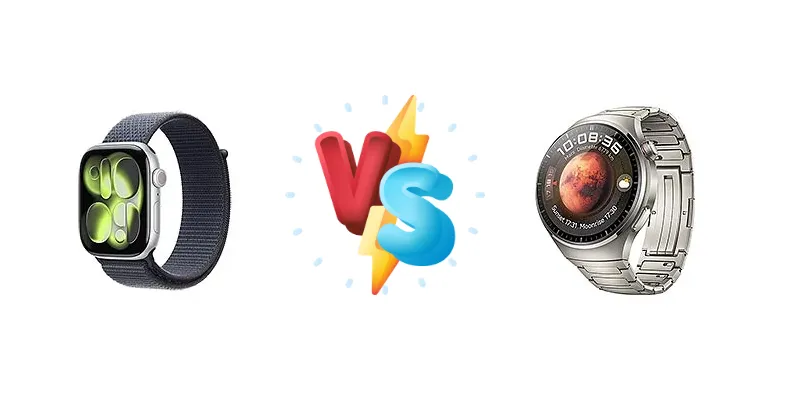
The smartwatch market offers a diverse range of options, from established players like Apple to rising contenders like Huawei. We pit the Apple Watch Series 11 Aluminum against the Huawei Watch 4 Pro, examining their core capabilities to determine which device delivers the best experience for different user profiles. While detailed specs for the Huawei Watch 4 Pro are limited, we'll leverage brand history and market positioning to provide a comprehensive analysis.
🏆 Quick Verdict
For users deeply embedded in the Apple ecosystem prioritizing seamless integration, the Apple Watch Series 11 remains a solid choice. However, the Huawei Watch 4 Pro, leveraging potential advancements in battery optimization and wireless charging, likely offers a more compelling experience for Android users or those seeking extended battery life, despite the limited information available.
| Network |
|---|
| 2G bands | GSM 850 / 900 / 1800 / 1900 | N/A |
| 3G bands | HSDPA 850 / 900 / 1700(AWS) / 1900 / 2100 - International, China, HK | HSDPA 850 / 900 / 1800 / 1900 / 2100 / 800 |
| 4G bands | 1, 2, 3, 4, 5, 6, 7, 8, 18, 19, 20, 25, 26, 28, 39, 40, 41, 66 - International, China, HK | LTE |
| 5G bands | SA/NSA | - |
| Speed | HSPA, LTE, 5G | HSPA, LTE |
| Technology | GSM / HSPA / LTE / 5G | HSPA / LTE |
| Launch |
|---|
| Announced | 2025, September 09 | 2023, May 10 |
| Status | Available. Released 2025, September 19 | Available. Released 2023, June 22 |
| Body |
|---|
| Build | Glass front, ceramic/sapphire crystal back, aluminum frame | Glass front, ceramic back, TC4 titanium frame |
| Dimensions | 46 x 39 x 9.7 mm (1.81 x 1.54 x 0.38 in) | 47.6 x 47.6 x 12.9 mm (1.87 x 1.87 x 0.51 in) |
| SIM | eSIM | eSIM |
| Weight | 29.7 g (42mm), 36.9 g (46mm) (1.06 oz) | 65 g (2.29 oz) |
| | - | 50m water resistant
5 ATM
Compatible with standard 22mm straps |
| Display |
|---|
| Protection | Ion-X strengthened glass (2025 gen) | Sapphire crystal glass |
| Resolution | 496 x 416 pixels (~330 ppi density) | 466 x 466 pixels (~310 ppi density) |
| Size | 1.96 inches | 1.5 inches |
| Type | Retina LTPO3 OLED, 2000 nits (peak) | LTPO AMOLED |
| | - | * the display resolution is unconfirmed
Always-on display |
| Platform |
|---|
| CPU | Dual-core | - |
| Chipset | Apple S10 | - |
| GPU | PowerVR | - |
| OS | watchOS 26, upgradable to watchOS 26.1 | HarmonyOS 3.0 |
| Memory |
|---|
| Card slot | No | No |
| Internal | 64GB | 32GB 2GB RAM |
| Sound |
|---|
| 3.5mm jack | - | No |
| 35mm jack | No | No |
| Loudspeaker | Yes | Yes |
| Comms |
|---|
| Bluetooth | 5.3, A2DP, LE | 5.2, A2DP, LE |
| NFC | Yes | Yes |
| Positioning | GPS, GLONASS, GALILEO, QZSS, BDS | GPS (L1+L5), GLONASS, BDS, GALILEO, QZSS |
| Radio | No | No |
| USB | No | No |
| WLAN | Wi-Fi 802.11 b/g/n, dual-band | Wi-Fi 802.11 b/g/n (market/region dependent) |
| Features |
|---|
| Sensors | Accelerometer, gyro, heart rate, barometer, always-on altimeter, compass, SpO2, VO2max, temperature (body), temperature (water) | Accelerometer, gyro, heart rate, barometer, compass, SpO2, thermometer (body temperature) |
| Battery |
|---|
| Charging | Wireless, 0-80% in 30 min | Wireless |
| Type | Li-Ion | Li-Ion |
| Misc |
|---|
| Colors | Jet Black, Space Gray, Rose Gold, Silver | Titanium |
| Models | A3333, A3331, A3335, A3337, A3450, A3451, A3452, A3453 | MDS-AL00, MDS-AL10 |
| Price | € 398.00 | About 550 EUR |
| SAR | 0.42 W/kg (head) | - |
| SAR EU | 0.11 W/kg (head) | - |
Apple Watch Series 11 Aluminum
- Seamless integration with Apple devices
- Mature and refined watchOS ecosystem
- Fast charging (0-80% in 30 minutes)
- Limited compatibility with Android smartphones
- Potentially shorter battery life compared to Huawei
Huawei Watch 4 Pro
- Likely broader compatibility with smartphones (Android and iOS)
- Potential for longer battery life (based on Huawei’s history)
- May offer unique health and fitness tracking features
- Less established app ecosystem compared to watchOS
- Performance is unknown without chipset details
Display Comparison
Information regarding the display specifications of both devices is currently unavailable. However, given Apple’s history, the Series 11 likely features a high-resolution OLED display with excellent color accuracy. The Huawei Watch 4 Pro, positioned as a 'Pro' model, likely incorporates a similarly high-quality display, potentially with LTPO technology for improved power efficiency, though this is speculative. Bezels are expected to be minimal on both devices, reflecting current design trends.
Camera Comparison
Neither device is primarily marketed for its camera capabilities, and no camera specifications are provided for either. Therefore, this section is largely irrelevant to the comparison.
Performance
The Apple Watch Series 11 is powered by the dual-core Apple S10 chipset. This provides a solid foundation for smooth performance within the watchOS environment. The Huawei Watch 4 Pro’s chipset is unknown, but Huawei has been increasingly focused on in-house chip development. While the S10 is a known quantity, the potential for Huawei to optimize its chipset for power efficiency and specific smartwatch tasks cannot be discounted. The Apple Watch’s performance is optimized for quick app launches and responsive interactions within its ecosystem. Without knowing the RAM configuration of the Huawei Watch 4 Pro, it’s difficult to assess its multitasking capabilities relative to the Apple Watch.
Battery Life
Both the Apple Watch Series 11 and the Huawei Watch 4 Pro support wireless charging. The Apple Watch Series 11 boasts a 0-80% charge in 30 minutes, indicating a relatively fast charging speed. Huawei typically prioritizes battery life in its wearables, and the 'Pro' designation suggests the Watch 4 Pro may offer improved battery endurance compared to the Series 11. However, without specific mAh ratings or charging wattage details for the Huawei Watch 4 Pro, it’s impossible to definitively state which device offers superior battery performance. The faster partial charge time of the Apple Watch is a benefit for users needing a quick top-up.
Buying Guide
Buy the Apple Watch Series 11 Aluminum if you require tight integration with iPhones, rely heavily on the watchOS app ecosystem, and prioritize a familiar user interface. Buy the Huawei Watch 4 Pro if you prefer a more open ecosystem, potentially benefit from longer battery life (based on Huawei’s track record), and are comfortable with a different smartwatch operating system. The Huawei Watch 4 Pro is likely the better choice for Android smartphone users.
Frequently Asked Questions
❓ Does the Apple Watch Series 11 still receive software updates?
Apple typically provides several years of software support for its Apple Watch models. While the Series 11 is an older model, it likely continues to receive security updates and potentially some feature enhancements, though the latest watchOS features may not be fully supported.
❓ Is the Huawei Watch 4 Pro compatible with iPhones?
While Huawei watches have improved iOS compatibility, the experience is typically limited compared to using them with Android devices. Features like notification mirroring and basic fitness tracking may work, but full functionality and app integration are unlikely.
❓ How does the Apple S10 chipset compare to potential Huawei chipsets in terms of app performance?
The Apple S10 is a proven performer within the watchOS ecosystem. Without knowing the specifications of the Huawei Watch 4 Pro’s chipset, it’s difficult to make a direct comparison. However, Huawei’s increasing focus on in-house chip development suggests they are striving for comparable performance and optimization.