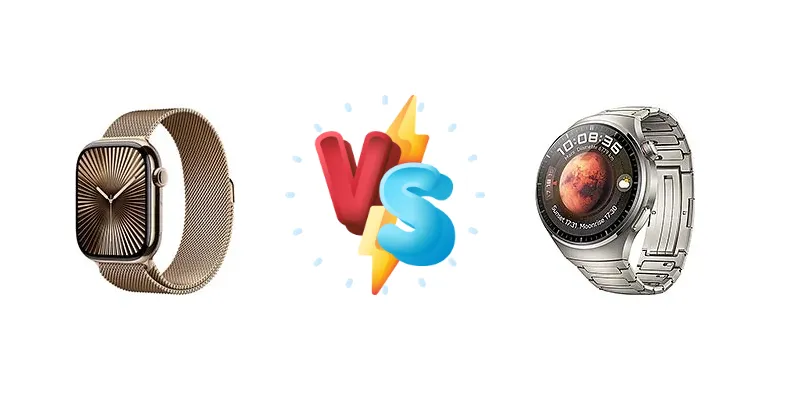
The smartwatch market is increasingly competitive, with Apple and Huawei offering premium experiences. This comparison focuses on the upcoming Apple Watch Series 10, powered by the new S10 chip, against the established Huawei Watch 4 Pro. While both aim for a high-end user, their approaches to performance, features, and ecosystem integration differ significantly.
🏆 Quick Verdict
For users deeply embedded in the Apple ecosystem, the Series 10’s seamless integration and likely enhanced features make it the superior choice. However, the Huawei Watch 4 Pro presents a compelling alternative for those prioritizing battery life and a more open platform, despite lacking the Apple’s chip performance.
| Network |
|---|
| 2G bands | GSM 850 / 900 / 1800 / 1900 | N/A |
| 3G bands | HSDPA 850 / 900 / 1700(AWS) / 1900 / 2100 - International, China, HK | HSDPA 850 / 900 / 1800 / 1900 / 2100 / 800 |
| 4G bands | 1, 2, 3, 4, 5, 6, 7, 8, 18, 19, 20, 25, 26, 28, 39, 40, 41, 66 - International, China, HK | LTE |
| Speed | HSPA, LTE | HSPA, LTE |
| Technology | GSM / HSPA / LTE | HSPA / LTE |
| Launch |
|---|
| Announced | 2024, September 09 | 2023, May 10 |
| Status | Available. Released 2024, September 20 | Available. Released 2023, June 22 |
| Body |
|---|
| Build | Sapphire crystal front, ceramic/sapphire crystal back, titanium frame (grade 5) | Glass front, ceramic back, TC4 titanium frame |
| Dimensions | 46 x 39 x 9.7 mm (1.81 x 1.54 x 0.38 in) | 47.6 x 47.6 x 12.9 mm (1.87 x 1.87 x 0.51 in) |
| SIM | eSIM | eSIM |
| Weight | 34.4 g (42mm), 41.7 g (46mm) (1.48 oz) | 65 g (2.29 oz) |
| | - | 50m water resistant
5 ATM
Compatible with standard 22mm straps |
| Display |
|---|
| Protection | Sapphire crystal glass | Sapphire crystal glass |
| Resolution | 496 x 416 pixels (~330 ppi density) | 466 x 466 pixels (~310 ppi density) |
| Size | 1.96 inches | 1.5 inches |
| Type | Retina LTPO3 OLED, 2000 nits (peak) | LTPO AMOLED |
| | - | * the display resolution is unconfirmed
Always-on display |
| Platform |
|---|
| CPU | Dual-core | - |
| Chipset | Apple S10 | - |
| GPU | PowerVR | - |
| OS | watchOS 11, upgradable to watchOS 26.1 | HarmonyOS 3.0 |
| Memory |
|---|
| Card slot | No | No |
| Internal | 64GB | 32GB 2GB RAM |
| Sound |
|---|
| 3.5mm jack | - | No |
| 35mm jack | No | No |
| Loudspeaker | Yes | Yes |
| Comms |
|---|
| Bluetooth | 5.3, A2DP, LE | 5.2, A2DP, LE |
| NFC | Yes | Yes |
| Positioning | GPS, GLONASS, GALILEO, QZSS, BDS | GPS (L1+L5), GLONASS, BDS, GALILEO, QZSS |
| Radio | No | No |
| USB | No | No |
| WLAN | Wi-Fi 802.11 b/g/n, dual-band | Wi-Fi 802.11 b/g/n (market/region dependent) |
| Features |
|---|
| Sensors | Accelerometer, gyro, heart rate, barometer, always-on altimeter, compass, SpO2, VO2max, temperature (body), temperature (water) | Accelerometer, gyro, heart rate, barometer, compass, SpO2, thermometer (body temperature) |
| Battery |
|---|
| Charging | Wireless, 0-80% in 30 min | Wireless |
| Type | Li-Ion 327 mAh | Li-Ion |
| Misc |
|---|
| Colors | Slate, Gold, Natural | Titanium |
| Models | A3001, A3002, A3003, A3206 | MDS-AL00, MDS-AL10 |
| Price | € 614.01 | About 550 EUR |
| SAR | 1.08 W/kg (head) | - |
| SAR EU | 0.26 W/kg (head) 0.83 W/kg (body) | - |
Apple Watch Series 10
- Faster processor with the Apple S10 chip.
- Seamless integration with the Apple ecosystem.
- Likely superior app performance and responsiveness.
- Requires daily charging.
- Limited compatibility outside the Apple ecosystem.
- Potential for higher price point.
Huawei Watch 4 Pro
- Potentially longer battery life.
- More platform-agnostic compatibility.
- Wireless charging convenience.
- Likely slower processor compared to the Apple S10.
- Less developed app ecosystem.
- May lack some of Apple’s advanced health features.
Display Comparison
Details regarding display technology are currently unavailable for the Series 10, but Apple historically utilizes LTPO OLED panels for efficient refresh rate scaling. The Huawei Watch 4 Pro is expected to continue with a high-resolution AMOLED display. The Series 10 will likely benefit from Apple’s advancements in color accuracy and peak brightness, potentially exceeding the Huawei’s display. Bezels are expected to be minimal on both, but Apple’s focus on maximizing screen real estate could give it an edge.
Camera Comparison
Neither device is primarily marketed for its camera capabilities. Both are expected to have basic camera functionality, but details are scarce. Given Apple’s focus on image processing, the Series 10 may offer slightly better image quality, but this is speculative. The Huawei Watch 4 Pro may focus on health-related camera features, such as heart rate monitoring, but a detailed comparison is impossible without further information.
Performance
The Apple Watch Series 10’s dual-core Apple S10 chipset represents a significant upgrade over previous generations. While core count remains the same, architectural improvements are expected to deliver noticeable performance gains. The Huawei Watch 4 Pro’s chipset details are currently unknown, but it’s unlikely to match the S10’s raw processing power. This difference will be most apparent in demanding tasks like app loading and complex watch face animations. The S10’s optimized architecture will likely translate to better power efficiency, despite the performance advantage.
Battery Life
The Huawei Watch 4 Pro is expected to maintain its focus on extended battery life, potentially offering several days of use on a single charge. The Apple Watch Series 10, while improving with each generation, typically requires daily charging. Both devices support wireless charging, with the Series 10 achieving 0-80% charge in 30 minutes. The Huawei’s charging speed is currently unknown, but a slower charging rate would be offset by its longer overall battery life.
Buying Guide
Buy the Apple Watch Series 10 if you need tight integration with iPhones, rely heavily on Apple’s health ecosystem (Fitness+, HealthKit), and prioritize the latest processor for smooth app performance. Buy the Huawei Watch 4 Pro if you prefer a longer-lasting battery, a more platform-agnostic experience, and are less concerned with the absolute fastest processing speeds or Apple-specific features.
Frequently Asked Questions
❓ How will the Apple S10 chip impact real-world app performance on the Series 10?
The Apple S10’s dual-core architecture, combined with Apple’s software optimization, is expected to deliver noticeably faster app loading times, smoother animations, and improved responsiveness compared to previous Apple Watch models. This will be particularly beneficial for demanding apps like mapping and fitness tracking.
❓ Does the Huawei Watch 4 Pro offer the same level of health tracking accuracy as the Apple Watch?
While the Huawei Watch 4 Pro offers comprehensive health tracking features, including heart rate monitoring and sleep analysis, Apple’s HealthKit ecosystem and advanced sensors often provide a more refined and accurate experience. The Series 10 is expected to build upon these strengths with potentially new sensor technologies.
❓ Is the wireless charging speed on the Apple Watch Series 10 competitive with other smartwatches?
The Series 10’s 0-80% charge in 30 minutes is a respectable wireless charging speed, placing it in line with many competitors. However, some smartwatches offer faster wireless charging capabilities, though this often comes at the cost of battery health.