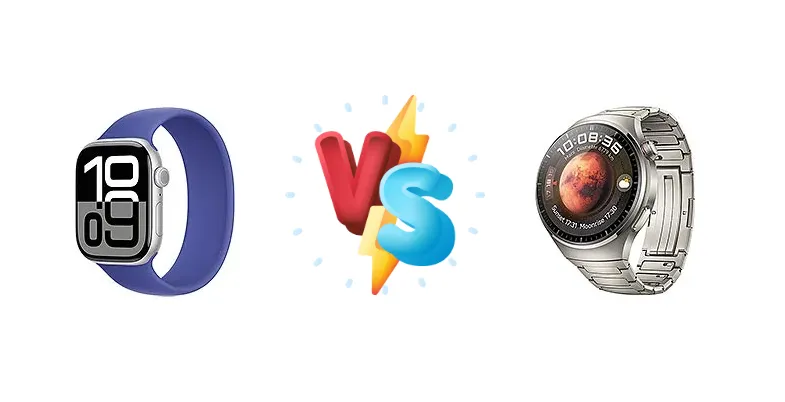
The smartwatch market is increasingly competitive, with Apple and Huawei consistently pushing boundaries. This comparison focuses on the upcoming Apple Watch Series 10 Aluminum and the Huawei Watch 4 Pro, two devices targeting the premium wearable segment. While both offer comprehensive health tracking and smart features, they diverge significantly in chipset architecture, operating system, and ecosystem integration.
🏆 Quick Verdict
For users deeply embedded in the Apple ecosystem, the Apple Watch Series 10 Aluminum offers seamless integration and a refined user experience. However, the Huawei Watch 4 Pro presents a compelling alternative, potentially offering longer battery life and a more open platform, though lacking the same level of app support.
| Network |
|---|
| 2G bands | GSM 850 / 900 / 1800 / 1900 | N/A |
| 3G bands | HSDPA 850 / 900 / 1700(AWS) / 1900 / 2100 - International, China, HK | HSDPA 850 / 900 / 1800 / 1900 / 2100 / 800 |
| 4G bands | 1, 2, 3, 4, 5, 6, 7, 8, 18, 19, 20, 25, 26, 28, 39, 40, 41, 66 - International, China, HK | LTE |
| Speed | HSPA, LTE | HSPA, LTE |
| Technology | GSM / HSPA / LTE | HSPA / LTE |
| Launch |
|---|
| Announced | 2024, September 09 | 2023, May 10 |
| Status | Available. Released 2024, September 20 | Available. Released 2023, June 22 |
| Body |
|---|
| Build | Glass front, ceramic/sapphire crystal back, aluminum frame | Glass front, ceramic back, TC4 titanium frame |
| Dimensions | 46 x 39 x 9.7 mm (1.81 x 1.54 x 0.38 in) | 47.6 x 47.6 x 12.9 mm (1.87 x 1.87 x 0.51 in) |
| SIM | eSIM | eSIM |
| Weight | 29.3 g (42mm), 35.3 g (46mm) (1.02 oz) | 65 g (2.29 oz) |
| | - | 50m water resistant
5 ATM
Compatible with standard 22mm straps |
| Display |
|---|
| Protection | Ion-X strengthened glass | Sapphire crystal glass |
| Resolution | 496 x 416 pixels (~330 ppi density) | 466 x 466 pixels (~310 ppi density) |
| Size | 1.96 inches | 1.5 inches |
| Type | Retina LTPO3 OLED, 2000 nits (peak) | LTPO AMOLED |
| | - | * the display resolution is unconfirmed
Always-on display |
| Platform |
|---|
| CPU | Dual-core | - |
| Chipset | Apple S10 | - |
| GPU | PowerVR | - |
| OS | watchOS 11, upgradable to watchOS 26.1 | HarmonyOS 3.0 |
| Memory |
|---|
| Card slot | No | No |
| Internal | 64GB | 32GB 2GB RAM |
| Sound |
|---|
| 3.5mm jack | - | No |
| 35mm jack | No | No |
| Loudspeaker | Yes | Yes |
| Comms |
|---|
| Bluetooth | 5.3, A2DP, LE | 5.2, A2DP, LE |
| NFC | Yes | Yes |
| Positioning | GPS, GLONASS, GALILEO, QZSS, BDS | GPS (L1+L5), GLONASS, BDS, GALILEO, QZSS |
| Radio | No | No |
| USB | No | No |
| WLAN | Wi-Fi 802.11 b/g/n, dual-band | Wi-Fi 802.11 b/g/n (market/region dependent) |
| Features |
|---|
| Sensors | Accelerometer, gyro, heart rate, barometer, always-on altimeter, compass, SpO2, VO2max, temperature (body), temperature (water) | Accelerometer, gyro, heart rate, barometer, compass, SpO2, thermometer (body temperature) |
| Battery |
|---|
| Charging | Wireless, 0-80% in 30 min | Wireless |
| Type | Li-Ion 327 mAh | Li-Ion |
| Misc |
|---|
| Colors | Jet Black, Rose Gold, Silver | Titanium |
| Models | A3001, A3002, A3003, A3206, A2997, A2998, A2999, A3000 | MDS-AL00, MDS-AL10 |
| Price | € 334.24 | About 550 EUR |
| SAR | 1.08 W/kg (head) | - |
| SAR EU | 0.26 W/kg (head) 0.83 W/kg (body) | - |
Apple Watch Series 10 Aluminum
- Seamless integration with the Apple ecosystem.
- Access to a vast app library through the App Store.
- Optimized performance with the Apple S10 chipset.
- Limited compatibility with Android devices.
- Potentially shorter battery life compared to Huawei.
- Ecosystem lock-in may be restrictive for some users.
Huawei Watch 4 Pro
- Potentially longer battery life due to chipset optimization.
- More open platform and broader compatibility.
- Independent operation with less reliance on a smartphone.
- Smaller app ecosystem compared to watchOS.
- HarmonyOS may have a learning curve for new users.
- Integration with Apple devices is limited.
Display Comparison
While specific display details for the Series 10 are currently unavailable, Apple typically employs LTPO OLED panels for power efficiency and excellent color accuracy. The Huawei Watch 4 Pro is expected to continue with a high-resolution AMOLED display. The key difference will likely be in peak brightness and always-on display implementation. Apple’s displays are known for their excellent outdoor visibility, a feature Huawei will need to match. Bezels are also a critical factor; Apple consistently minimizes these, contributing to a more immersive experience.
Camera Comparison
Neither device is primarily marketed for its camera capabilities, and detailed camera specs are unavailable for either. Smartwatches generally feature limited camera functionality, focusing on quick snapshots or video calls. Any camera on these devices will be secondary to their core smartwatch features.
Performance
The Apple Watch Series 10, powered by the Apple S10 dual-core chipset, benefits from Apple’s silicon design expertise. This allows for optimized performance and power efficiency within the watchOS environment. The Huawei Watch 4 Pro’s chipset details are currently limited, but Huawei has been focusing on improving its chipsets for wearables. The S10’s architecture is likely more mature, offering a smoother experience for complex tasks and app execution. The impact of RAM speed (likely LPDDR5x in both) will be less noticeable than the core CPU performance difference.
Battery Life
Both the Apple Watch Series 10 and Huawei Watch 4 Pro support wireless charging. The Series 10 boasts a 0-80% charge in 30 minutes, indicating a relatively fast charging speed. However, Huawei’s focus on power efficiency with its chipsets and software optimization could translate to longer real-world battery life, despite potentially lacking the same rapid charging capabilities. The actual battery capacity (mAh) will be a crucial factor, but without that data, we can only speculate based on brand history and software optimization.
Buying Guide
Buy the Apple Watch Series 10 Aluminum if you prioritize tight integration with iPhones, access to a vast app library, and a mature smartwatch operating system. Buy the Huawei Watch 4 Pro if you value a potentially longer battery life, a more independent experience from a smartphone ecosystem, and are comfortable with HarmonyOS's growing, but still limited, app selection.
Frequently Asked Questions
❓ How does the Apple S10 chip compare to the chipset in the Huawei Watch 4 Pro in terms of app loading times and responsiveness?
The Apple S10 benefits from Apple's tight software and hardware integration, generally resulting in faster app loading times and a more responsive user interface. While Huawei has improved its chipset design, it likely won't match the optimized performance of the S10 within its respective ecosystem.
❓ Is the 0-80% charge time of 30 minutes for the Apple Watch Series 10 a significant advantage over the Huawei Watch 4 Pro's charging speed?
The 30-minute 0-80% charge time is convenient for quick top-ups. However, if the Huawei Watch 4 Pro offers significantly longer battery life, the slower charging speed may be a worthwhile trade-off for users who don't need to charge their watch daily.
❓ How does the app ecosystem differ between watchOS and HarmonyOS, and will I be able to find the apps I need on the Huawei Watch 4 Pro?
watchOS boasts a significantly larger and more mature app ecosystem with a wider selection of third-party applications. HarmonyOS is growing, but currently offers a more limited selection. Users heavily reliant on specific apps may find them unavailable on the Huawei Watch 4 Pro.