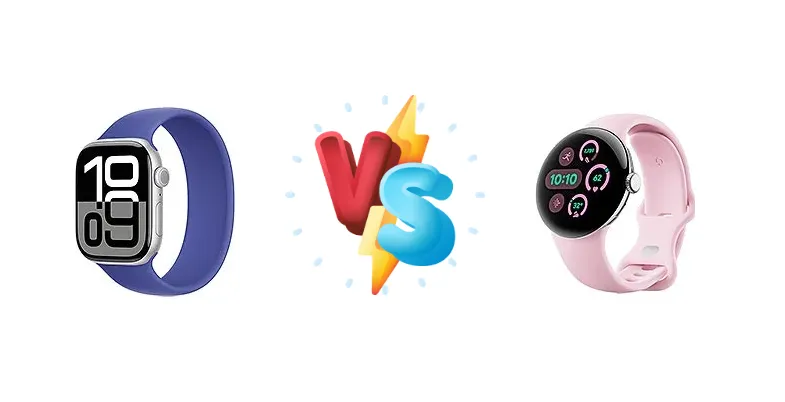
The smartwatch landscape is dominated by Apple and Google, each offering a compelling blend of fitness tracking, notification management, and app integration. The Apple Watch Series 10, building on a mature platform, faces off against the Google Pixel Watch 3, which aims to refine Google’s wearable experience. This comparison focuses on the core hardware differences – the Apple S10 versus the Qualcomm SW5100 – and how those translate to real-world performance and user experience.
🏆 Quick Verdict
For users deeply embedded in the Apple ecosystem, the Apple Watch Series 10 offers seamless integration and a refined experience. However, the Google Pixel Watch 3 presents a strong alternative, particularly for Android users, with potentially faster charging (depending on model) and a more open platform. The Series 10 wins for overall polish, but the Pixel Watch 3 is a viable contender.
| Network |
|---|
| 2G bands | GSM 850 / 900 / 1800 / 1900 | GSM 850 / 900 / 1800 / 1900 |
| 3G bands | HSDPA 850 / 900 / 1700(AWS) / 1900 / 2100 - International, China, HK | HSDPA 850 / 900 / 1700(AWS) / 1900 / 2100 |
| 4G bands | 1, 2, 3, 4, 5, 6, 7, 8, 18, 19, 20, 25, 26, 28, 39, 40, 41, 66 - International, China, HK | LTE |
| Speed | HSPA, LTE | HSPA, LTE |
| Technology | GSM / HSPA / LTE | GSM / HSPA / LTE |
| Launch |
|---|
| Announced | 2024, September 09 | 2024, August 13 |
| Status | Available. Released 2024, September 20 | Available. Released 2024, September 10 |
| Body |
|---|
| Build | Glass front, ceramic/sapphire crystal back, aluminum frame | Glass front (Gorilla Glass 5), aluminum frame |
| Dimensions | 46 x 39 x 9.7 mm (1.81 x 1.54 x 0.38 in) | 45 x 45 x 12.3 mm (1.77 x 1.77 x 0.48 in) |
| SIM | eSIM | eSIM |
| Weight | 29.3 g (42mm), 35.3 g (46mm) (1.02 oz) | 37 g (1.31 oz) |
| Display |
|---|
| Protection | Ion-X strengthened glass | Corning Gorilla Glass 5 |
| Resolution | 496 x 416 pixels (~330 ppi density) | 456 x 456 pixels (~320 ppi density) |
| Size | 1.96 inches | 1.4 inches |
| Type | Retina LTPO3 OLED, 2000 nits (peak) | LTPO AMOLED, 2000 nits (peak) |
| Platform |
|---|
| CPU | Dual-core | - |
| Chipset | Apple S10 | Qualcomm SW5100 |
| GPU | PowerVR | - |
| OS | watchOS 11, upgradable to watchOS 26.1 | Android Wear OS 5, up to 3 major Android upgrades |
| Memory |
|---|
| Card slot | No | No |
| Internal | 64GB | 32GB 2GB RAM |
| Sound |
|---|
| 35mm jack | No | No |
| Loudspeaker | Yes | Yes |
| Comms |
|---|
| Bluetooth | 5.3, A2DP, LE | 5.3, A2DP |
| NFC | Yes | Yes |
| Positioning | GPS, GLONASS, GALILEO, QZSS, BDS | GPS, GLONASS, GALILEO |
| Radio | No | No |
| USB | No | No |
| WLAN | Wi-Fi 802.11 b/g/n, dual-band | Wi-Fi 802.11 a/b/g/n/ac/6, dual-band |
| Features |
|---|
| Sensors | Accelerometer, gyro, heart rate, barometer, always-on altimeter, compass, SpO2, VO2max, temperature (body), temperature (water) | Accelerometer, gyro, heart rate, altimeter, compass, SpO2, thermometer (skin temperature), skin conductance |
| Battery |
|---|
| Charging | Wireless, 0-80% in 30 min | Wired, 50% in 28 min, 80% in 50 min - 45mm model
Wired, 50% in 24 min, 80% in 35 min - 41mm model |
| Type | Li-Ion 327 mAh | Li-Ion 420 mAh |
| Misc |
|---|
| Colors | Jet Black, Rose Gold, Silver | Matte Black, Polished Silver, Champagne Gold, Matte Hazel |
| Models | A3001, A3002, A3003, A3206, A2997, A2998, A2999, A3000 | - |
| Price | € 334.24 | € 215.76 |
| SAR | 1.08 W/kg (head) | - |
| SAR EU | 0.26 W/kg (head) 0.83 W/kg (body) | - |
Apple Watch Series 10 Aluminum
- Seamless integration with Apple devices
- Optimized watchOS experience
- Wireless charging convenience
- Ecosystem lock-in
- Potentially slower charging compared to Pixel Watch 3 (41mm)
Google Pixel Watch 3
- Faster charging (41mm model)
- Open Wear OS platform
- Better compatibility with Android phones
- Wired charging requirement
- Potential for software fragmentation on Wear OS
Display Comparison
While display specs aren't provided, the Apple Watch traditionally utilizes LTPO OLED panels for efficient refresh rate scaling. The Pixel Watch 3 likely employs a similar technology. The key differentiator will be peak brightness and color accuracy, areas where Apple typically excels. Bezels are also a crucial factor; smaller bezels contribute to a more immersive experience, and Apple has consistently minimized these. Without specific data, it's reasonable to assume Apple maintains a slight edge in display quality based on historical performance.
Camera Comparison
Neither device is marketed for its camera capabilities, and detailed camera specs are absent. Smartwatches primarily use cameras for limited functions like video calls or potentially NFC payments. Therefore, this section is less critical for this comparison. Any camera present will likely be low-resolution and focused on functionality rather than image quality.
Performance
The core of the performance difference lies in the chipsets. Apple’s dual-core S10 chip is a system-on-a-chip (SoC) designed specifically for the Apple Watch, allowing for tight hardware-software optimization. Google’s Pixel Watch 3 utilizes the Qualcomm SW5100, a platform built for Wear OS. While Qualcomm has made strides in wearable performance, Apple’s in-house design gives it a potential advantage in efficiency and responsiveness. The S10’s architecture is likely optimized for the specific tasks a smartwatch performs, while the SW5100 is a more general-purpose solution. RAM speed (likely LPDDR5x in both) will also play a role, but the chipset itself is the primary determinant of performance.
Battery Life
Charging speeds are a clear point of divergence. The Apple Watch Series 10 offers wireless charging, reaching 80% in 30 minutes. The Pixel Watch 3, however, utilizes wired charging, with the 45mm model achieving 80% in 50 minutes and the 41mm model in 35 minutes. This suggests the Pixel Watch 3, particularly the 41mm variant, can potentially charge faster to a usable level. While mAh capacity isn’t specified, the faster charging of the Pixel Watch 3 could offset a potentially smaller battery, providing comparable real-world usage for many users. The convenience of wireless charging remains a benefit for the Apple Watch.
Buying Guide
Buy the Apple Watch Series 10 Aluminum if you prioritize seamless integration with iPhones, iPads, and Macs, and value Apple’s established health and fitness ecosystem. Buy the Google Pixel Watch 3 if you’re an Android user, prefer a more customizable experience, and appreciate Google’s suite of apps and services. The Pixel Watch 3 also appeals to those who may want faster charging times, depending on the model chosen.
Frequently Asked Questions
❓ Does the Qualcomm SW5100 in the Pixel Watch 3 experience thermal throttling during extended use, like GPS tracking or workout sessions?
While the SW5100 is a capable chipset, sustained high-intensity tasks can lead to thermal throttling in any wearable. However, Google’s software optimization and the Pixel Watch 3’s design aim to mitigate this. User reports will be crucial to determine the extent of throttling in real-world scenarios, but the Apple S10’s tighter integration may offer slightly better thermal management.
❓ How does the Apple Watch Series 10’s wireless charging compare to the Pixel Watch 3’s wired charging in terms of convenience for daily use?
Wireless charging on the Apple Watch Series 10 offers greater convenience, allowing you to simply place it on a charging puck. The Pixel Watch 3 requires a USB-C cable connection. However, the Pixel Watch 3’s faster charging times, especially on the 41mm model, mean you may spend less *time* actually charging, even with the wired connection. The trade-off is convenience versus speed.
❓ What are the implications of watchOS versus Wear OS for app availability and customization?
watchOS boasts a curated app store with a focus on quality and integration with Apple services. Wear OS, powered by Google, offers a wider range of apps, including Google’s own suite, and greater customization options. However, Wear OS app quality can be more variable. Users prioritizing a polished, consistent experience may prefer watchOS, while those seeking flexibility and a broader app selection might lean towards Wear OS.