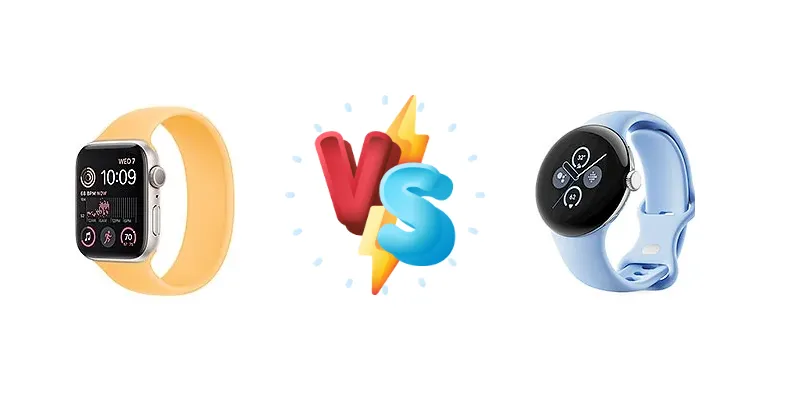
The smartwatch market is increasingly competitive, with Apple and Google offering compelling options at different price points. The Apple Watch SE 2 represents Apple’s entry-level offering, prioritizing core functionality and affordability. Conversely, the Google Pixel Watch 2 aims to deliver a premium Wear OS experience, leveraging Google’s software prowess and a more modern chipset. This comparison dissects the key differences between these two devices, focusing on performance, charging, and the implications of their respective ecosystems.
🏆 Quick Verdict
For iPhone users deeply embedded in the Apple ecosystem, the Apple Watch SE 2 remains the more seamless and efficient choice. Its tight integration with iOS and established app library outweigh the Pixel Watch 2’s faster charging. However, Android users will find the Google Pixel Watch 2 a superior experience, offering a more open and customizable platform.
| Network |
|---|
| 2G bands | GSM 850 / 900 / 1800 / 1900 | GSM 850 / 900 / 1800 / 1900 |
| 3G bands | HSDPA 850 / 900 / 1700(AWS) / 1900 / 2100 - International, China, HK | HSDPA 850 / 900 / 1700(AWS) / 1900 / 2100 |
| 4G bands | 1, 2, 3, 4, 5, 6, 7, 8, 18, 19, 20, 25, 26, 28, 39, 40, 41, 66 - International, China, HK | LTE |
| Speed | HSPA, LTE | HSPA, LTE |
| Technology | GSM / HSPA / LTE | GSM / HSPA / LTE |
| Launch |
|---|
| Announced | 2022, September 07 | 2023, October 04 |
| Status | Available. Released 2022, September 16 | Available. Released 2023, October 12 |
| Body |
|---|
| Build | Glass front, plastic/sapphire crystal back, aluminum frame | Glass front (Gorilla Glass 5), aluminum frame |
| Dimensions | 44 x 38 x 10.7 mm (1.73 x 1.50 x 0.42 in) | 41 x 41 x 12.3 mm (1.61 x 1.61 x 0.48 in) |
| SIM | eSIM | eSIM |
| Weight | 33 g (1.16 oz) | 31 g (1.09 oz) |
| Display |
|---|
| Protection | Ion-X strengthened glass | Corning Gorilla Glass 5 |
| Resolution | 448 x 368 pixels (~326 ppi density) | 450 x 450 pixels (~320 ppi density) |
| Size | 1.78 inches | 1.2 inches |
| Type | Retina LTPO OLED, 1000 nits (peak) | AMOLED, 1000 nits (peak) |
| Platform |
|---|
| CPU | Dual-core | - |
| Chipset | Apple S8 | Qualcomm 5100 |
| GPU | PowerVR | - |
| OS | watchOS 9.0, upgradable to watchOS 26.1 | Android Wear OS 4 |
| Memory |
|---|
| Card slot | No | No |
| Internal | 32GB 1GB RAM | 32GB 2GB RAM |
| Sound |
|---|
| 35mm jack | No | No |
| Loudspeaker | Yes | Yes |
| Comms |
|---|
| Bluetooth | 5.3, A2DP, LE | 5.0, A2DP, LE |
| NFC | Yes | Yes |
| Positioning | GPS, GLONASS, GALILEO, QZSS | GPS, GLONASS, GALILEO, BDS, QZSS |
| Radio | No | No |
| USB | No | No |
| WLAN | Wi-Fi 802.11 b/g/n | Wi-Fi 802.11 b/g/n |
| Features |
|---|
| Sensors | Accelerometer, gyro, heart rate (2nd gen), barometer, always-on altimeter, compass | Accelerometer, gyro, heart rate, altimeter, compass, SpO2, thermometer (skin temperature), skin conductance |
| Battery |
|---|
| Charging | Wireless | Wired, 80% in 45 min |
| Type | Li-Ion 296 mAh | Li-Ion 306 mAh |
| Misc |
|---|
| Colors | Midnight, Starlight, Silver | Polished Silver, Matte Black, Champagne Gold |
| Models | A2722, A2723, A2724, A2727, A2856, A2725, A2726, A2855, watch6,10, watch6,11, watch6,12, watch6,13 | G4TSL, GC3G8, GD2WG |
| Price | € 148.85 | About 160 EUR |
| SAR | 0.27 W/kg (head) 1.96 W/kg (body) | - |
| SAR EU | 0.27 W/kg (head) 1.96 W/kg (body) | - |
Apple Watch SE 2
- Seamless integration with iPhone and iOS.
- Mature and optimized watchOS ecosystem.
- Strong resale value.
- Slower wireless charging.
- Limited customization options compared to Wear OS.
- Ecosystem lock-in – best experienced with other Apple devices.
Google Pixel Watch 2
- Faster wired charging (80% in 45 minutes).
- Open and customizable Wear OS platform.
- Fitbit integration for advanced health tracking.
- Performance may be limited by Wear OS overhead.
- Battery life potentially impacted by Qualcomm 5100’s efficiency.
- Less polished ecosystem compared to Apple’s.
Display Comparison
While specific display specs aren't provided, the Apple Watch SE 2 likely utilizes an OLED panel, typical of Apple’s smartwatch lineup. The Pixel Watch 2 also features an OLED display. The key difference lies in the software optimization; Apple’s watchOS is renowned for its smooth animations and efficient rendering. The Pixel Watch 2’s display quality will depend heavily on Google’s calibration and the efficiency of the Qualcomm 5100 chipset in driving the panel. Bezels are likely comparable, given the similar form factors. Color accuracy is expected to be high on both devices, though Apple typically leads in color calibration.
Camera Comparison
Neither device features a camera, a common trend in modern smartwatches. This omission prioritizes battery life and design aesthetics. The focus is entirely on sensor-based health tracking, not visual capture.
Performance
The core architectural difference lies in the chipsets. The Apple Watch SE 2 is powered by the dual-core Apple S8, a system-on-a-chip (SoC) designed specifically for Apple’s wearables. The Google Pixel Watch 2 utilizes the Qualcomm 5100, a platform built for Wear OS. While core count is similar, Apple’s S8 benefits from tight software integration and optimization within the watchOS environment. The Qualcomm 5100, while newer, must contend with the overhead of Wear OS and potential fragmentation across Android devices. RAM specifications are not provided, but Apple typically optimizes memory usage effectively. Thermal management will be crucial for the Pixel Watch 2, as the Qualcomm 5100’s performance will be limited by its ability to dissipate heat within the compact form factor.
Battery Life
Battery capacity isn’t specified for either device. However, the Pixel Watch 2’s wired charging capability – achieving 80% charge in 45 minutes – is a significant advantage over the Apple Watch SE 2’s wireless charging. Wireless charging is inherently less efficient, resulting in slower charging times. While Apple may optimize power consumption through watchOS, the Pixel Watch 2’s faster charging mitigates concerns about daily battery depletion, particularly for users who forget to charge overnight. The Qualcomm 5100’s power efficiency will be a key factor in determining the Pixel Watch 2’s real-world battery performance.
Buying Guide
Buy the Apple Watch SE 2 if you prioritize seamless integration with an iPhone, value Apple’s established health features, and prefer a mature app ecosystem. You’ll benefit from effortless pairing, iMessage notifications, and a generally more polished user experience within the Apple world. Buy the Google Pixel Watch 2 if you’re an Android user seeking a stylish smartwatch with advanced health tracking powered by Fitbit, and appreciate the flexibility and customization options of Wear OS. The Pixel Watch 2’s faster charging is a significant advantage for those who dislike overnight charging.
Frequently Asked Questions
❓ Does the Qualcomm 5100 chipset in the Pixel Watch 2 generate noticeable heat during extended use, like GPS tracking or workout sessions?
The Qualcomm 5100 is a relatively new platform for smartwatches. While Qualcomm has made strides in power efficiency, the compact form factor of the Pixel Watch 2 could limit its ability to dissipate heat effectively. Users engaging in prolonged GPS tracking or intensive workouts may experience some warmth, but significant overheating is unlikely given Google and Qualcomm’s thermal management strategies.
❓ How does the Fitbit integration on the Pixel Watch 2 impact battery life compared to the Apple Watch SE 2’s native health tracking features?
Fitbit’s health tracking algorithms are generally power-efficient, but continuous heart rate monitoring, sleep tracking, and activity detection do consume battery. The Pixel Watch 2’s battery life will depend on the intensity of Fitbit feature usage. Apple’s watchOS is highly optimized for power management, but the Pixel Watch 2’s faster charging capability helps offset any potential battery drain from Fitbit’s features.
❓ Is the Apple Watch SE 2 still a viable option for Android users, or is the ecosystem lock-in too restrictive?
While technically possible to pair an Apple Watch SE 2 with an Android phone, the experience is severely limited. Core features like notifications, app integration, and health data synchronization will be significantly compromised. The Apple Watch SE 2 is overwhelmingly designed for iPhone users and is not recommended for Android users due to the restrictive ecosystem.