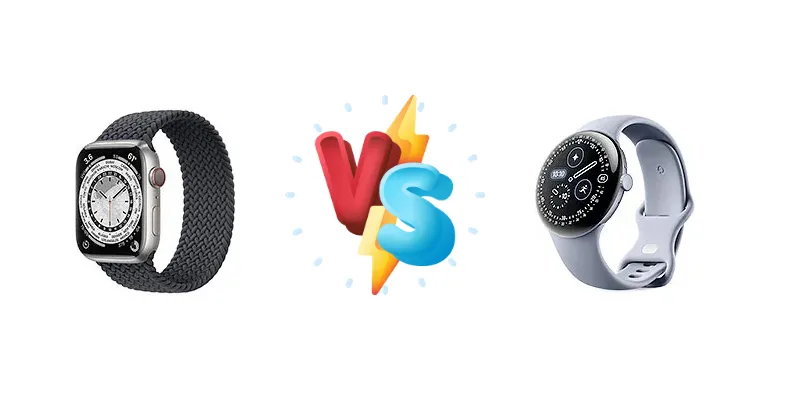
The smartwatch landscape is heating up. Apple’s Series 7, while established, now faces a strong contender in Google’s Pixel Watch 4. This comparison isn’t just about specs; it’s about contrasting Apple’s mature ecosystem with Google’s push for a faster, more efficient Wear OS experience powered by Qualcomm’s latest silicon. We’ll dissect the key differences to help you decide which wearable best suits your needs.
🏆 Quick Verdict
For the average user prioritizing speed and convenience, the Google Pixel Watch 4 emerges as the winner. Its Snapdragon W5 Gen 2 chipset and significantly faster charging – reaching 50% in just 15 minutes – offer a tangible advantage. However, Apple’s seamless integration with iOS and established app ecosystem remain compelling for iPhone users.
| Network |
|---|
| 2G bands | GSM 850 / 900 / 1800 / 1900 | GSM 850 / 900 / 1800 / 1900 |
| 3G bands | HSDPA 850 / 900 / 1700(AWS) / 1900 / 2100 - International | HSDPA 850 / 900 / 1700(AWS) / 1900 / 2100 |
| 4G bands | 1, 2, 3, 4, 5, 7, 8, 18, 19, 20, 25, 26, 28, 39, 40, 41, 66 - International | LTE |
| Speed | HSPA, LTE | HSPA, LTE |
| Technology | GSM / HSPA / LTE | GSM / HSPA / LTE |
| | 1, 2, 3, 4, 5, 7, 12, 13, 14, 17, 18, 19, 25, 26, 39, 40, 41, 66 - USA, LATAM, Canada | - |
| Launch |
|---|
| Announced | 2021, September 14 | 2025, August 20 |
| Status | Available. Released 2021, October 15 | Available. Released 2025, October 09 |
| Body |
|---|
| Build | Sapphire crystal front, ceramic/sapphire crystal back, titanium frame | Glass front (Gorilla Glass 5), aluminum frame |
| Dimensions | 45 x 38 x 10.7 mm (1.77 x 1.50 x 0.42 in) | 45 x 45 x 12.3 mm (1.77 x 1.77 x 0.48 in) |
| SIM | eSIM | eSIM |
| Weight | 37 g (41mm), 45.1 g (45mm) (1.31 oz) | 31 g or 37 g (1.09 oz) |
| | IP6X certified
50m water resistant
ECG certified (region dependent SW application; HW available on all models) | - |
| Display |
|---|
| Protection | Sapphire crystal glass | Corning Gorilla Glass 5 |
| Resolution | 484 x 396 pixels (~326 ppi density) | 456 x 456 pixels (~320 ppi density) |
| Size | 1.9 inches | 1.4 inches |
| Type | Retina LTPO OLED, 1000 nits (peak) | LTPO AMOLED, 3000 nits (peak) |
| | Always-on display | - |
| Platform |
|---|
| CPU | Dual-core | Quad-core (4x1.7 GHz Cortex-A53) |
| Chipset | Apple S7 | Qualcomm Snapdragon W5 Gen 2 (4 nm) |
| GPU | PowerVR | Adreno A702 |
| OS | watchOS 8.0, upgradable to watchOS 26.1 | Android Wear OS 6 |
| Memory |
|---|
| Card slot | No | No |
| Internal | 32GB 1GB RAM | 32GB 2GB RAM |
| Sound |
|---|
| 3.5mm jack | No | - |
| 35mm jack | No | No |
| Loudspeaker | Yes | Yes |
| Comms |
|---|
| Bluetooth | 5.0, A2DP, LE | 6.0, A2DP |
| NFC | Yes | Yes |
| Positioning | GPS, GLONASS, GALILEO, QZSS, BDS | GPS (L1+L5), GLONASS, GALILEO (E1+E5a) |
| Radio | No | No |
| USB | No | No |
| WLAN | Wi-Fi 802.11 b/g/n, dual-band | Wi-Fi 802.11 a/b/g/n/ac/6, dual-band |
| Features |
|---|
| Sensors | Accelerometer, gyro, heart rate, barometer, always-on altimeter, compass, SpO2, VO2max | Accelerometer, gyro, heart rate, altimeter, compass, SpO2, thermometer (skin temperature), skin conductance |
| | Natural language commands and dictation (talking mode)
Ultra Wideband (UWB) support | - |
| Battery |
|---|
| Charging | Wireless, 0-80% in 45 min | Wired, 50% in 15 min, 80% in 30 min, 100% in 60 min - 45mm model
Wired, 50% in 15 min, 80% in 25 min, 100% in 45 min - 41mm model |
| Type | Li-Ion 309 mAh (1.19 Wh) | Li-Ion 455 mAh |
| Misc |
|---|
| Colors | Space Black, Titanium | Matte Black, Polished Silver, Champagne Gold, Satin Moonstone |
| Models | A2475, A2476, A2477, A2478, watch6,8, watch6,9 | - |
| Price | About 830 EUR | € 353.94 |
| SAR | 1.10 W/kg (head) | - |
| SAR EU | 0.70 W/kg (head) 1.50 W/kg (body) | - |
Apple Watch Edition Series 7
- Seamless iOS integration
- Mature app ecosystem
- Potentially superior display quality (LTPO, color accuracy)
- Slower charging speeds
- Older chipset (Apple S7)
- Less efficient processor
Google Pixel Watch 4
- Faster charging (50% in 15 minutes)
- Newer, more efficient chipset (Snapdragon W5 Gen 2)
- Wear OS flexibility
- Less established app ecosystem
- Potential for software fragmentation
- Integration with non-Android devices may be less seamless
Display Comparison
Both watches lack specific display details in the provided data, but given the Series 7’s positioning as a premium device, it likely features an LTPO display for variable refresh rates and power savings. The Pixel Watch 4’s display quality will be crucial; a vibrant, high-nit display is essential for outdoor visibility. Apple’s historically superior color accuracy and calibration will be a key differentiator if present in the Series 7. Bezels will also be a critical visual factor.
Camera Comparison
Neither device’s camera capabilities are detailed in the provided data. Smartwatches generally prioritize functionality over photographic excellence. Any camera on either device is likely intended for quick scans or video calls, not high-quality photography. The absence of detailed camera specs suggests this isn’t a primary battleground for either watch.
Performance
The core difference lies in the chipsets. The Google Pixel Watch 4’s Qualcomm Snapdragon W5 Gen 2, built on a 4nm process, represents a significant leap in efficiency and performance compared to the Apple S7’s dual-core architecture. The quad-core Cortex-A53 cores in the Pixel Watch 4, clocked at 1.7 GHz, suggest a greater capacity for handling complex tasks and background processes. While Apple optimizes its silicon tightly with watchOS, the Snapdragon’s newer architecture and process node should translate to better thermal management and sustained performance, especially during demanding applications. The Apple S7’s performance is adequate, but the Pixel Watch 4 aims to deliver a smoother, more responsive experience.
Battery Life
Charging is where the Pixel Watch 4 truly shines. Achieving 50% charge in 15 minutes, 80% in 30 (45mm model) or 25 (41mm model), and 100% in 60 (45mm) or 45 (41mm) minutes is a substantial advantage over the Apple Watch Series 7’s 45-minute 0-80% charge time. While battery capacity (mAh) isn’t specified, the Snapdragon W5 Gen 2’s efficiency could offset any potential capacity differences. The faster charging significantly reduces downtime and makes topping up the Pixel Watch 4 much more convenient.
Buying Guide
Buy the Apple Watch Edition Series 7 if you are deeply embedded in the Apple ecosystem, value seamless integration with iPhones and other Apple devices, and prioritize a refined, polished user experience. Buy the Google Pixel Watch 4 if you prefer the flexibility of Wear OS, prioritize faster charging speeds, and want a smartwatch powered by the latest Qualcomm Snapdragon W5 Gen 2 chipset for potentially improved performance and efficiency.
Frequently Asked Questions
❓ Does the Snapdragon W5 Gen 2 in the Pixel Watch 4 noticeably improve app launch times and overall responsiveness compared to the Apple S7?
Yes, the Snapdragon W5 Gen 2’s quad-core architecture and 4nm process node are expected to deliver a significant performance boost. While Apple’s software optimization is excellent, the newer chipset should result in faster app launch times, smoother animations, and a more responsive user experience, particularly when multitasking.
❓ How does the faster charging of the Pixel Watch 4 impact daily usage? Is it a game-changer for users who frequently forget to charge their watch?
The Pixel Watch 4’s charging speed is a major convenience factor. Being able to add 50% charge in just 15 minutes is ideal for users who often find themselves with low battery levels. It minimizes downtime and allows for quick top-ups throughout the day, making it far more forgiving for those who aren’t diligent about nightly charging.
❓ Is the Wear OS experience on the Pixel Watch 4 as polished and intuitive as watchOS on the Apple Watch Series 7?
Historically, watchOS has been praised for its simplicity and ease of use. However, Google has made significant strides in refining Wear OS, particularly with the Pixel Watch 4. While some may still prefer watchOS’s streamlined interface, Wear OS offers greater customization options and integration with Google services. The experience is now competitive, though user preference will play a significant role.