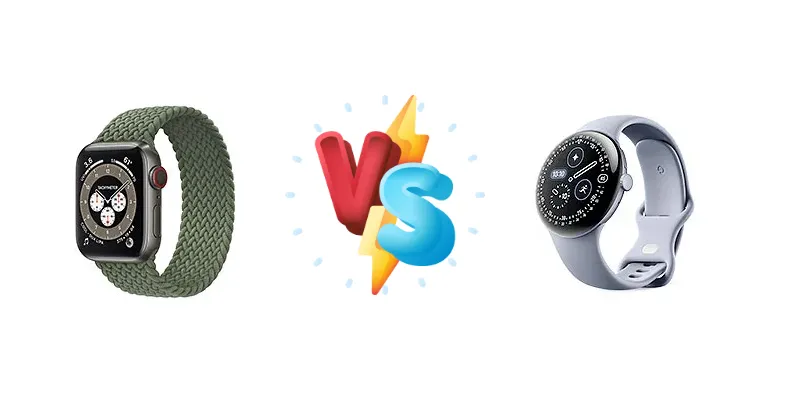
The smartwatch landscape has evolved significantly since the Apple Watch Series 6 launched. Now, Google’s fourth-generation Pixel Watch enters the fray, promising a modern Wear OS experience powered by Qualcomm’s latest silicon. This comparison dissects the core differences between the Apple Watch Series 6 and the Pixel Watch 4, focusing on performance, charging, and the overall user experience to determine which smartwatch reigns supreme.
🏆 Quick Verdict
For most users, the Google Pixel Watch 4 offers a compelling upgrade with its faster Snapdragon W5 Gen 2 chipset and significantly quicker charging speeds. While the Apple Watch Series 6 benefits from Apple’s mature ecosystem, the Pixel Watch 4’s performance and convenience make it the better choice for those prioritizing responsiveness and minimizing downtime.
| Network |
|---|
| 2G bands | GSM 850 / 900 / 1800 / 1900 | GSM 850 / 900 / 1800 / 1900 |
| 3G bands | HSDPA 850 / 1700(AWS) / 1900 / 2100 - USA, LATAM, Canada | HSDPA 850 / 900 / 1700(AWS) / 1900 / 2100 |
| 4G bands | 1, 2, 3, 4, 5, 7, 12, 13, 17, 18, 19, 25, 26, 39, 40, 41, 66 - USA, LATAM, Canada | LTE |
| Speed | HSPA, LTE | HSPA, LTE |
| Technology | GSM / HSPA / LTE | GSM / HSPA / LTE |
| | 1, 2, 3, 4, 5, 7, 8, 18, 19, 20, 25, 26, 28, 39, 40, 41, 66 - Global | - |
| Launch |
|---|
| Announced | 2020, September 15 | 2025, August 20 |
| Status | Available. Released 2020, September 18 | Available. Released 2025, October 09 |
| Body |
|---|
| Build | Glass front (Sapphire crystal), ceramic/sapphire crystal back, titanium frame | Glass front (Gorilla Glass 5), aluminum frame |
| Dimensions | 44 x 38 x 10.7 mm (1.73 x 1.50 x 0.42 in) | 45 x 45 x 12.3 mm (1.77 x 1.77 x 0.48 in) |
| SIM | eSIM | eSIM |
| Weight | 41.3 g (1.45 oz) | 31 g or 37 g (1.09 oz) |
| | 50m water resistant
ECG certified (region dependent SW application; HW available on all models) | - |
| Display |
|---|
| Protection | Sapphire crystal glass | Corning Gorilla Glass 5 |
| Resolution | 448 x 368 pixels (~326 ppi density) | 456 x 456 pixels (~320 ppi density) |
| Size | 1.78 inches | 1.4 inches |
| Type | Retina LTPO OLED, 1000 nits (peak) | LTPO AMOLED, 3000 nits (peak) |
| | Always-on display | - |
| Platform |
|---|
| CPU | Dual-core | Quad-core (4x1.7 GHz Cortex-A53) |
| Chipset | Apple S6 | Qualcomm Snapdragon W5 Gen 2 (4 nm) |
| GPU | PowerVR | Adreno A702 |
| OS | watchOS 7.0, upgradable to watchOS 26.1 | Android Wear OS 6 |
| Memory |
|---|
| Card slot | No | No |
| Internal | 32GB 1GB RAM | 32GB 2GB RAM |
| Sound |
|---|
| 3.5mm jack | No | - |
| 35mm jack | No | No |
| Loudspeaker | Yes | Yes |
| Comms |
|---|
| Bluetooth | 5.0, A2DP, LE | 6.0, A2DP |
| NFC | Yes | Yes |
| Positioning | GPS, GLONASS, GALILEO, QZSS | GPS (L1+L5), GLONASS, GALILEO (E1+E5a) |
| Radio | No | No |
| USB | No | No |
| WLAN | Wi-Fi 802.11 b/g/n, dual-band | Wi-Fi 802.11 a/b/g/n/ac/6, dual-band |
| Features |
|---|
| Sensors | Accelerometer, gyro, heart rate, barometer, always-on altimeter, compass, SpO2, VO2max | Accelerometer, gyro, heart rate, altimeter, compass, SpO2, thermometer (skin temperature), skin conductance |
| | Natural language commands and dictation (talking mode)
Ultra Wideband (UWB) support | - |
| Battery |
|---|
| Charging | Wireless | Wired, 50% in 15 min, 80% in 30 min, 100% in 60 min - 45mm model
Wired, 50% in 15 min, 80% in 25 min, 100% in 45 min - 41mm model |
| Type | Li-Ion 303.8 mAh | Li-Ion 455 mAh |
| Misc |
|---|
| Colors | Titanium, Space Black | Matte Black, Polished Silver, Champagne Gold, Satin Moonstone |
| Models | A2293, A2294, A2375, A2376 | - |
| Price | About 810 EUR | € 353.94 |
Apple Watch Edition Series 6
- Seamless integration with Apple ecosystem
- Mature app library and software support
- Established health and fitness tracking features
- Slower charging speeds
- Older processor architecture
- Limited customization options compared to Wear OS
Google Pixel Watch 4
- Faster Snapdragon W5 Gen 2 processor
- Significantly faster charging speeds
- Flexible Wear OS platform with Google Assistant
- Relatively new platform with potential software bugs
- Battery life may vary depending on usage
- Ecosystem integration not as refined as Apple's
Display Comparison
While display specifications aren't provided, the Apple Watch Series 6 is known for its bright and color-accurate OLED display. The Pixel Watch 4 likely utilizes an OLED panel as well, but the key differentiator will be refresh rate and outdoor visibility. The Snapdragon W5 Gen 2’s display driver could potentially enable features like LTPO for variable refresh rates, improving battery life. Bezels are a critical visual element; a smaller bezel on the Pixel Watch 4 would contribute to a more modern aesthetic.
Camera Comparison
Neither watch is primarily marketed for its camera capabilities, and detailed camera specs are unavailable. However, the Apple Watch Series 6 has a history of basic photo functionality. The Pixel Watch 4’s camera performance will depend heavily on Google’s image processing algorithms, which are typically strong in their smartphone offerings. Without specific sensor details, it’s difficult to assess a clear advantage.
Performance
The core performance difference lies in the chipsets. The Apple Watch Series 6’s dual-core Apple S6 is a capable processor, but the Google Pixel Watch 4’s quad-core 1.7 GHz Cortex-A53, built on the 4nm Snapdragon W5 Gen 2, represents a significant leap in processing power and efficiency. The 4nm process node is crucial; it allows for higher transistor density and reduced power consumption compared to the S6. This translates to snappier app launches, smoother animations, and potentially better multitasking on the Pixel Watch 4. The S6’s architecture is optimized for watchOS, while the W5 Gen 2 is designed for Wear OS, meaning software optimization plays a vital role in real-world performance.
Battery Life
Battery capacity isn’t specified for either device, but the Pixel Watch 4’s charging capabilities are a clear win. Offering 50% charge in 15 minutes, 80% in 30 (45mm) or 25 (41mm) minutes, and 100% in 60 (45mm) or 45 (41mm) minutes, the Pixel Watch 4 addresses a common smartwatch pain point. The Apple Watch Series 6 relies solely on wireless charging, which is generally slower. The Snapdragon W5 Gen 2’s improved power efficiency should also contribute to longer battery life on the Pixel Watch 4, even with its faster charging.
Buying Guide
Buy the Apple Watch Edition Series 6 if you are deeply entrenched in the Apple ecosystem, prioritizing seamless integration with iPhones and other Apple devices, and value the established app library. Buy the Google Pixel Watch 4 if you prefer the flexibility of Wear OS, prioritize faster performance thanks to the quad-core Snapdragon W5 Gen 2, and need a smartwatch that can rapidly recharge – crucial for overnight or on-the-go charging.
Frequently Asked Questions
❓ Does the Snapdragon W5 Gen 2 in the Pixel Watch 4 generate excessive heat during demanding tasks?
The Snapdragon W5 Gen 2 is built on a 4nm process, which is significantly more efficient than older chipsets. This improved efficiency minimizes heat generation, even during intensive tasks like GPS tracking or app usage. While some warmth is normal, the Pixel Watch 4 is unlikely to experience overheating issues.
❓ How does the Wear OS experience on the Pixel Watch 4 compare to watchOS on the Apple Watch Series 6 in terms of app availability?
watchOS has a more established app ecosystem, but Wear OS has made significant strides in recent years. The Pixel Watch 4 benefits from access to the Google Play Store, offering a growing selection of apps specifically designed for Wear OS. While some niche apps may be exclusive to watchOS, the core functionality and popular apps are readily available on both platforms.
❓ Is the faster charging speed of the Pixel Watch 4 detrimental to long-term battery health?
Modern lithium-ion batteries are designed to handle fast charging. Google has implemented safeguards to prevent overcharging and minimize any potential impact on long-term battery health. While all batteries degrade over time, the Pixel Watch 4’s fast charging shouldn’t significantly accelerate this process.